
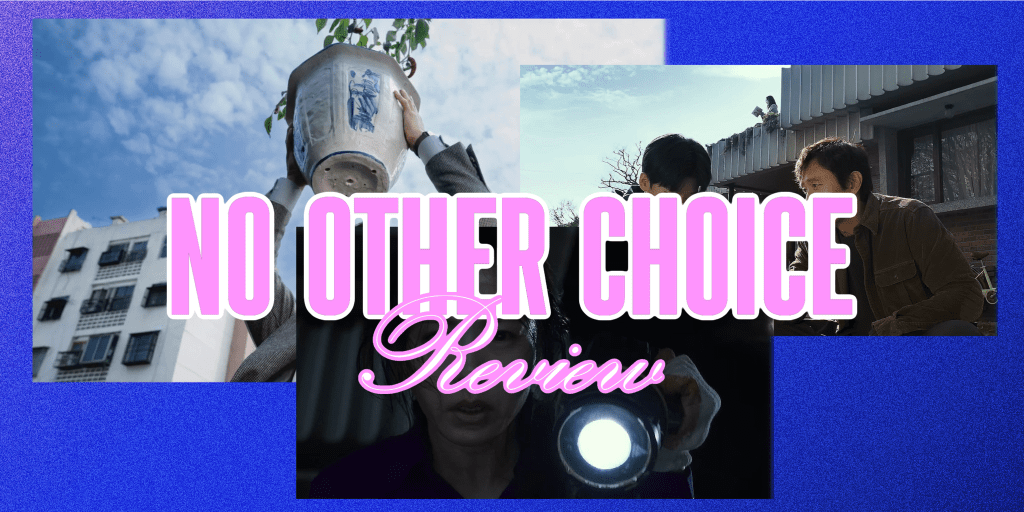
While No Other Choice is dementedly hilarious, it’s also deeply sad as it scrutinizes how our will to live is so tied to our employment and finances but the examination of the toll it takes on your relationships and how women handle pressure versus how some men will violently refuse to take action and adapt in the face of a crisis. Anchored by beautiful performances and kinetic editing, No Other Choice proves yet again no one does it like Park Chan-wook.
No Other Choice was adapted from a novel by Donald E. Westlake’s titled ‘The Ax,’ which served as a double entendre for both the firing of the man at the center and the violence he uses throughout the story. The title update signifies more so how our protagonist feels the violence was the only way, he had no other choice. Westlake’s novel perfectly sets up the timeliest symbol you could ask for in a story exploring the concept of man vs machine, a man who works for a paper company fired and replaced by machines. While No Other Choice presents the man other humans as his competition and the face value plot explores him taking out the competition, the situation only presents him and his fellow paper industry comrades due to technology replacing them and being embraced by the industry. The initial reaction of almost anyone is survival of the fittest when a crisis presents themselves. The desperation associated with financial safety, particularly those providing for a family, is unmatched. No Other Choice opens as we see a family not feeling the tightness of purse strings but the luxury of not just financial security but wealth, a true disposable income allowing for music lessons, gifts and a roof over their head. Yoo Man-su (Lee Byung Hun) seems stress free, the burden of financial restraint not clouding his thoughts as he looks at the family he loves and provides for, his wife Lee Miri (Son Ye-jin), their son Si-one (Kim Woo Seung), their music prodigy daughter Ri-one (Choi So Yul), and two labradors, Si-two and Ri-two. Quite quickly, Man-su is let go by his employer after American businessmen acquire the company and quickly begin replacing the workforce with technology. Park Chan-wook has become known as the master of utilizing modern technology in his films and with No Other Choice not only do we see the best use of iPhones and iPads but the thread of technology replacing us.
What makes the film feel fresh and invigorating is not that Man-su reinvents himself after a brutal, embarrassing job market but he quite literally does the opposite. Instead of forming a way to become the best inspired by his competition or discovering a way to embody a talent or skillset that would make him impossible to replace with technology, he takes a violent way out, he begins to kill his competition. This twist is not just played for laughs, despite being one of the funniest films of the year. What challenged my expectations and view of the themes of the story were the relationship imbalance between Man-su and Miri. Throughout all of the Looney Tunes-esque slapstick comedy on Man-su’s journey, his motivations are full of a refusal to just do better. The script is smart in you know it’s all stacked against the worker; you know the system is not allowing them to succeed but the difference is you see how Miri chooses to navigate in a way that is best for her family. The way a woman, a wife, a mother looks at the situation is entirely different. Where Man-su is slightly consumed with his manhood and the way society conditions men to take a different route versus just simply doing the work plays out so incredibly sharply. Park had mentioned before filming that the script writing took longer with this adaptation of the novel as he wanted to extend the character of the wife, and you can feel that every step of the film. For a film titled No Other Choice, she is the only one who accepts to make a choice regardless of the personal repercussions she’ll face.
Park is such a master as he moves the camera but in No Other Choice for me is when he lets it linger and us stew in the overwhelming emotions each character is feeling. The entire film builds upon the idea of how our will to live is so entangled with what we do, conflating our identity with what we do. As someone with a full-time job and a child to provide for, quite often do I forget my own place and identity outside of these things as my job is what keeps our roof over our head, our kitchen stocked with food and my daughter safe, it’s easy to let what I do be all I think about outside of her. What’s masterful about No Other Choice is while I never feel I’m rooting for Man-su, I do feel sympathy for him and his situation. I never truly agree with him and quite often want to scream at him how easier it would be to make a different choice, but the film allows there to be sympathy for how the system was stacked against him. It’s part of what makes Park such an incredible storyteller as he quite often balances this character drive of them becoming easier to like despite their stories becoming wilder as they go, sometimes even insane. However. No Other Choice feels a bit more realistic for the path the characters choose. It always feels an extension of circumstance caused by capitalism versus Man-su going insane. While I would never resort to murdering my competition, it feels like a natural result of his situation, no matter how crazy the antics are. It’s an interesting exploration between ego versus solution. It weighs into the stress and burden of how hard it is to interview after weeks of searching. These people are judging you and, in this case, he was just fired. It’s a vulnerable situation as you put yourself out there, but in No Other Choice, Man-su cannot escape his ego. He cares more to protect the image he projects, being upper middle-class, versus switching jobs or working for someone who was previously below him. His ego is to tied into what he does and who he projects himself as, he doesn’t want to be judged or perceived in a certain way. This is where the complexity of his wife is so fascinating. Miri is so clearly his foil every step of the way. So much of her character is based exactly on this same issue of how you’re perceived, what you assume she is like, what you assume her motivations are. By the final act, you clearly realize she was the glue of the family and you never knew her true motivations.
You cannot talk about this film without talking about the brilliant performances. The entire film operates a hot wire and Lee is absolutely electric, dominates the film while still being entirely grounded in reality with palpable emotions. The physicality of his performance balances so much without ever being too big and he is absolutely masterful, a lead performance for the ages. Yeom Hye-ran, while a brief appearance, is absolutely hilarious yet again balances the depth of how demented the story is; a true highlight in such a perfectly acted film. The highlight of the film for me is Son, a screen legend already, but delivering a show-stopping performance here. She’s able to balance so much complexity without ever dominating the screen or overpowering the narrative, exactly how her character is meant to be perceived. Son and Lee have an undeniable chemistry that burns through the screen. They both bring new meaning to parental unit and what parents will do to survive and provide and protect their children. All of this only shines through such a crazy set up with performances grounded in reality but self-aware of the material.
While No Other Choice is dementedly hilarious, it’s also deeply sad as it scrutinizes how our will to live is so tied to our employment and finances but the examination of the toll it takes on your relationships and how women handle pressure versus how some men will violently refuse to take action and adapt in the face of a crisis. Anchored by beautiful performances and kinetic editing, No Other Choice proves yet again no one does it like Park.
Grade: A-
Oscar Prospects:
Likely: Best International Feature
Should be Considered: Best Picture, Best Director, Best Lead Actor (Lee Byung-hun), Best Supporting Actress (Son Ye-jin), Best Film Editing, Best Sound
Release Date: December 25, 2025
Where to Watch: In Select Theaters

Kenzie Vanunu
she/her @kenzvanunu
Lives in LA. Misses Arclight, loves iced vanilla coffees.
Favorite Director: David Cronenberg
Sign: Capricorn






Leave a Reply