
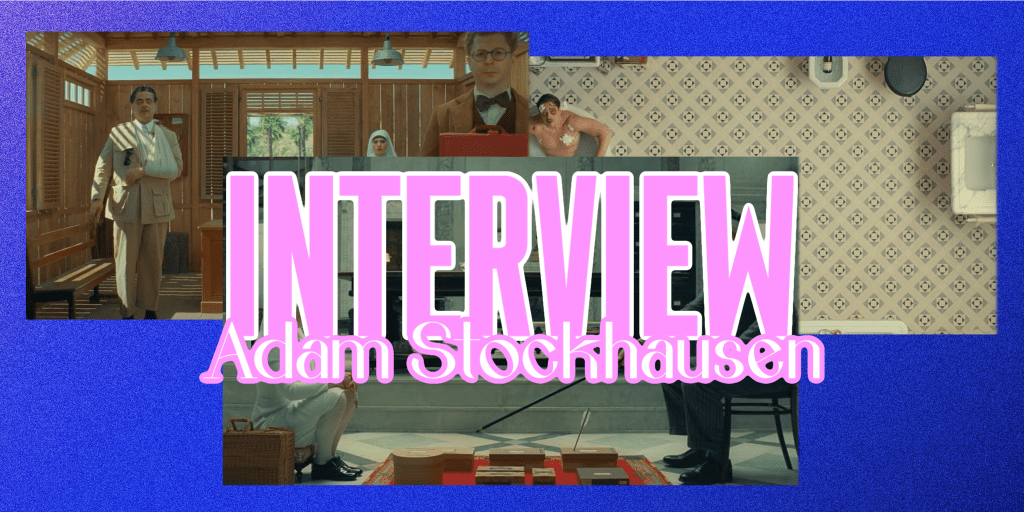
Wes Anderson and his frequent collaborators are known for bringing whimsy and beautiful attention to detail to the screen. The Phoenician Scheme is no exception as Anderson and his amazing team bring his legendary visual style and art direction back to the screen. Offscreen Central had the amazing chance to speak with Production Designer Adam Stockhausen about bringing this new Anderson story to the screen and the world building experience through his longtime collaboration with the writer/director.
Meredith Loftus: Well, first I want to start off with the fact that I believe this is your seventh collaboration with Wes Anderson hopping in around Moonrise Kingdom. I’d love to know what your first impression was of him [Anderson] when you were brought on for that.
Adam Stockhausen: Well, I knew him pretty well at that point. My first, before I started designing for Wes, I was the art director on Darjeeling Limited. So I met him in 2006 on Darjeeling, and I was working for a designer named Mark Friedberg. My responsibility was getting that train ready. So it was, and it was pretty intense because I just, you know, it was my first time art directing for Mark [Friedberg]. It was my first time meeting Wes. It was my first time in India. It was a lot of firsts. And India is an incredibly intense experience anyway. So it was, so it was wild. I mean, it was unforgettable. It was a wonderful experience. And I’m so glad that it’s led to this this long-standing relationship with Wes.
Starting Moonrise was incredibly fun. I mean, that one was kind of the first one where we’re (what we call Google scouting) where we weren’t even sure where the film was going to be made. There were a key couple of us. There was Jeremy Dawson, myself, and Molly Cooper was doing this, too. There were a bunch of people, and we were dividing up areas. Molly was taking the UK and Ireland; and I was taking the Northeast; and Jeremy was taking the Southeast. We were scrambling around trying to find the key components, the key ingredients to the film, in just the quickest search on Google. That was a really amazing process to do live and to do for the first time with him [Anderson]. And then we started scouting. We took the first scout up to Rhode Island and we were off and running.
Meredith Loftus: I can’t believe how you divided it and conquered in order to find the perfect location for Moonrise Kingdom! What have you enjoyed the most about working with Wes Anderson and what have been some of the challenges that you have faced with each new film that you have worked on with him?
Adam Stockhausen: Well what’s wonderful is a couple of things. I mean, I love the stories he tells, and I love the way he tells them. To be able to be a part of that, to be able to help out with that, is really special. It has been since the day I met him, and it still is the same. The biggest challenge is that, you know, these movies are so completely different from each other, really. There are these puzzles that need to be solved each time; and sometimes the puzzles are really hard. Like on The French Dispatch, for instance, you know, it was just all of these stories crammed into the space of this film. So there was just hundreds of sets. We were going through multiple sets every single day. And so, just the speed of it was an incredible challenge. But of course, the complexity of the shot-making that he does is always a challenge. We’re always doing this kind of forensic process in a way on his storyboards to try to figure out how to translate them into three-dimensional reality, if that makes sense.
Meredith Loftus: The sets are always so impressive, and I think it speaks to Wes’s particular eye of symmetry that you’re able to match that within the intricate stories that he is telling. Talk to me about what was pre-production like on The Phoenician Scheme. What puzzles were challenging for you to piece together in order to bring 1950s Europe alive through his lens?
Adam Stockhausen: Well, the main one on this one, I would say, is that is that there’s a grand scope and scale to this story. It’s this adventure story across his invented Phoenicia. And of course, we weren’t in the 1950s, and we weren’t anywhere near this made-up place, you know? We were in Potsdam, in Germany. This took place largely on stage sets. The trick was how to give it that scale and that scope without building. We built very big sets, but without going full DeMille on the whole thing. It wasn’t Spartacus. We weren’t building entire gigantic worlds. There’s a theatricality to it. Each one of the pieces was sort of intricately figured out that way. Like, for instance, this massive tunnel construction. How to build a tunnel through a mountain without showing any rock whatsoever was a really unique challenge for this one. It was a really fun thing to try to figure out. It’s this kind of theatrical way of problem solving that Wes really likes to do, and it is really fun to do with him.
Meredith Loftus: Well, I feel like it kind of brought a little bit of some train tracks, some Darjeeling Limited essence there.
Adam Stockhausen: We’ve done some trains.
Meredith Loftus: I was most impressed by two sets in particular. One being as Zsa-Zsa Korda’s (Benicio del Toro) house, the Italian Palazzo, especially all of the tile and just the grand scope of it, yet the dilapidated state that we see it in. Can you talk to me about the inspiration behind the house in particular for you?
Adam Stockhausen: There were a bunch of inspirations, and it was a long conversation with Wes. Part of it had to do with the nature of our prep. We geared up to make the movie and then the SAG strike happened, and we shut down. We worked on a commercial for Montblanc. We were doing that in Germany as well, and we were looking at the sets and stuff; and then we came back to it and did it a second time. The design of that house bridged over that sort of interrupted process, and it gave it time to really develop. We started off with the kind of grand space. We knew the basic shape of the space. But then Wes had this thought in the second half of that process that maybe it’s a palazzo. Maybe it’s Italian, even if we’re not in Italy, it’s heavily influenced by these palazzos. In particular, the painted nature of them. We were looking at Villa Farnesina in Rome. It has these rooms with perspective painted into the walls. It’s a grand room already; but then it’s painted with a massive vista going off into perspective, continuing the real architectural elements of the room, which are physically there, but then they carry on into the painting as it goes into the wall. He [Anderson] really liked that, and so then we started to retool Zsa-Zsa’s entire house with that in mind. It took on this incredible quality where the whole thing is stone, but there isn’t a single piece of real stone in the thing. It’s all faux painting, and a lot of it with this kind of perspective tricks.
I like the idea that, and I think Wes liked the idea, that Zsa-Zsa’s a collector, it’s what he does, but the house is also sort of an object of this constant development. His collection isn’t a perfect thing that is complete and then it’s on display. It’s very much a collection in process of being acquired– transferring some parts of it over here, and then this one comes in for a while, and then it gets shoved over there. The house had that feeling too, where it was by no means run down, but it was very much in process of coming and going from where it had been to where it’s gonna ultimately end up. I think that really made it alive and exciting. You could feel it physically in the space.
Meredith Loftus: I completely agree. Of course, I have to ask you about Wes’s version of heaven and the afterlife. Talk to me about constructing his view of heaven, and what were you inspired by in creating the set for that?
Adam Stockhausen: That one took a long time to develop because we tried it so many different ways. We’re like, well, maybe it should be in Zsa-Zsa’s house. We’ll take it, whitewash it, and paint the entire thing white and put clouds inside of it. We thought about that carefully for a while and then we were like, “No, it’s not inside Zsa-Zsa’s house.” Maybe it should be in a location. We looked at a bunch of locations, and we considered them and tried to plot the scenes out in them. Ultimately, he [Anderson] said no. The one thing he kept coming back to was this theatrical idea, like the train tunnel. I would say also like the prison in The French Dispatch. There’s an element where the thing is simultaneously working as what it is supposed to be. It’s presenting you as a set for heaven. But it’s also… it’s not denying. It’s embracing and celebrating the fact that it’s within a train station or it’s this prison is within an old factory. You can see off the edges, and there’s a real joy to that. That’s something that he [Anderson] wanted to find. We were looking to see if the puzzle piece fit in Zsa-Zsa’s house. We were looking to see if that puzzle piece fit in these different locations, in this old church or this old train station. It never quite did, but he [Anderson] wanted that feeling of a found space and he wanted this light. So there was this one spot, which was nothing, it was a loading dock really; but it’s where we shot the greenhouse set for Zsa-Zsa, where his plants were. They have these beautiful windows overhead. So finally, at the eleventh hour, he [Anderson] said, “Why don’t you try it here? Let’s sketch it here.” By that point we’d kind of figured out all the little scenery pieces that were required to make the shots. We plugged them into the space, and it all kind of worked. We slammed it together in three or four days or something like that.
Meredith Loftus: Well I think it came together very nicely. We’re wrapped for time, but I did want to quickly ask you if there were any Easter eggs from previous Wes Anderson films that had snuck into the production design at all.
Adam Stockhausen: Yes, and I can’t take credit for this. Wes put this one in himself. The paintings that the arsonists are carrying in the hallway are paintings that we made for The Wonderful Story of Henry Sugar.
Meredith Loftus: Oh my goodness!
Adam Stockhausen: Yeah.
Meredith Loftus: Adam, I could sit and talk with you about The Phoenician Scheme and Wes Anderson for hours, so thank you so much for chatting with me.
Adam Stockhausen: Thank you!
The Phoenician Scheme is currently in theaters.
You can find our review here.


Leave a Reply