
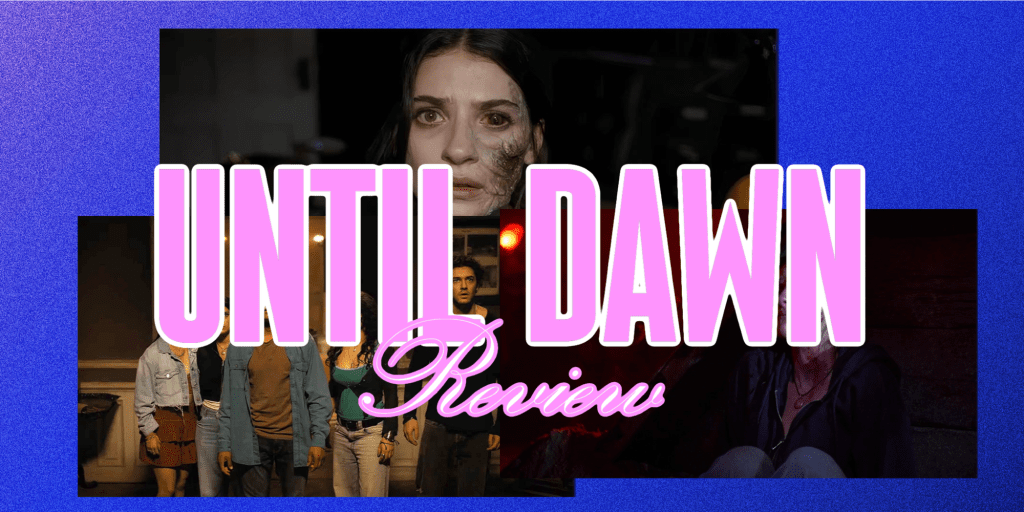
Fans of the 2015 video game Until Dawn will find little to connect with in this film adaptation. A time-loop becomes the main plot device, with mixed results. For fans of slashers, some of the gore may be enticing, but ultimately the film has little personality.
The 2015 video game Until Dawn was always bound to have a film adaptation. It has sold millions of copies and its playthroughs on Youtube have amassed millions of views. It follows in the footsteps of several horror video game adaptations that have struggled critically, including the Silent Hill franchise, the Resident Evil franchise, and Five Nights at Freddy’s (with a sequel building it into a franchise coming soon!). The film adaptation of the 2015 video game Until Dawn has little in common with the massively successful game. The filmmakers changed the setting and characters, with a time-loop becoming the main plot device.
The time-loop is a tried and true plot device, with great results in films like Edge of Tomorrow (2014) and Palm Springs (2020). Particularly with Palm Springs, there’s a contemporary feeling to the plot device, as we all recently experienced a sort of time-loop during the COVID-19 pandemic, stuck in our homes. Horror has taken on the time-loop as well, with Happy Death Day (2017) combining this with black comedy and the slasher. The most effective aspect of this plot device is the repetition, allowing both our protagonists and audience to pick up on patterns. As a viewer, it’s satisfying to watch the protagonist figure out the mechanics of the time-loop, using the repeating day to their advantage, or even against the opposing force.
Until Dawn doesn’t do the time-loop in a typical way. These young adults are trapped in a nightmarish time-loop, reliving the same night again and again. The only way to make it to morning is to survive the night. The film switches things up by throwing new monsters at the protagonists every new cycle. So, the film is less repetitive than a typical time-loop movie. Ultimately, little about the mechanics of the time-loop are explored. Instead, for most of the run-time we watch these characters get slaughtered in new gory ways. To be fair, there is a fun feature of the time-loop in the guest sign-in book. The “base” of the time-loop is a museum visitor’s center, and the characters watch as their sign-in signatures build up and become increasingly loopier as the nights pile up. There is another feature of the time-loop that’s fun (if not a little out-of-place) involving the water that will satisfy fans of gore. You can also see the effects of the kills on the characters’ faces even when the night re-sets, a reminder of a stab to the face with a faded black bruise.
The film at its core is a slasher, but ultimately has little personality. For example, the film’s opening follows from a bird’s eye view the stale image of a car driving down a long empty road. There’s a possession randomly in the film, relying on all the film cliches of demonic possessions. The film builds it’s emotional core around Clover (Ella Rubin) retracing the final days of her sister before her disappearance. Much of the emotional crutch of the film tries to emulate the emotional underpinnings of It (2017) and It Chapter 2 (2019), emphasizing grief and the group’s friendship as essential. Until Dawn doesn’t have much success in these emotional themes, as these characters are given few details. The film relies on broad pieces of backstory to do the heavy lifting. Clover (Ella Rubin) is a bit wooden at times, but the rest of our young actors do fine with the material.
Until Dawn feels like a sped-up slasher set in an escape room. There is a fun montage of the crew’s attempts to survive the nights that makes good use of the time-loop. Most of the film’s effects appear to be practical, which does make the danger appear more immediate and physical. It also makes for better gore. But, the creature design of the main monsters – the wendigo– feel like those life-like animatronics that Spirit Halloween sells every year. In comparison to the original video game’s creature design, these pale in comparison. But, it may be a constraint from the budget and practical effects.
I found myself wondering during the screening how this film got a release date in April of all months, rather than January when horror films are often “dumped.” While Until Dawn is nothing to write home about, I am happy Sony gave this film a chance in theaters. With its limited budget and the– broadly speaking– success of horror in theaters, I would not be surprised if the film made a profit. As of writing, the film has reportedly made $18 million opening weekend. As outlined above, I also admire the film’s commitment to using primarily practical effects. But ultimately, Until Dawn uses broad horror cliches to craft this slasher, losing any personality that makes these films so fun. Unfortunately for fans of the original game, the 2015 video game is significantly more creative than this adaptation.
Grade: D
Oscars Prospects:
Likely: None
Should be Considered: None
Where to Watch: In Theaters

Madelyn Land
she/her @maddiexdrew
Lives in Seattle with her large earring collection.
Favorite Director: Sofia Coppola
Sign: Aries


Leave a Reply