
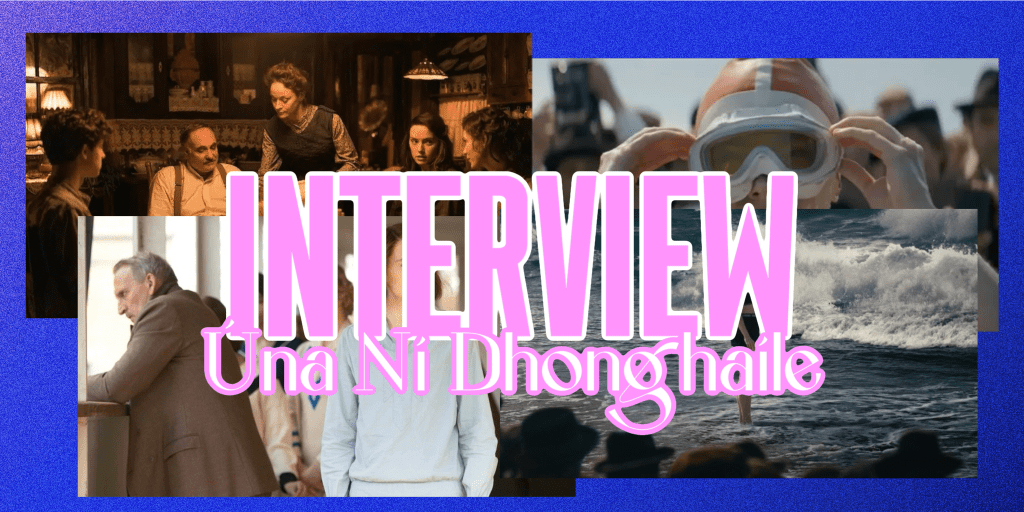
Trudy Ederle made history as the first woman to swim across the English Channel and finally, her story has received cinematic treatment from the iconic producer Jerry Bruckheimer. Swimming against all the odds and Jellyfish stings Trudy made a major achievement for women’s sports during the 1920’s and her legacy will forever be cemented.
Offscreen Central had the honor to talk to editor Úna Ní Dhonghaíle about the significant responsibility to portray Trudy’s journey authentically, how the film’s editing aimed to capture the subjective experience of swimming and using sound design and careful montages to convey Trudy’s challenges and achievements.
Jillian Chilingerian: I’ve never heard about the story, and so I love that film to me, it has given us this new leeway of female stories that have been forgotten in history. The perspective of history passed down is all through the male gaze. For this to be such an impactful story with women’s sports is so astonishing that we haven’t heard about it much until now. I want to start there, by just coming onto this project to tell the story of Trudy.
Úna Ní Dhonghaíle: Well, I’m really like you. I love telling stories. As a filmmaker, I gravitate towards stories or films of the people whose voices have been removed from history. When I got the offer and read the script, it was so beautiful, and I couldn’t believe it was a story I had never heard because I thought I was quite good at finding brilliant women in our history. I wanted to do it, and I felt that out of respect for Trudy. As an editor, I made sure that I got under the skin of Trudy and gave her the subjective point of view so any scene that we had Daisy Ridley was magnificent. Her performance felt authentic, Joachim Ronning, the director, wanted to shoot in open water and our actor embraced that even though she had a bit of a fear, and she did it. She trained for three months before even principal photography. I felt a huge obligation of responsibility to the real woman, and I felt a huge application of responsibility to Daisy Ridley because her performance was so beautiful and so nuanced, as it was with her family in the film. It was a total honor for me and I think I wanted to find the musicality as well in the rhythm of the swim so that as an audience, you wouldn’t get swimming fatigue, you feel for her and want her to get through all those challenges.
Jillian Chilingerian: I mean, I have a fear of open water, so every time she’s in the water and watching her, I just don’t know how she did that.
Úna Ní Dhonghaíle: She did it. She was magnificent. I can tell you there was a body double, but I think it’s only one or two shots maximum. It’s all Daisy. So she kept going back in and even when Meg comes out of the water and she’s freezing, the actors were above par, all of them. They just gave everything, which makes my life easier, because of the truthfulness to it, and then we’re starting on a higher playerfield. It’s really about the storytelling and how to collapse the film.
Jillian Chilingerian: A lot of this is swimming sequences that we see mixed with so many different perspectives, from her and everyone around her feeling like, whether they’re hearing it on the radio or they’re in the boat right next to her there is a connection to Trudy. It speaks a lot to the audience as to how we’re feeling. When we’ve seen swimming, it’s so fast with the pace, and here it isn’t as fast, but you can feel the hardship of her making it through those waves. When you’re tasked with these swimming sequences that might not be the most exciting, but you just feel that hardship and how you help tell the story through all those perspectives.
Úna Ní Dhonghaíle: Well, that’s where I think, for me, I’m very interested in that sort of subjective point of view. So say, in the swim, there were scenes that we could have these beautiful, big wide shots, so you could have that objective point of view, but once I cut down to the water, or we had a tank shoot, hearing the breath, so sound design, physical element a character in its own right in the film, as was the water. Once I was cutting, I tried to be organic and very intuitive, but every time I went down, even from the first day of principal photography, I was asking my second and first assistant to begin to build the sound, and they were even doing their breaths. I’ve said this in another interview with my poor second assistant had her head in a bucket, and she was doing the breaths during the shoot until Daisy came in to do it again in the ADR. Even at that early stage, when I was sending the film back to Jerry Bruckheimer and Joachim, I needed it to feel real, and being with her, helped the audience engage. Even in the Australian swim, there were such nice elements of the audience scattered. There weren’t many people there. The men were bored, and one man was asleep, and then being able to keep going back to them to show as she began to improve, they began to wake up and take notice. So all those elements, and in the long swim that you picked up on the radio was a huge device for us because it allowed us to circumvent the length of the swim. It’s 21 miles, and she did it actually in 42 miles so by going there, we could use the voice and create this poetic realism, where the voice of the radio announcer could be the soft thing telling you how many miles she’s done. Once we went back to the water, the abrasion of the sound of the water could be quite shocking, and that was a really important element to help make the film feel visceral and not fatigued by a front crawl and always just in the top of her head. I think all of those elements worked and then there is the emotional core, because I always try and find the subtext, and sometimes the subtext is in the onset and not on people’s faces. The mother with her locket and the story of the twin, that was essential, but in the screen time of the film it’s very small, but the audience has a memory, and that memory comes to fruition when they say she’s lost in the shallows of the mother holds the thing, hopefully, the hairs go out the back of your neck and you begin to believe she might die, even though you might know she already broke the record.
Jillian Chilingerian: With films that are based on true stories, whether someone knows it or not, the stakes get raised. How does that also factor into what you’re saying about you got to keep these different moments? I love that we see so much of her family and her impact of swimming on them. They love her and they want her to do well, but they also are protective of her safety and her livelihood.
Úna Ní Dhonghaíle: Yes, exactly. Something I was buried in my mind was how to allow the audience to forget that they knew and the process of what she had to go through is almost as important as the fact that she achieved it and did the record. That was very clear at the beginning, that she would be drugged, that you would see everything that she went through, and then for the family and some of the scenes, as we were collapsing them, Joachim and I did discuss there were some things we didn’t want to shorten too much, you need to keep the family element strong so when she has been drugged and Stephen Graham’s brilliant character comes in trying to encourage her to swim again, we didn’t want the father to say yes too quickly. We needed someone in the room to say no, this is not happening she’s not going to swim, because that’s what the audience should be feeling. You need some character to reflect the audience’s point of view and then using those reverse shots and the reaction shots of people, allows the audience to also come to the same conclusion as the father of well, maybe she does have to do this, because this is her dream, and it’s her vocation. It’s in her bones, and we have to support her. Then that brilliant line where her father says, your mother would kill me and that was sort of fun as well, to play with those social stereotypes of he was the patriarch, but Trudy’s mother ruled him. That was also a lovely element, I think, of the humor of the film to show that even in that time, there were decent marriages where the father may have been perceived to be the patriarch, but actually, the mother was ruling the roost behind the scenes. Yeah, I love that. Just
Jillian Chilingerian: The women of the film are driving forces, whether it’s her sister who gets in the water with her and is swimming, and they all start to realize, like, how much this means to her, and what she’s putting herself in through, like with the jellyfish and like that last moment in the shallows, and then everyone rallies around with the fires. It’s beautiful to see an entire community come out for one person.
Úna Ní Dhonghaíle: That’s all true, by the way, for anyone who doesn’t know that is true, that is what happened. They lit those fires, which is extraordinary.
Jillian Chilingerian: I think it speaks to a lot of what we’ve been talking about, even little moments, like no woman will ever swim the English Channel. It makes you so infuriated, because as the audience, you’re like, I think she can do this, whether you know or not, and laying out how men felt about women in sports at the time, or women in society, and peek into what that looked like for Trudy.
Úna Ní Dhonghaíle: Even to this day, people of all, races, gender, religion, whatever, we’re still striving to just be seen. Visibility is to be seen, be accepted, be championed. There’s still so much more to do, even in our own lives. I’m sure you and I both know, that there are so many of us globally who need to continue to push and push and follow your dreams, and don’t allow anyone to tell you you can’t do it, because life is very short. I’m a mother and for my kids, they’re proud of me making this film. We just have to continue to make a better life for all of us and champion the underdog. That’s what Trudy is, the odds were stacked against her with her hearing, and that was a really important element, again, from the sound design perspective, which I was very conscious of, even in the early time of editorial, making sure that we referred to it, but didn’t overstate it, because she went profoundly deaf later in the 40s, outside of the domain of this movie. It was very important as a little girl that she was told the risks, but she wanted to swim and then her dad did teach her like that. He tied a robe around her and she dived it into the water. I mean, these were images to celebrate, and I think Jeff Nathanson’s beautiful script and Joachim, we all came together as a family to tell the story. I hope it does inspire anyone who does want to do something that maybe isn’t easy to do because people aren’t ready for it yet.
Jillian Chilingerian: That is so poetic and it’s so important to have these types of conversations. Sometimes people get down on themselves, and it’s hard but when you have the inspiration to keep going, and with the story, it’s so relatable, so many things, even like watching with like myself, and just like thinking about like me in this world and like what I do, and it’s just like, you know, yeah, you just want to push.
Úna Ní Dhonghaíle: We have to do something hopefully really valuable to us, even if it’s simple and it’s giving love to our friends and family, or if it’s something more than that, but it’s just live it the best you can and follow your dream and don’t allow yourself to be beaten down by anything.
Jillian Chilingerian: I also wanted to kind of talk about her childhood as well, like those moments, where it is the transition between her as a child and then her as a teenager. This is based on a book with the scripting, what were the conversations to make sure that you give audiences the right exposition on her before you go into the journey?
Úna Ní Dhonghaíle: In the first cut, what it was, say, two hours, 35 minutes, it took longer to get to the Australian race. It did mean that some of the initial places where we had to collapse were in that early section, and that was our conversation. How could we condense the story and keep the truthfulness of what happened to this child so that the audience would care? If your audience cares better, then you’re halfway there. If you watch the film again, you will notice a lot of montage, these vignettes of storytelling of the rise of Trudy and the fall of Meg. Meg had been a better swimmer, but in three little shots of her becoming second and third, then not even on the podium, and the way she sort of looks away as Trudy gets another. We did know the importance of setting up the family. The Slocum ferry tragedy was an essential one in the book. Jeff had that early day in the beginning to set the tone of so many of those women and children who died because they couldn’t swim and they could have walked to shore, as her mother said, I think they’re only 20 yards something from shore, so we knew we couldn’t lose that. The things that we ended up collapsing or losing were a little bit more of Meg’s story with Chip Anderson and the fact that Chip Anderson’s family wouldn’t allow her to marry him. We just began to do a Trudy pass and follow the thread of the narrative through the eyes of Trudy. I do that sometimes in any film I do, I just do a pass to make sure that you have the best of those character stories so that the audience is engaged and leaning in and wanting to know what happens next. We did find that doing these little montages was a simple way to show her finally getting to swim or beginning to practice and winning and becoming a world champ. We moved that scene down so we did a little bit of restructuring there to just keep the flow of the film going, so we could keep this visceral pattern until eventually she becomes a world leader. We moved the Bill Burgess scene down, and we cut to her coming home, and the father saying, I have this nut peddler for you to marry, because I felt very strongly, that world leader, and here’s the man you’re going to marry so that that felt like a good and I think then, once we, once we did, a few of those changes, the energy, the story reveals itself. Jeff was brilliant, because as the writer, he was fearless with us, saying, Okay, let’s interrogate this, and how can we collapse it, and what happens if we move it? Burgess became great, because when we moved him later, we moved him out to the Olympics, and he became the tool for why she was going to swim, because we used the cinema for Meg, to give Meg the power of the gaze, and she saw it, and the audience see Meg realizing it, and then that all just came together.
Jillian Chilingerian: It is this effect on everyone we’ve been with her sister when Meg realizes it, and it’s also genuine. All the things that you set up with Trudy and all the things working against her, then when it finally clicks. I feel like the film works so harmoniously in those moments with the editing and the sound to pull you into all of their perspectives. Women are complicated like women are complex, and so I feel like it really does bring in all those aspects, and specifically with the period as well.
Úna Ní Dhonghaíle: Also when she comes so when she finally says to Burgess, you do not take me out of the water and as she swims off, we wanted to create this visual poem, a love letter, because her father thinks she’s going to die. He doesn’t believe she’s going to survive it and that’s why we use the very simple sort of high note and then crash to just full sound, no music, which is lost in all that elliptical style of editing which allows you, I think, a psychology for the audience. They’re as disorientated as Trudy. I feel the gift of filmmaking is to have that private self and public Self and allow the audience to be intimate with somebody who you could never know what they feel, except we show a little glimpse. When Trudy comes to shore and then her feet touch the sand, we stop the music and we always wanted to do that because we wanted just her breath and her muffled ears. As she stands Joachim calls this the moment walking on the moon. We kept the rear view shot of her standing again, denying the audience her face, and then the audience started applauding, and the music soared back in beautifully. It just felt like a great collaboration with all of us, wanting to be in her shoes and allowing the audience the privilege of feeling how she must have felt in that moment.
Jillian Chilingerian: I love it when everyone just gets the vision. Well, thank you so much for this time to dive into your work, because it’s so beautiful and an inspiring story.
Úna Ní Dhonghaíle: Thank you so much, Jillian, and thank you for all your brilliant work as well, as all your reviews bring insight into the film and cinema.
Jillian Chilingerian: : Oh, thanks so much!
Young Woman and the Sea is available to watch on Disney+.


Leave a Reply