
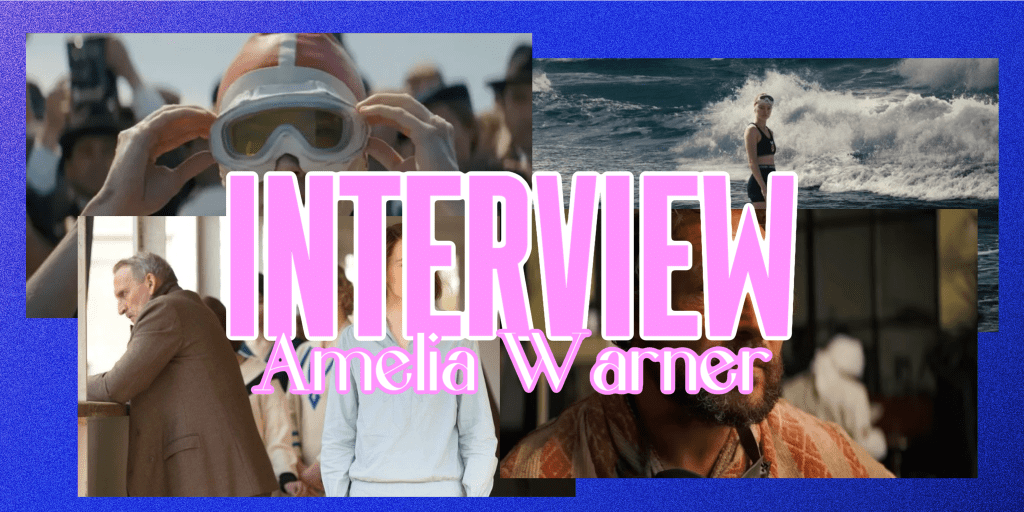
Trudy Ederle made history as the first woman to swim across the English Channel and finally, her story has received cinematic treatment from the iconic producer Jerry Bruckheimer. Swimming against all the odds and Jellyfish stings Trudy made a major achievement for women’s sports during the 1920’s and her legacy will forever be cemented. Offscreen Central had the honor to talk to composer Amelia Warner about the importance of sharing this film with audiences, specifically women, Trudy’s complexities captured in the score, and balancing the sound with her beautiful score.
Jillian Chilingerian: Hi Amelia, very nice to meet you.
Amelia Warner: It’s so nice to meet you as well. How are you?
Jillian Chilingerian: I’m doing good. Thanks.
Jillian Chilingerian: Most of history, we get through, the male gaze, the male perspective, there’s so many forgotten women who did such amazing things that we don’t get to hear about. Film has been such a perfect medium for being able to listen to these stories like Trudy’s. So I first want to start there with, what it means to you to be a part of telling her story and bringing it to large audiences of people who never heard the story, like myself included, I had no idea, and I’m still amazed by everything that we saw in the movie.
Amelia Warner: Yeah, I mean, it’s just incredible. I hadn’t heard of Trudy, and when I met all the filmmakers, we all had the same response, which was, how have we not heard about this incredible woman and how is this story not more known in our consciousness, you know? I just presumed that parts of it were made up, but it’s all true, and it’s the most incredible story. I have three daughters, and so these are the films that you want in the world to be able to sit down and watch with them. It was really important and really meaningful to be part of it. I think we all felt this real shared responsibility of getting it right, telling her story, doing her justice, and getting the story out there because, you know, it’s not that long ago that this happened, and what she did was it changed everything for women. Everyone needs to be made aware of her incredible spirit and her incredible story.
Jillian Chilingerian: I love that you can share this with your daughters, and this can be a part of their history of learning about women throughout time because 100 years is not that long ago.
Amelia Warner: It’s not long at all, and she lived until not very long ago as well. It does feel really meaningful. I was so grateful to be working on it and to be able to have that experience of showing it to my daughters and them being like, wow, this is incredible.
Jillian Chilingerian: When you come on to this project, and this woman is so extraordinary, words can’t even describe it, are you thinking of the different themes that could come up of what you want to tackle from a musical perspective? I love scores, and it blows my mind when you see the final product and I’m just like, what are their brains like, where they’re like, Yes, this is how this should sound for these moments. I love the complexity that we get of, she’s an athlete, she’s a sister, she’s a daughter. We get to see her family. We get to see her in these conditions of how people thought about women at the time and in sports. So knowing all of this and her story, where do you start to figure out what is the musical journey of Trudy?
Amelia Warner: I mean, what you said is astute to notice the complexities of her character. It wasn’t just one thing, I think that it was trying to illustrate all the different parts of her. I was really happy to write thematically and to be allowed to write a melodic score, and I think we all knew that we needed a great theme for Trudy and, once we had that theme, I kind of thought that was going to be it, to be honest. As we went through the film, it just became clear that, actually, yeah, we had the emotional theme and the, I suppose her family and her sister in that relationship, and the close-knit, supportive family that she came from, but there was also this other side to her that was just like a really powerful athlete. I remember in one of those kind of early meetings, Jerry Bruckheimer saying, this is a sports movie, and she needs a sports theme. It was like, Yeah, of course, that’s exactly what we need so trying to find that sound and find that theme that could be that side of the film. I wanted something that felt classic but also felt contemporary, it had to feel current. I didn’t want her to be restricted by the period, I wanted it to be big bombastic, and bold. There was the last theme for Trudy, we ended up calling it the Free Spirit theme, because, again, there was just like this gap in the score where we were like, she’s kind of fun and she’s playful and she’s a rebel, and we need something that’s just a bit lighter and a bit more mischievous and playful. So that was the third theme. Once we had all the pieces, it became much easier to shape and orchestrate the score. It was finding all of those elements and getting all of those separate elements working, that was the starting point for all of it.
Jillian Chilingerian: The contemporary elements, because she’s a woman ahead of her time, going through this process, putting it in that context, makes it timeless for audiences to interpret it without placing it that this is just strictly the 1920s and this period. It connects us through with just simply to the music of things that we recognize.
Amelia Warner: That was important to me, I didn’t want to feel restricted and I wanted the story to feel exciting. Sometimes it’s hard to achieve that without some more electronic elements or an exciting, propulsive feeling. We wanted it to feel exciting, because there’s a lot of time that she’s in the water and that you’re not seeing her, and so it’s like, how do you make this exciting? How do you find a rhythm and something that’s going to feel current cool and exciting?
Jillian Chilingerian: When we watch swimming, it’s like, the Olympics, fast moving, it’s kinetic. Here when you’re watching her swim, it’s, if you’re like, Okay, she’s going at her pace that is fast, but it’s the distance of the water and like her little body. When you’re scoring that, how do you think of that pacing to match how she’s moving?
Amelia Warner: In the earlier sections where she’s racing the theme was different, and to the more open water channel swimming, they almost felt quite different, because the pace was very different, and the tempo was very different, like when she’s swimming, early on, she’s doing this 28 beat American crawl. It was trying to find something that matched that tempo, whereas later on it was more about the scope, like you say huge so I wanted the music to feel expansive and convey the colossal thing that she was doing and how enormous it was.
Jillian Chilingerian: I felt the cold water when she got out, the jellyfish stings, you think the plights she’s going through in all these obstacles, which is so impressive and also like the emotion. I’m also very curious about balancing those themes where you mentioned it’s a sports story, but it never feels like it’s too cliche or too melodramatic. I wrote down some of the names of the song, like, Reaction to Failure and Trudy Escapes. These are very pessimistic sounding, but you listen to it and it’s just very upbeat. There’s like, this constant optimism so how was it to balance those different aspects of it, to create something impactful and has a lot of meaning?
Amelia Warner: What was always in mind was something classic, and trying to think back to films that maybe I watched when I was younger, that kind of old school Disney movies, or I remember thinking a lot about A League of Their Own, which Hans Zimmer did an amazing score for that and trying to think of this film to me is very honest about what it is, and so I want, I wanted the score to reflect that, and make you feel something as you say, feel the jellyfish stinging, feel the cold, feel when she’s lost, feel the hopelessness. Still, I don’t think it ever really goes dark in the film. There’s always this hopefulness, this triumph, this optimism and it feels nostalgic to me. It feels like a film from another time, it’s hard to find things that have that hopefulness and positivity, and I think it’s really hard to not go cynical with stuff. I just loved that there was real honesty, and there’s so much heart in the film. We all were so caring and careful with it because we just wanted it to feel like this old-fashioned experience where you go and watch it at the cinema, we were lucky to get that release, and you just escape and hand yourself over to the film. It pulls levers, it pushes buttons, it takes you with it.
Jillian Chilingerian: I remember, like, when I was younger, the movies that I would watch and you’re like, wow, I’m rooting for them. I remember watching The Greatest Game Ever Played and this movie reminded me so much of that era. I love this where it’s not a story we’re super familiar with, but we feel the stakes we’re rooting for Trudy, and I love that. It’s like it’s a bad era for women trying to prove people wrong, but there’s always that hope even the lines of them being like, no woman has crossed the is going across the English Channel. It’s like you’re watching that you feel energized, and you just want to give so much to Trudy.
Amelia Warner: Absolutely and what’s nice about the film is she’s surrounded by strong women. She has an amazing sister who supports her so much, her mother is there behind the scenes making it all happen for her and I love the journey that her father goes on, who maybe starts off thinking one thing, and then he has such a beautiful arc. It’s like a classic underdog story, that is something that Jerry has such a track record with. If you look at some of his films, it’s like finding these real people, these real stories, who have had everything stacked against them, who, when you look at it, you just think, how on earth did they ever manage to achieve this? How did they even have the idea to do this? Somehow they managed to do something that felt completely impossible and I think that’s what’s so captivating about the film, is everything’s against her. You’re watching it from our place in time now, we can see the impact that it had and the beneficiaries of her bravery and her courage. I think she paved the way for so many women and proved men wrong. We need those women, we need to be talking about them, and we need to be celebrating them.
Jillian Chilingerian: This movie also has so much sound that helps you get into it, whether it’s like the waves crashing, or her muffled hearing, or in the end, when she makes it onto the sand, and it’s kind of like quiet, and then it breaks out into the music. So I want to know about working with these sounds that are coming through, and then figuring out what moments that it’s like, maybe not music here, maybe music there.
Amelia Warner: It was a dance with the sound because obviously, water is loud. It’s noisy and you want that visceral feeling of water and the waves crashing and the arms splashing, but in a kind of technical way, it’s really hard with music sometimes, because it’s white noise all the time. It was a push and a pull, and there’d be points where it would be like, let’s really lean into the noise of the swimming, and then let’s have time where the music is dominating. Jo Kim and the sound department played around. There was a section there about the Australian race the first kind of race that she won the sound was intense. They’re all wearing yellow hats, they’re all swimming, it’s confusing and we were just finding it, like people were struggling to know who was winning, what was happening. Jerry eventually was just like, let the score tell the story and that was one of those moments where you let the the score come up and just tell you what is going on. There is a huge amount of music towards the end of the film and so it was about really trying to find those moments where the score could just, pull back especially when she’s on her own in the water, and just try and find these moments where we could have her breath and being exhausted.
Jillian Chilingerian: I always think about this with music where it’s like, sometimes you don’t want it to get too bombastic and too much, and then it’s overwhelming to watch, or losing track of the story. So it’s a really interesting balance that we see here with, the waves and so much that’s happening, and that the score knows when to accelerate or pull back, and just it helps with her journey that I loved.
Amelia Warner: The pacing of it was hard because from the beginning of her second attempt, when she runs into the water, to the end, you’ve got almost 20 minutes of big stuff happening and that was ultimate, knowing where you end up, knowing that you’re going to get to the beach, knowing that she’s going to arrive to the crowds, but before that, you’ve got her being lost, you’ve got the fires, there was just so much. But it was like, how do we make this feel epic and emotional while always keeping just enough room, like above our heads that we know we can just step up another gear? It just keeps notching up all the way, and then you have the parade at the end. So I think I actually did the end first, and then that was like, okay, so this is, this is where we get to and then it was working out how we get there, and, having it accelerate and then pull back but it was that was probably one of the biggest challenges.
Jillian Chilingerian: Well, thank you so much for this time and for answering all my questions so meaningfully. One of the first things I heard from my friends who had seen this before me, they’re like, the score is so amazing. It was so emotional. and it’s been one that I’ve been, like, thinking about and returning to. So I was very happy to get to speak to you and the fact that there are women behind this movie, and it’s a female story, and getting that added perspective to it, I think just really like makes it connect so well. So this was like a dream to be able to speak with you about this.
Amelia Warner: It also just feels nice, because I feel like there is the second wave of people discovering the film. Now, even though it came out. While ago. You know, I feel like there are people who are just like, still discovering it. Thank you so much.
Jillian Chilingerian: Thank you so much. Bye.
Young Woman and the Sea is available to watch on Disney+.


Leave a Reply