
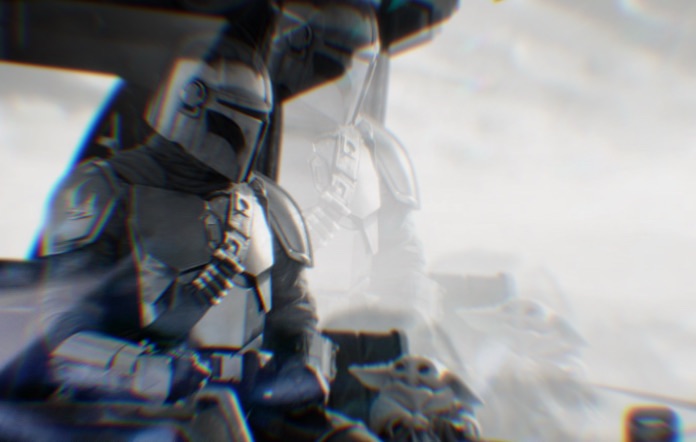
The Mandalorian and Grogu should’ve followed the basic requirements of good storytelling. It’s cute, but hollow. Star Wars: The Mandalorian and Grogu is a cash-grab that feels like it has been stamped with corporate approval.
No franchise has experienced highs and lows like Star Wars. And even funnier is that almost everybody has different opinions on what should be considered the highs and the lows. The one consensus opinion was that the first season of The Mandalorian felt like a breath of fresh air; Baby Yoda (now known as Grogu) was a star, everybody loved Pedro Pascal’s steamy Mandalorian voice, and their dynamic was enchanting to watch. Lucasfilm seemed to have found the perfect formula, so how could these two not work on the big screen as well? Unfortunately, Star Wars: The Mandalorian and Grogu is a cash-grab that feels like it has been stamped with corporate approval.
Star Wars: The Mandalorian and Grogu has Din Djarin training his adopted son Grogu and working for the New Republic by rounding up ex-Imperial warlords. His boss, Commander Ward (Sigourney Weaver), instructs him to find Rotta the Hutt (Jeremy Allen White), Jabba the Hutt’s son, and return him to his aunt and uncle, also known as the Hutt Twins. Ward tells him they will exchange Rotta for information on the elusive Commander Coin. When Mando finds Rotta in the fighting pits on Shakari, he quickly learns that there is more to the situation than he realized. Rotta is proud to work off his debt to Janu, and refuses to be saved. Also, the twins omitted that Janu and Coin are the same person. It turns out they only wanted Rotta back to kill him so they could officially take over the Hutt cartel. Grogu is along for the adventure and helps out Mando where he can, although they get separated about halfway through the film.
In one way, it’s nice for the audience not to be required to watch three seasons of The Mandalorian (and The Book of Boba Fett) to watch the movie. Forcing your audience to do homework isn’t ideal, and The Mandalorian and Grogu being a stand-alone film makes it more accessible to the broader public. On the other hand, the lack of connection to any other Star Wars project (since they are previously established characters) makes the film superfluous. The creative team could easily drop into season four without even acknowledging the events of the film. No sequel has been announced and nothing was set up in the film that indicated a sequel, but it doesn’t feel like a conclusion to their story. That begs the question, “why is this movie being made?” And the only answer is making money off the back of Grogu’s cute little face.
The plot of The Mandalorian and Grogu feels like the sort of story AI would pop out, or better yet, the sort of content that Disney wants their Disney+ subscribers to watch with their licensing agreement through Open AI. There are no choices made, no swings taken. The Mandalorian and Grogu is blandly inoffensive with no genuine stakes for either character. It hasn’t felt like Disney has had their sticky little fingers over a project this badly since the disastrous The Rise of Skywalker. When will Disney and Lucasfilm stop being afraid of its fans and their opinions? This is the sort of Star Wars film that would be released during a political situation like what the United States is currently experiencing, where we have to settle for scraps of good enough, where surviving is the best we can do, and we must accept the slop presented to us daily.
Star Wars as a franchise has always been a commentary on political and social structures, particularly with its films. Solo was exempt from this requirement because it was an exploration of a character, and Star Wars: The Mandalorian and Grogu falls into that same category. Nobody was expecting this film to reflect the darkness of our current society in the same way Andor did. The only requirement that the film needed was having character arcs for our protagonists, and it failed at achieving that. Mando and Grogu are the exact same at the start and the end. The film feels like “A day in the life of Mando and Grogu,” which frankly doesn’t warrant a film.
The Mandalorian and Grogu is both beholden and not beholden to The Mandalorian show, and it hinders the characters. In one way, because it is a stand-alone film, it doesn’t have to follow any stories set up in the previous season(s). At the same time, because Disney has not made it fully clear that the show is officially over, or that these characters will only be in movies now, the film is unable to make any narrative decisions in case the studio decides to pick the show back up in the future. Disney has waded into storytelling limbo. Although the film could possibly make a billion dollars, the lack of planning essentially guarantees diminishing returns, whether that be on TV or on film.
Despite my brain knowing how shallow the film is, I can’t deny that I enjoyed aspects of it. First, Ludwig Göransson is doing god’s work. His Mandalorian theme was already iconic, so he easily could’ve phoned it in, but instead he dropped the sickest techno theme while incorporating the pre-established Mandalorian themes. Being aware that you are experiencing an artist creating their legendary works in real time is surreal, but that is how listening to a Göransson score feels. I’ll be able to say, “I was there” and “I remember the first time I heard this.” I’m unsure if the Academy will permit this in the Best Original Score category since quite a bit is adapted (likely not since Dune: Part Two was ineligible) but if Göransson somehow snuck in with this too (since The Odyssey is already likely to show up) I wouldn’t be upset.
Second, The Mandalorian and Grogu genuinely looked good. The visual effects looked sharp and high quality and the puppetry was unsurprisingly excellent. What really struck me was how much I liked the cinematography. It’s no The Last Jedi, but the lighting looked commendable. It was bright at times without it being flat, and I could see the light reflecting off the Mandalorian helmet; it never felt dull. The first season of The Mandalorian used the Volume technology, and it’s not clear how much of this film used the Volume. Whatever combination of CGI and sets and lighting they used worked, and it seems like the creative team has fully figured out how to balance it all.
Pascal, Brendan Wayne, and Lateef Crowder are all given credit for their joint performance as the Mandalorian as the voice, the suit performance, and the stunt performer, respectively. Pascal has a scene where his face is revealed, which is always a lovely sight. This isn’t the only time a Star Wars character has been played by multiple people, with Darth Vader being the most famous example. I can only hope that this is for creative quality control rather than a lack of dedication. As for the supporting cast, Sigourney Weaver is painfully underutilized. To ask the sci-fi icon to be in a Star Wars film and not give her anything juicy to work with is criminal. Jeremy Allen White’s Rotta the Hutt was simply fine. Casting him was unnecessary because, despite being familiar with his work, I could barely tell that that was his voice coming out of Rotta. There’s nothing wrong with it per se, but the role could’ve gone to a voice actor in need of a job. Finally, Martin Scorsese as the sandwich-making alien Hugo Durant was amazing. The size of the role was perfect. His iconic voice felt right at home on Shakari, a planet that felt inspired by a futuristic New York City.
Star Wars: The Mandalorian and Grogu is technically a film, but it’s more akin to half a season of The Mandalorian (without any character growth). It is a fine entry point for a child’s first foray into the Star Wars universe, but in conversation with the entirety of Star Wars, it falls flat. Not every film or TV show has to be life-changing, but at the bare minimum, The Mandalorian and Grogu should’ve followed the basic requirements of good storytelling. It’s cute, but hollow. Disney and Lucasfilm need to do some introspection on why they are making Star Wars films and what statement they want to make. Star Wars is a lucrative franchise, but without a sense of purpose, the moral backbone that makes it special will begin to falter, and will ultimately lead to unsustainability. The Rise of Skywalker was the canary in a coal mine, and The Mandalorian and Grogu only shows that Lucasfilm is continuing in that direction, with Andor being an anomaly.
Grade: C
Oscars Prospects:
Likely: None
Should Be Considered: Best Visual Effects, Best Sound, Best Original Score
Where to Watch: In Theaters

Eva Kirby
She/her @eva_kirby21
Lives in Florida. Loves sports, Diet Coke, and rewatching Fleabag.
Favorite Director: James Cameron
Sign: Pisces


Leave a Reply