
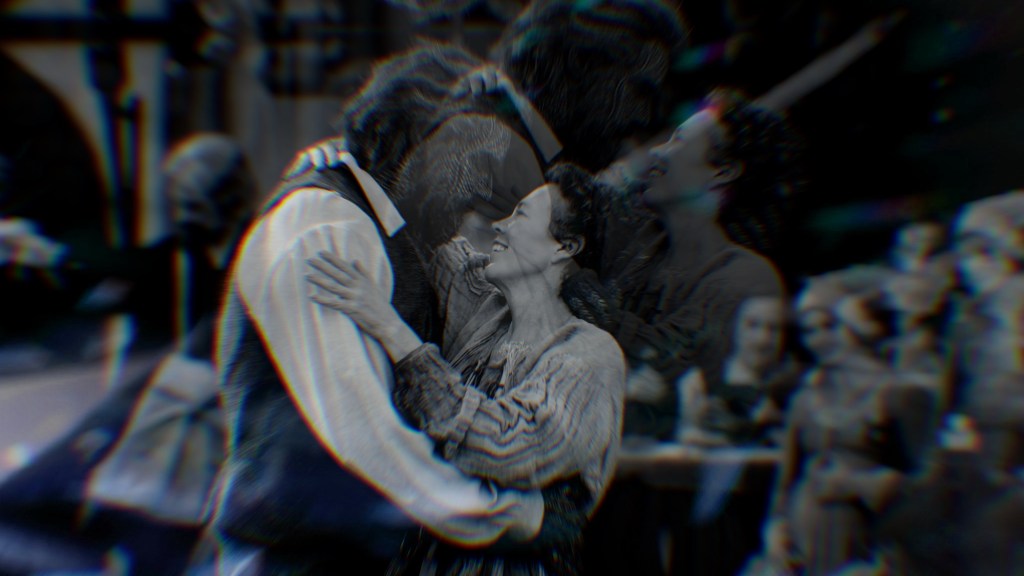
Wicker is the romantic fairy tale adults have been yearning for with more heart, exploration of patriarchy and a woman discovering the joys of pleasure. The story takes on a life of its own, becoming folklore with the earnest words and characters that could fall flat under lesser writing and performances. Wicker is easily one of the year’s best.
Alex Huston Fischer and Eleanor Wilson, the married co-writers/co-directors, give the once short story so much life it becomes its own fable on screen. It’s so easy to believe the life, love, and wonder of this quaint village because of the depth given to the story and how easily the story flows. Fisherwoman (Academy Award Winner Olivia Colman) is taunted by her village as a spinster for being unmarried at her age, aside from the taunting of her fish smell, the point is driven further home by seeing very young girls married off in a ceremony where instead of a ring around their finger, they receive a collar around their neck. Most of these public lashings are led by town matricarial gossip Tailor’s Wife/Doctor’s Daughter (Elizabeth Debicki). Eventually, Fisherwoman has had enough of not being taken seriously and decides to seek out the Basketweaver (Peter Dinklage) to weave her a husband, whom he delivers one month later. The Wicker Husband (Alexander Skarsgård) is handsome, attentive, affectionate, and devoted to her immediately, yet there’s such an authenticity to his love for her.
Something so impressive about the actual end product is there are so many films marketed or discussed as ‘horny’ or ‘erotic’ that just feature a few steamy kisses and allude to sex whereas Wicker embraces sex as part of what makes romance so consuming. The filmmakers use the period to exaggerate traditional attitudes toward marriage, sexuality, and women’s independence yet reflect many viewpoints of modern audiences regarding sex itself. There’s still today an idea that sex is not something women think about for their own pleasure or that audiences don’t want to see sex in films. The time period allows the female villagers to finally envision sex for pleasure versus just simply fulfilling their martial duty. At first the women are judgemental of their courtship until they begin to hear the sex. Before the Wicker Husband arrives, the Fisherwoman is ridiculed for being unmarried (and smelly due to the nature of her job). The village treats marriage as a woman’s ultimate achievement, being collared, but it doesn’t seem particularly concerned with whether the women are actually happy in their marriages (which still on some level rings true today). When Fisherwoman gets her husband, their sex life is enthusiastic, frequent, and mutually satisfying. The film, at times, plays it for bawdy comedy, their bed continuously breaks, but there’s a serious point underneath the jokes that Fischer and Wilson never lose sight of, she is finally experiencing sexual pleasure without having to apologize for wanting it.
The people in the village start at one point of judgement, whether it’s jealousy, anger or confusion, and they all come to see the sex and affection stem from a place of love. At one point Wicker Husband states he fixes things around the house simply because it makes her happy and the men cannot begin to understand how he arrived at that motivation. Their relationship disrupts the traditional social order and makes everyone in the village confront how unhappy their own relationships are. The wives see the attention and affection the Fisherwoman receives from her Wicker Husband, and they resent that she has something they don’t seem to have in their own marriages. It evolves from a jealousy of sex because of the actions they see day in and day out from Wicker Husband. The only reason the men even take notice of his behavior is because their own wives begin to act differently; they want sex that is pleasurable, they ask for things to be done around the house. The village men make no effort to be better husbands until their wives are acting out of the societal norm, just as the relationship that’s challenging them all. Fisherwoman’s relationship itself is radical. She chooses her husband, enjoys her sexuality, and maintains an identity beyond being somebody’s wife. Their relationship challenges the village’s assumption that a husband’s authority is simply part of the marital bargain. The character names dive into the politics of identity within society and most interestingly Debicki’s role. All of the women in town are “___ Wife” with the exception of Fisherwoman. Debicki’s role is fascinating as she is still called Doctor’s Daughter and Tailor’s Wife, she’s unable to get her shadow out from either man that ruled over her in some capacity. Wicker Husband is the only man in town referred to as ‘husband’ and not his occupation; all the men in town are their roles, Baker, Basketmaker, Tailor, Doctor. All of these characters feel so lived in and real, they have their purpose in the village and the story itself. No side plot feels forced as the actors uplift the well rounded characters to feel so necessary in moving the story along but also bringing this village to life.
Fisherwoman is a role Colman was born for; easily her best performance since The Lost Daughter, she’s given so much room to be charming, angry, upset, sexy, and confused and Colman never loses sight of how central all these emotions are to a real woman. Feeling talked down to because of your relationship status is something all women can relate to and as we get older and times change, there is still this weight of society expecting you to have settled down. It’s a complex feeling as you can be happy in life without a romantic partner but what Colman does throughout the film embodies that feeling of confusion when you do fall in love. She’s able to humanize how you can be so happy choosing to be single or needing that love in your life. There’s a scene at the fireplace where she’s speaking to Wicker Husband without looking at him and it’s some of the most emotional work of her career. Skarsgård is pitch perfect in something so many are saying is ‘out of character’ for him but I think it’s so inline with some of his previous work. There are touches of Eric Northman and Monroe Rutherford (the initial intro to him I swear). It’s impossible to talk about Wicker and how much Wicker Husband works without talking about Wētā, who created the character’s look for Skarsgård. The team developed custom materials and techniques to create the woven body, face, and hands while allowing Skarsgård to perform in the suit with his emotion palpable through his expressive eyes and retaining his gestures that grow as more and more human as time goes on. The minimal visual effects used to have light shine through his body to show he’s physically hollow allow for this practical work to truly be some of the best make-up work of the year.
Typically, I am not into romances outside of the troubling kind (Coppola’s Dracula is my ultimate, let’s be real about my insights/interests in romance), but Wicker itches a scratch of romance I didn’t know I even had. Maybe it’s the stage I’m at in my life, but this felt earnestly sweeping, consuming and most of all, real. It takes the fantasy of being loved completely and literally builds a person around it. The Wicker Husband isn’t just attractive or devoted to the Fisherwoman. He exists because she wants to be loved, and he treats that desire as something worth fulfilling.She has spent her life being rejected and ridiculed by the people in the village who consider her undesirable. Then she creates someone who sees her as desirable without needing to be convinced; she doesn’t have to become prettier, wealthier, or more socially acceptable to earn his affection and attention. He loves the woman she already is. The fantasy isn’t just that she gets a perfect husband. It’s that she gets to be wanted without having to change herself first. Furthermore, what’s romantic about the Wicker Husband isn’t only the passion, it’s the idea of having someone who wants to share your life, pay attention to you, and make you happy. The fantasy extends beyond being desired in a bedroom, it’s being desired in the middle of an ordinary day, when you’re doing nothing particularly special. He makes being somebody’s wife feel like being somebody’s beloved. There’s a scene where they’re simply watching the sunset on the roof and he says, “without you, I would have never seen the sun on the ocean,” and it is so simple yet so entirely romantic. It’s earnest in how much ordinary life is what people yearn for to share with one another, not only the moments of bed breaking passion. Wicker doesn’t treat love as a prize awarded to Fisherwoman as someone who finally meets society’s expectations. It treats love as something she was worthy of all along. The Wicker Husband doesn’t make her worthy of being loved. He makes it impossible for the audience to understand why anyone ever thought she wasn’t.
Grade: A
Oscar Prospects:
Likely: Best Make-up & Hairstyling
Should Be Considered: Best Lead Actress (Olivia Colman), Best Cinematography, Best Production Design
Release Date: October 16, 2026
Where to Watch: In Theaters

Kenzie Doyle
she/her @kenzie__xcx
Lives in LA. Misses Arclight, loves iced vanilla coffees.
Favorite Director: David Cronenberg
Sign: Capricorn





Leave a Reply