
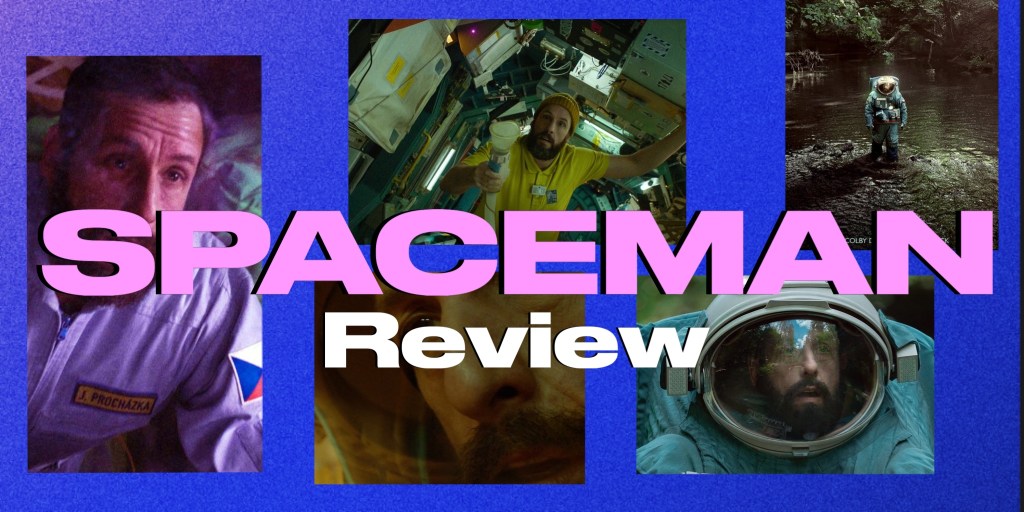
Like stepping into a planetarium, Johan Renck’s Spaceman is a somber psychoanalysis into the mysterious depths of the human psyche led by a stunning subdued Adam Sandler.
Johan Renck uses the preexisting material, Spaceman in Bohemia, to adapt the mission of Czech space cadet Jakub (Adam Sandler) as he heads into the cosmos. What makes Renck’s Solaris variant engaging is the personality he injects in the midst of a time when all sci-fi films are devoid of any personality-sacrificing culture in favor of chrome visuals. The art-house approach to the sci-fi genre is reminiscent of the 1970s films that came before it. The bond between astronauts and Earth, usually makes them the perfect subjects for examining isolation and love. Spaceman treks along the classic trope of loneliness but edges into the specific feeling of self-imposed loneliness as told through Sandler’s cosmonaut. Spaceman questions the human instinct to push others away in times when they should bring people in and the mentality behind building barriers for those we love most. Jakub is plagued by the sins of his father wearing them into his descendant to the edge of the universe until he is fully absolved.
Sandler never disappoints with a dramatic turn, and Spaceman is just another point in the long-standing claim that Sandler is one of our finest actors. In a somber performance that could easily come across as deadpan if the wrong actor was in place, Sandler crafts a compelling portrait of loneliness that speaks to the strength of his talents. He is tasked to carry the film for a majority of the time alone and his perspective from the start is intriguing, bringing the audience on the edge of their seats to figure out if this is reality or fiction. There is something so perplexing about his embodiment of this character that reminds us why he has been a mainstay for decades due to his multifaceted talents.
Sandler has his usual moves that have withstood every genre he has entered, but he lets the Sandman shed here as he brings himself to the center. The trick is his delivery of clunky dialogue that perfectly balances sentimentality and cynicism without ever coming off as cheap. Each word comes from a place of a man struggling with trauma that he has tried to escape many times. Put him opposite Paul Dano’s “calm app spider”, Hanus, and he makes this CGI monster feel real tapping into the emotional bond the two possess regardless of creature differences.
Even though we only hear Dano’s voice, he conveys one of his best performances in a long time, striking up an intimate yet unsettling vocal inflection as he documents his observations. His haunting voice ponders if at any time he will strike against his Earthly companion which adds to the film’s overall mystique. Dano’s giant spider follows the device of using the other to examine what it means to be human and is a superb example in its execution. Fragments of Jakub’s upbringing and relationship with his wife are haphazardly strewn as a patchwork of the soul as he is forced to relive pain in order for a nonhuman to grasp these emotions.
Jakub’s sixth-month otherworldly expedition is more than just a personal reflection, but a love story with galaxies in between lovers. The loneliest man in the universe outfitted in Soviet aesthetics communicates with his wife Lenka through a chat system. Lenka has gone silent leaving their marital home with her pregnant belly into a haven for single pregnant women. Carey Mulligan once again plays a grieving wife with a performance eerily similar to her Oscar-nominated turn as Felicia Bernstein. Hanus is the mediator their relationship needs, making Jakub come to his senses about what has been actually trying to escape all his life that hurts those around him, specifically Lenka.
Blending the spiritual with the substance is Max Richter’s ominous soundscape that hints at forces beyond our own adding to the mystique of Renck’s space. Richter taps directly into the brain’s auditory cortex, plummeting the mind into the despair of Jakub. Using nostalgia of the 80s and 90s to not only set the period of the story but engage in a trance matching the claustrophobic nature of what’s unraveling on screen. Experiencing this level of sound with abstract visuals from Jakob Ihre in a darkened theater sets the tone for a sensory experience like no other. With an untethered camera movement imitating the gravityless environment, the camera moves through the analog and digital corridors of the spaceship like moving through the maze of Jakub’s memories.
Renck doesn’t reinvent the space genre but creates his own entry into how audiences interpret the luminous galaxy.
Grade: B+
Oscar Prospects:
Likely: None
Should be Considered: Best Cinematography, Best Actor (Adam Sandler), Best Supporting Actor (Paul Dano)
Release Date: March 1, 2024
Where to Watch: In Select Theaters, Streaming on Netflix




 offscreencentral.com
Leave a reply to ‘Spaceman’ – Interview with Writer Colby Day – Offscreen Central Cancel reply