
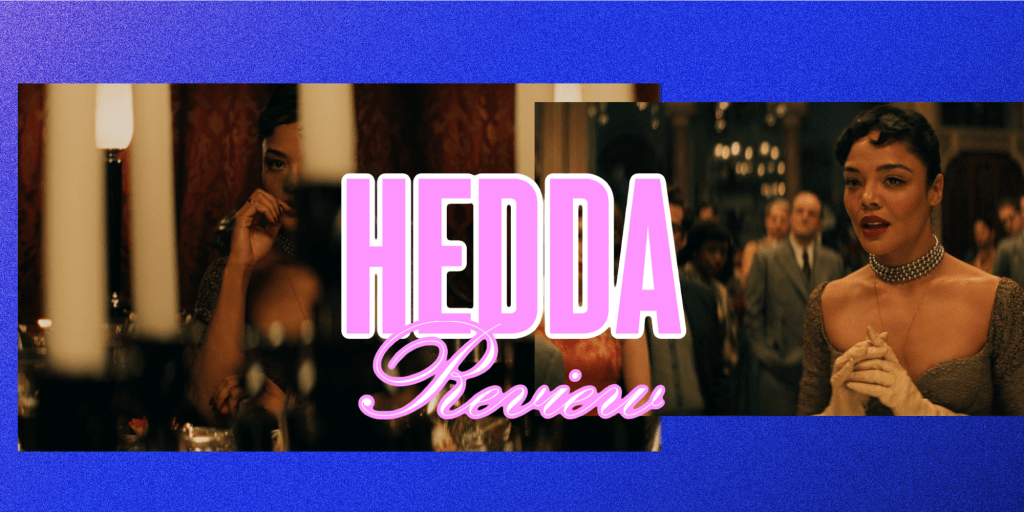
Lead by a remarkable Tessa Thompson and directed by the phenomenal Nia DaCosta, Hedda is one of the year’s most visually stunning films, and a modern yet timeless adaptation of the original play.
Directed by Nia DaCosta, Hedda is an enthralling, colorful, and layered reimagining of Henrik Ibsen’s play, “Hedda Gabler,” one that has arguably gifted readers one of the first truly complex anti-heroines. Some scholars have even declared Hedda as the female variation of the character, Hamlet. More than a century after its debut, DaCosta revisits Ibsen’s story of a woman suffocating within the limits of her era and turns it into a sweeping yet intimate portrait of female desire, repression, and power. What’s remarkable is how Hedda, though set in the 19th century, feels startlingly modern. Through DaCosta’s vision and Tessa Thompson’s magnetic lead performance, the film transcends its period trappings to become a meditation on the timeless struggle for agency – particularly for women who have been told that wanting more is a type of sin.
Working from a taut, intelligent script that retains Ibsens precision but reshapes its tone, DaCosta crafts Hedda as both character study and gothic thriller. Shot almost entirely within the cavernous confines of a single estate, the film uses space and architecture as part of the emotional language. The production design is absolutely gorgeous and is only elevated by the stunning costumes. Cinematographer Sean Bobbitt captures the home’s vast corridors and suffocating rooms with an eerie beauty – shafts of light slicing through the thick darkness, reflections bending into distortion, every corner holding the suggestion of unrest. The camera moves deliberately, echoing Hedda’s own restrained yet calculated movements, as though even the lends must obey the invisible social codes hemming her in.
Despite the single location, Hedda never feels stage-bound. DaCosta’s direction is fluid, cinematic, and emotionally exacting. She allows the tension to build gradually, every look and silence imbued with a sense of impeding collapse. There’s a quiet mastery in the pacing – the film breathes when it needs to, yet never loses its pulse. By the time it reaches the final act, the estate feels alive, almost like an accomplice to Hedda’s unraveling.
Thompson delivers one of the defining performances of her career. Her Hedda is sharp, melancholy, and unknowable – a woman whose intelligence and ambition make her dangerous in a world that wants her docile. Thompson communicates volumes with the smallest gestures: the flicker of disdain in a smile, the rigidity of her posture, the tremor of a hand when she does finally lose control. In DaCosta’s interpretation, Hedda’s frustration isn’t only psychological or marital – it’s existential. Her yearning for autonomy clashes not just with social norms, but with a society that denies her the very right to imagine herself freely.
Layering this story with the perspective of a Black and queer woman depends its resonance immeasurably. DaCosta doesn’t ignore the racial dynamics implicit in such a casting choice; rather, she allows them to subtly expand the film’s emotional vocabulary. Watching a Black woman fight for self-determination within an aristocratic 19th-century setting invites new questions about visibility, erasure, and the cost of existing in spaces that were never meant to hold you. Even more groundbreaking is that Hedda is such a flawed human. She is selfish, calculated, and does not care who she hurts as long as it results in her maintaining power over herself. Very rarely do we see stories of non-White women be given such nuance, which nonetheless adds to how refreshing Hedda feels.
Nina Hoss gives a quietly remarkable performance as Eileen Lovborg, a role that was gender swapped from the original play. With Eileen being a woman in the largely male dominated field of higher academia, she is constantly feeling the urge to prove herself not just for career gains, but for the simple respect of her peers. She and Thompson have a chemistry together that will have audiences feeling everything from their intimate breaths to the sweat of nerves from their faces. Their shared scenes hum with unspoken grief and recognition of each other coping with their individual cages in different ways.
The film’s emotional architecture is held together by Hildur Guðnadóttir’s extraordinary score. A spectral chorus drifts through the soundscape, interwoven with muted horns and percussive heartbeats that seem to mirror Hedda’s own. It’s at once beautiful and suffocating, heightening the tension until silence itself feels like a scream. Guðnadóttir’s compositions here blur the lines between the music and the emotion, pulling us deeper into Hedda’s fractured psyche.
Ultimately, Hedda is a story about the illusion of control. DaCosta’s visual storytelling is both elegant and devastating – her use of lighting, shadows, and navigating the space helps transform a domestic tragedy into a cinematic study of power and paralysis. In her hands, every frame feels deliberate and every cut feels meaningful. The result is a film that’s as intellectually stimulating as it is emotionally shattering. DaCosta has long been celebrated for her sharp storytelling instincts and visual precision, but Hedda marks her most accomplished work yet – a film that bridges the past and the present with remarkable grace. It’s a reminder that women’s battles for autonomy, respect, and self-definition are not relics of history, but living, breathing struggles that persist in new forms.
By the end, Hedda doesn’t offer catharsis so much as recognition. It is the portrait of a woman trying desperately to claim power in a world determine to strip it from her – a haunting, modern echo of an old tragedy. DaCosta’s adaptation and Thompson’s performance don’t just revive Ibsen’s masterpiece – they reclaim it, reframing Hedda’s despair as something universal, her defiance as something timeless. It is one of the year’s most visually and emotionally commanding films, and a modern-day triumph of interpretation and adaptation.
Rating: A
Oscar Prospects:
Likely: Best Lead Actress (Tessa Thompson)
Should be Considered: Best Director, Best Supporting Actress (Nina Hoss), Best Original Score, Best Production Design
Where to Watch: In Select Theaters and Streaming on Amazon Prime

Sarah Abraham
she/her @sarsaraaaaah
Lives in Orlando with her mom & dog. Clarinetist that loves movies, EDM, yoga, hot girl walks, and tzatziki.
Favorite Actor(s): Omar Sharif, Danielle Deadwyler, Hiam Abbass, and Daniel Day-Lewis
Sign: stereotypical Taurus


 offscreencentral.com
Leave a reply to Brittani Burnham Cancel reply