
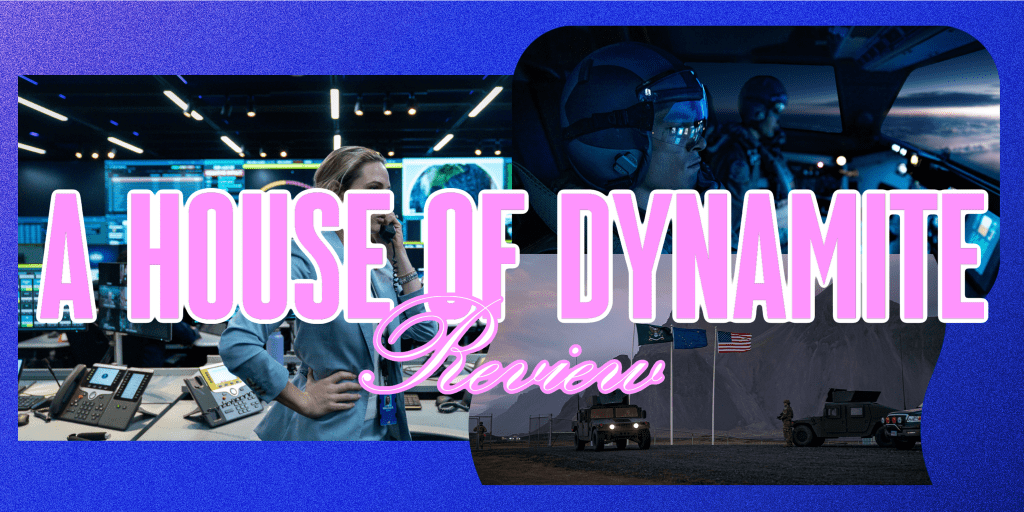
A House of Dynamite is more than just a thriller — it’s a visceral meditation on fear, responsibility, and the fragility of modern life. Kathryn Bigelow proves once again why she is a master of her craft, creating a film that is as thrilling as it is terrifyingly real.
After Zero Dark Thirty (2012) and Detroit (2017), Academy Award winner (don’t you just love saying that) Kathryn Bigelow returns, and she strikes once again, confronting us with the terrifying immediacy of nuclear threat. To me, Bigelow is one of the best filmmakers working today: a woman unafraid to break barriers, creating films in a genre largely dominated by male directors, with a singular directing style that feels immersive, haunting, and deeply relevant.
I’ve always loved so-called “films for guys” — action, science fiction, war films… You name it (no wonder I love Kathryn Bigelow so much). Growing up, I called them “guilty pleasures”, because I never fully allowed myself to enjoy something outside “the usual” for girls. But things have changed now, and for weeks, I couldn’t stop telling anyone who would listen that A House of Dynamite was one of my most anticipated films at the Venice Film Festival, and that I was exactly the target audience for it (and I was right).
There is a lot to say about A House of Dynamite, yet nothing feels entirely right, and perhaps that’s exactly the point. The film “explores the madness of a world that lives under the constant shadow of annihilation, yet rarely speaks of it,” and it somehow feels uncomfortably close to reality, given the current geopolitical climate. Bigelow captures not only the technical and strategic aspects of a nuclear threat but also the human consequences: the tension, the fear, and the impossible decisions that leaders and ordinary people alike must confront. While watching it, you can’t help but reflect on the fragility of our world and the eerie normalisation of threats that could wipe out millions. The film lingers long after the credits roll (for days, even weeks), creating a haunting reminder that some dangers are ever-present, even when hidden behind layers of secrecy and bureaucracy.
In the world we live in, where multiple nations possess nuclear weapons, the stakes have never felt higher. And yet, as Bigelow said, “there’s a kind of collective numbness, a quiet normalisation of the unthinkable.” There are an estimated 12,241 warheads worldwide, spread across nine countries: the United States, Russia, the United Kingdom, France, Israel, Pakistan, India, China, and North Korea. Isn’t that terrifying? As a world leader, how do you defend your nation? And “how can we call this ‘defense’ when the inevitable outcome is total destruction?” Knowing that such a threat could materialize at any moment makes Bigelow’s film feel chillingly urgent.
A House of Dynamite made me feel sick to my stomach — in the best possible way. No one directs war films like Bigelow, and no one captures human emotion and urgency quite like she does. For 112 minutes, I was on the edge of my seat with a lump in my throat. I couldn’t stop thinking about how this could happen any day, that governments are likely monitoring that kind of threats, and that we may never fully know the scope because much is classified. Even after watching it twice, the tension and dread hit me just as hard, proving this film’s relevance and impeccable execution.
After an unidentified missile is launched at the United States, a race begins to trace its origins and determine the response. The film is divided into three parts: Inclination is Flattening, Hitting a Bullet with a Bullet, and A House Filled with Dynamite. Bigelow uses a Rashomon effect, showing the same crisis from different perspectives across multiple departments. This approach not only builds suspense but also highlights how each team interprets information and makes life-or-death decisions under pressure. While the narrative structure can feel repetitive for some, I think it ultimately deepens our understanding of both the crisis and the human experience within it. For viewers unfamiliar with the military world, some events and terminology, like DEFCON levels or strategic protocols, it might feel overwhelming, at first, but thankfully, on-screen text clarifies key acronyms and procedures, allowing the audience to follow the story without losing the tension that drives every scene.
Everything begins as usual, a “normal” day in the State Department. The Defense Readiness Condition (DEFCON) is at four, meaning increased intelligence watch and strengthened security measures above normal readiness. Nothing seems alarming — until an unidentified missile is suddenly launched. The target? Chicago, putting nearly 10 million lives at risk. The clock is ticking. Nineteen minutes. Nineteen minutes to identify who is responsible, nineteen minutes to decide what to do: a choice between “surrender or suicide.”
Before the clock even hits ten in the morning, DEFCON drops to two, the next step toward nuclear war: armed forces ready to deploy and engage in less than six hours, last declared during the Cuban Missile Crisis in 1962 and then one, meaning nuclear war is imminent or has already begun — maximum readiness, immediate response, which was never officially declared in history.
Watching this film feels suffocating. True to her signature style, Bigelow puts the audience in the heart of the action, using handheld cameras, tight framing, and quick cuts to create a constant sense of immediacy and tension. Just like her previous films, A House of Dynamite has the feel of a documentary despite being fiction, heightening the suspense and making every moment feel urgent and viscerally real. The pacing pulls you into the chaos, making it impossible to look away, while Volker Bertelmann’s score reinforces that tension at every turn. Instantly recognizable, its haunting melodies thread through the action and amplify the stakes. The combination of Bigelow’s immersive direction and Bertelmann’s music leaves the audience both breathless and unsettled, fully immersed in a world where every second counts.
A House of Dynamite is more than just a thriller — it’s a visceral meditation on fear, responsibility, and the fragility of modern life. Kathryn Bigelow proves once again why she is a master of her craft, creating a film that is as thrilling as it is terrifyingly real.
Grade: A
Oscar Prospects:
Likely: Best Picture, Best Sound, Best Original Score, Best Original Screenplay
Should be Considered: Best Director, Best Supporting Actress (Rebecca Ferguson), Best Film Editing, Best Casting
Release Date: October 10, 2025
Where to Watch: In Select Theaters; Streaming on Netflix on October 24th

Mar Tremblay
she/her @_martremblay
Lives in Montréal, can recite the Cerulean Monologue from The Devil Wears Prada word for word, and rewatches Mamma Mia at the slightest inconvenience
Favorite Actresses: Cate Blanchett & Gena Rowlands
Sign: Leo




 offscreencentral.com
Leave a comment