
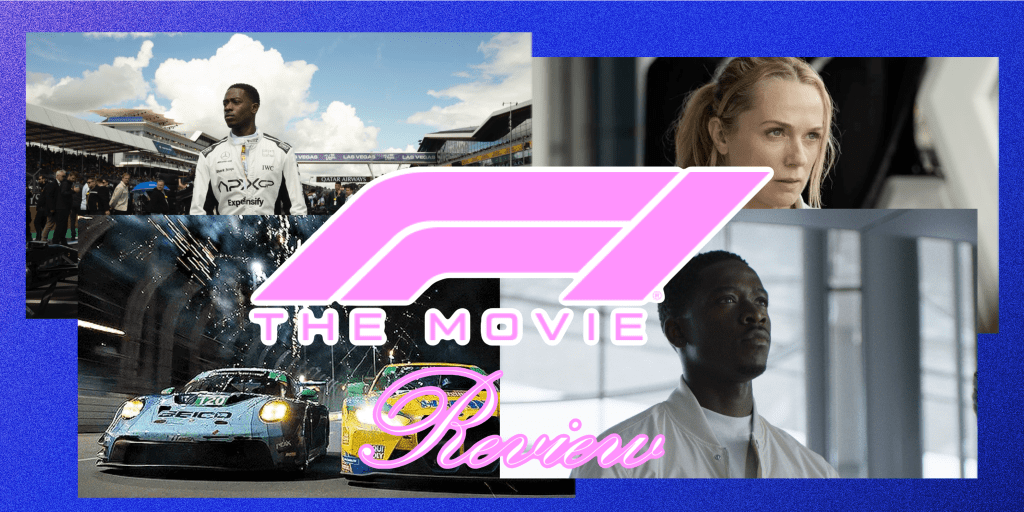
Despite expertly choreographed racing sequences and a charming cast, Joseph Kosinski’s F1 is unlikely to follow in the footsteps of Top Gun: Maverick’s blockbuster showing in theaters. F1 lacks heart, and its corporate energy distracts.
Top Gun: Maverick carried movie theaters during a time of uncertainty, and F1 is hoping to follow Maverick’s jetstream. With involvement from Jerry Bruckheimer Films– the studio responsible for Tom Cruise’s Days of Thunder (1990)– along with Joseph Kosinski directing, the F1 is closely aligned with Top Gun: Maverick. F1 follows an aged racecar driver Sonny Hayes (Brad Pitt) who is roped into driving for a failing Formula 1 team. His teammate is rookie Joshua Pearce (Damson Idris), and their relationship immediately gets off on the wrong foot as Sonny performs better due to his ability to take risks.
Certain scenes of F1 have the visual intrigue of a car commercial, filled with shades of gray. Simple dialogue scenes between characters are so underlit that half an actor’s face is shrouded in darkness. Still, there are moments of life to the film’s cinematography and editing. Joseph Kosinski has taken on the Tony Scott signature sunset as a recurring image in his filmography. There’s a fun late title card drop. The crisp digital cinematography at times looks great, made for a film of intense action. Scenes inside the Formula 1 cars feature a driver’s hand steering the wheel and literally covering the camera, a creative way of adding an immediacy to the action. The race scenes are the highlight of the film, with seamless close-ups of the drivers racing. This follows in the footsteps of the incredible flying scenes of Top Gun: Maverick.
It is essential that every race in the film has a clear “plot,” with rising action, a climax, etc. F1 accomplishes this wonderfully, with race scenes taking on different tones– some comedic, others euphoric. One race scene becomes completely silent during a moment of intensity, resulting in audible gasps from my theater’s audience. It is also essential that the filmmakers allow audiences with no experience watching Formula 1 racing (myself included) to understand the rules of the sport. The film accomplishes this in spades. I understood the components of a Formula 1 team, from the pit to the technical team to the drivers. These team members, as Sonny Hayes instructs at one point, are all fighting for 1/10th of a second. The film does a great job of showcasing how these team members work together, and it is a highlight of the film.
Hollywood is comfortable with stories centered on a mentor/mentee relationship. It allows filmmakers to continue to use aging stars, and lends itself to reboots or legacy sequels. F1 is an original story, but with Hollywood’s reluctance to experiment with new stars in expensive, untested “properties,” the film forgoes centering around new talent, Damson Idris, and instead stars 61 year old Brad Pitt. Interestingly, the film explores the age difference between the two stars; it becomes a sort of meta dynamic.
The film centers around the old-timer teaching the younger driver new tricks, pushing the rookie to be more risky. It is a welcome change from the typical cliches of a “hot-shot young rookie.” It also feels true to the generation divide the film spends much of its runtime focusing on, with Millennials and Gen Z being marked by less drinking and less sex – therefore less risky behavior. This isn’t the only marker of the generation divide between Hayes and Pearce, with characters repeatedly teasing Hayes for his age and Pearce often being seen holding a phone (but that may be in part due to a certain studio involved).
The story, with a script Aaron Sorkin touched at least once, has frustratingly muddled character arcs. These jumbled character arcs are in part why the film lacks a certain heart to it. Rooster and Maverick embracing at the end of Kosinski’s Top Gun: Maverick moves a viewer in part because their conflict is straight-forward. Top Gun: Maverick is laser-focused in naming and showing their conflict over and over again throughout the runtime. Hayes and Pearce don’t have this same dynamic, with their eventual allyship feeling like a story going through the motions. While we understand Hayes is a combat-orientated, risky driver, we never really learn what kind of driver Pearce is. There is little build-up to the eventual positive shift in their relationship. The two characters don’t even embrace at the end, instead saying their goodbyes from across a parking lot. Hayes ends the film at the exact same place he started the film at. Hayes does not grow throughout the film, and Pearce merely learns to become more like Hayes.
At one point in the film, Hayes shouts to an investor of his team that they “know nothing about racing!” The influence of the board of investors of this racing team is a central conflict of the film, and I can’t help but think about the giant logo I saw at the beginning of the film, of a certain tech company. Watching the film, I was somewhat shocked by the sheer amount of ads. This is expected for a movie about F1, but not only are there ads peppering the cars and racing suits of the drivers, but there are car ads, Apple product ads, etc. This is part to pay for the sheer expense of the film. F1 was interrupted by the SAG-AFTRA strikes, driving up costs, and the film is shot on real locations for Formula 1 racing. But other aspects of the film feel like hollow products. Hans Zimmer is phoning it in with the film’s score, and the film’s credits play over a milquetoast Ed Sheeran song about driving. All blockbuster films have tie-along soundtracks with pop stars, but at least films like Twisters, Barbie, or Elvis had some kind of intention with their collaborations. Damson Idris promoted the film by wearing a racing suit to the Met Gala, dressed by Tommy Hilfiger. His character’s car is of course emblazoned with Tommy Hilfiger’s logo. At times, the film feels like an ad for Formula 1 racing. Some aspects lean towards realism, like real faces from Formula 1 populating the film, and real commentators commenting on the events of the film (borrowing from Days of Thunder). Other additions are odd, like the real-life Lewis Hamilton (who is a producer on the film) competing with the fictional characters.
F1 is filled with charming actors, from Shea Whigham to Kerry Condon to Javier Bardem (who is a delight in this film). It is an original story. It is surprisingly, not sexless. So why is F1 unlikely to become a classic? It has something to do with its intense corporate energy, yes. It also has something to do with its limited audience once it’s exclusively on Apple TV+. But much of it has to do with its lack of emotional punch. It may have engrossing action scenes, but its lack of emotional climax is what will linger in audiences’ minds. F1 accomplishes an impressive feat by working for non-fans of Formula 1 and die-hards alike, but it is unlikely to have any real longevity.
Grade: C+
Oscars Prospects:
Likely: None
Should be Considered: Best Film Editing
Where to Watch: In Theaters

Madelyn Land
she/her @maddiexdrew
Lives in Seattle with her large earring collection.
Favorite Director: Sofia Coppola
Sign: Aries

 offscreencentral.com
Leave a reply to Thanksgiving 2025 Film Catchup Cancel reply