
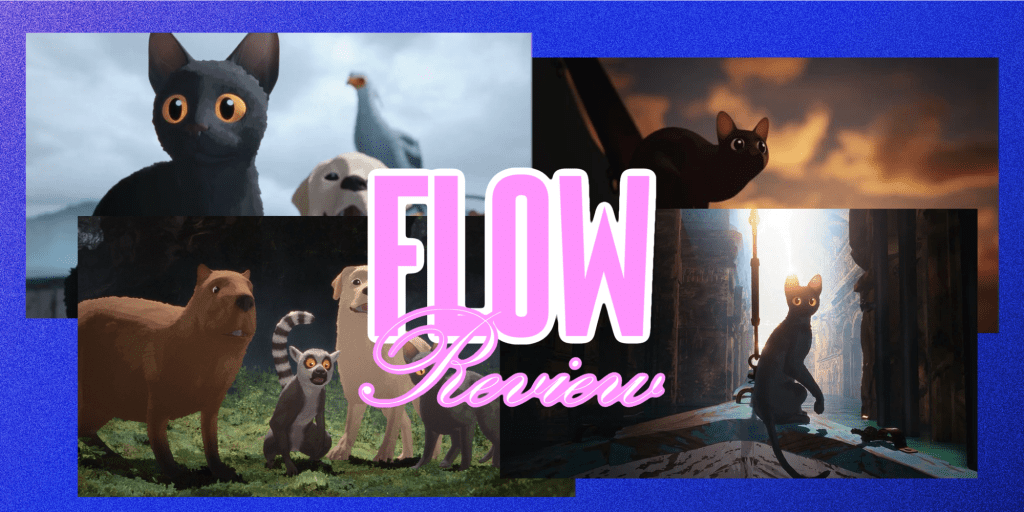
Flow is a transcendent and kaleidoscopic tale centered around a found family of animals trying to survive in a world on the brink of destruction. Told through the perspective of a cat and a group of various wild species, Flow gives a voice to the animals affected by the actions of humanity and the dire consequences of a climate emergency.
Animals have walked the earth longer than most civilizations have been constructed by humankind. As much as humanity has left an imprint into the animal kingdom, we are also at the root cause of the destruction that comes from an ever-changing society. In the last few years, humans have seen the Doomsday Clock remain at a minute and a half to midnight, signaling that we’ve never been closer to destruction with the impending doom of climate change. As we think about how each year we suffer from new climate emergenices, we also forget about the wildlife around us deeply affected by these actions. We may not be able to know what they’re going through, but we can attempt to understand. It’s this concept that is explored in Gints Zilbalodis’ Flow, putting audiences. into the eyes of a cat trying to survive a natural disaster with the help of other wild species.
Told through no dialogue, Flow centers around a black cat living a solitary life in the forest. The world is abandoned of all humanity, with little hints of what once existed through cat sculptures, mirrors, and boats. The cat is trying to survive on his own, trying to hunt for fish at the pond nearby the abandoned house it stays in. As the cat begins to hunt for food, we begin to be introduced to various animals that live in the surrounding area: a pack of dogs, rabbits and other wildlife. As a golden retriever from the pack of dogs begins to take interest in following the cat around. The dogs continue to scare the cat away, until the cat begins to notice that there is a stampede of wild deer running from a massive tsunami. The cat and the group of dogs make it out of the tsunami, but the grassy environment begins to be engulfed in water flooding the area. As the water keeps rising up, the cat tries to get to higher ground where it discovers an empty boat, escaping away until realizing that the boat has another guest: a capybara. The cat and capybara, with other animals such as a lemur, a secretary bird, and the golden retriever from before, begin to make their way across the terrain, and try to survive long enough to find higher ground.
Each animal in Flow has their own personality, and drives their own individual wants and needs as they attempt to survive amongst one another. The cat is more adventurous and nurturing, while the capybara is more rational and the decision-maker in the group. After the cat is saved by the secretarybird, we see the bird take a stand for saving other animals rather than trying to harm one another in the midst of a crisis. The lemur is more energetic and irrational, and of course, putting all four of these animals creates clashes between one another. Through Zilbalodis’ script, it almost feels like we can hear the animals communicating their frustrations through grunts and noises. We get a sense of who each animal is, and how each of them have their own strengths to keep moving forward. Each character is vastly different from each other, and yet, they’re also all similar in unique ways.
The scale of Flow, between landscape shots of a world engulfed by water and its past, feels otherworldly at times. Moments of the core four animals traveling into abandoned cities with landmarks feel as if we can touch the water hitting the boat, wet fur that we can imagine putting between our fingers, and the feeling of holding a golden mirror up to a sunset adds depth to an animated world that feels close to our current society.
The smallest details feel lived in, while the animals are intricately designed with mannerisms of their real-life counterparts. In a scene where the cat sees the lemur’s tail, it begins to play with it almost as if it was a real animal put on camera. In a way, you can see your own animals throughout the animals in Flow. The animation looks different than anything most have seen, and shows the beauty of an abandoned world ran by animals. It should be noted that the film was made on Blender, a free animation software and Eevee for rendering. The animation transcendents how animation is normally done, and has some of the most realistic animals put onto screen. Every scene has so much care and love that is animated into the way the water moves or how the cat flicks its ears, and it translates profoundly on screen.
It’s never fully explained what has happened to humanity in Flow, but we know that they once inhabited this environment. Large statues of cats and staircases, temples at the top of rocks and pots left behind add to the mystery. The film leaves it up to the audience’s imagination, and the horrors of what could’ve happened feel no less important to the animals and their adventure. Zilbalodis’ decision to keep what happened unrevealed allows for us to be in the perspective of the animals: unaware and trying to make amends instead of drowning in our thoughts.
At the core of Flow is a story about survival and how the climate crisis affects the animals around us. By utilizing storytelling that puts wildlife first, we understand nature and how our relationships can help us survive. Throughout all of the tribulations the animals go through, the four of them end up saving each other in hopes of moving forward. Flow isn’t just a warning to humanity, but rather, an exploration of how animals interact with one another on the brink of a catastrophe. Through the cat’s eyes, we see how the climate is always changing, but we have to be there for one another to continue to survive another day.
Grade: A+
Oscars Prospects:
Likely: Best Animated Feature, Best International Feature
Should Be Considered: Best Sound
Where To Watch: In Select Theaters

Leia Mendoza
she/her @leiassunsets
Lives in Austin and loves shopping sequences
Favorite Actor: Cillian Murphy
Zodiac: Cancer


 offscreencentral.com
Leave a reply to Our Favorite 2025 Academy Award Nominations Cancel reply