
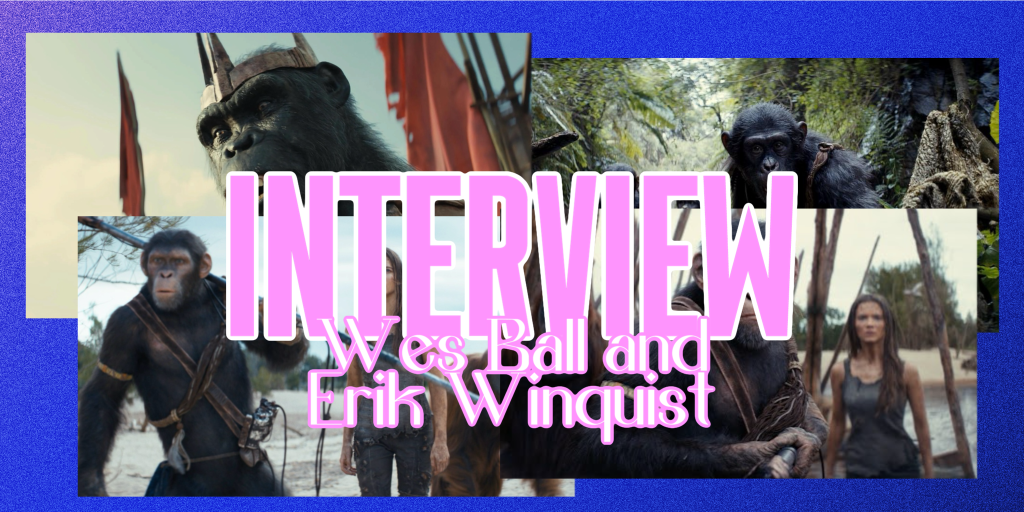
A world without Caesar, set 300 years since its last installment Kingdom of the Planet of the Apes returns to the world where Apes are feeling the lasting impact of a humanless world as vegetation covers skyscrapers and the stories of their beginnings become warped by power hungry leaders. Offscreen Central had the opportunity to talk to Director Wes Ball and Visual Effects Supervisor Erik Winquist on the decision to continue to story, documenting an overgrown environment, and figuring out how to properly animate wet hair during one of the film’s climatic sequences.
Jillian Chilingerian: Hi, I’m very excited to be talking with both of you today about the film.
Wes Ball: You too.
Jillian Chilingerian: I admit this was my 1st entry into the whole Planet of the Apes universe.
Wes Ball: Hey! That’s fascinating!
Erik Winquist: Oh!
Wes Ball: What did you think?
Jillian Chilingerian: I wasn’t planning on seeing it, that all my friends were talking about it, and I was like, Oh, I want to be part of the conversation. So then I went, and I didn’t expect to get so emotional as I was watching it and it’s stuck with me since then.
Wes Ball: That’s cool. You were exactly the people we were trying to think about a lot, how do you get new people into this thing because it’s a great franchise? It’s an emotional experience and involving.
Jillian Chilingerian: Even as I was coming up with my questions for this, I was like, Wow, I’m thinking, more and more deeply into it. It’s been some time since the last one and now we’re embarking on a new chapter within this universe. It’s set like 300 years out, so it makes you think how has this group evolved? What’s happening to the humans? What’s happening to the apes and what the world looks like?
Wes Ball: A lot of off-screen stories to imagine. Right?
Jillian Chilingerian: The environment tells a lot of the story visually and what cultures are popping up societies, speech, anatomy like all these different factors. So for the two of you, embarking on this journey, both from story and aesthetic, what were some of the early conversations you had of figuring out sometimes, why we need another one, or like, what is this going to add?
Wes Ball: Well that’s very much what you’re talking about there was my first thing right, when the studio came to me and said, Hey, what about doing another Planet of the Apes movie? What do you do? You know what I mean? I think very early I came up with the idea that okay, we need to cut. Originally I thought it was going to be a thousand years, but that idea of getting some distance from the previous movies that I love so much is right. How do you follow up on those things, I didn’t want to be a part 4. I didn’t think that was going to work as much as people might want to have seen it. I didn’t think it was going to be successful at doing what it needed. We needed to start a new trajectory, a new chapter to explore for future movies, right? It’s an important franchise for the studio. At the same time, I didn’t want to abandon the Caesar storyline. That was such a crucial, important thing that we had gained so much from and so that’s where we came to that idea of how Caesar’s storyline is the foundation of this movie, and you explore how this new character comes in and personifies him and meets up against his myths and legends, and that idea of that time cut it allowed for so much storytelling that we didn’t have to explain. Like you said the environment is telling you a lot of the story. For fans of the original 1968 movie. We wanted to start feeling like we’re heading towards there so aesthetically, the way we shoot it the way we block the cameras and we light it. We wanted to feel like we belonged in both worlds in a way, we were very conscious of that like, is that going to be a problem? Are we going to get squished by walking in the middle here? We did the best we could, and then it was just about coming up with a great adventure about a young boy who is naive and isolated and steps out into a dangerous and giant world, full of secrets and knowledge. Thinking about that core concept, your knowledge is power. That’s a cool idea to explore with apes and to see ourselves in them because their apes are so similar to us. That’s a tall order, of course, that these CG characters that aren’t real at all to find ourselves engaging with them on a very empathetic level. That’s a Testament to Erik and his team to be able to allow for that magic trick to happen.
Erik Winquist: Yeah, I had a similar reaction to Wes when I was 1st approached about it. Of, You know, am I interested in working on the next ape’s film? I’m like, I don’t know but when I read the script, it was the world that was pouring out of those pages was compelling in the sense of like what the opportunities that had for like to the images we could make and put on screen, which kind of like this cool thought experiment about what would happen in the days, and then the weeks and the months and the decades after human beings just like dropped off the planet. It starts painting these cool pictures in your head in terms of what that might look like. Interestingly, this guy’s been thinking about stuff, I mean, he did an animated short film in 2011 that there’s the bones of this movie.
Wes Ball: This was not planned by the way, it just happened to work out this way, it is a romantic idea of this subgenre. Human beings love the idea of the romantic reset when things go back to a simpler life when we don’t have to deal with phones or the complicated issues that we all deal with in modern life. There is something interesting about it. It’s like, that’s why Westerns are so interesting and this movie is in a Western.
Jillian Chilingerian: I walked out of the theater and I was like they weren’t real like, because you feel it so much with just what they’re going through.
Wes Ball: That warms my heart because I mean, that needs to be said. It’s like these characters aren’t real. All manufactured, and that is like it is incredible. They’re driven by really committed talented actors, that’s how we ultimately pull this thing off. They are the puppet masters essentially behind this crazy technical process of creating these things. But hopefully, if we’ve done all of our jobs right this sheer, massive effort of pulling something off that’s so technical goes away and you just get sucked into the story and the characters.
Erik Winquist: I think the thing that’s pretty telling is that I don’t know if you’ve seen the raw cut version of the movie but the before and after you can watch this film and be just as taken in by the human actors, even with the dots on their face like what was going on there. It tells you everything and our mission with this is to make sure that we don’t lose that stuff like that. That is exactly what the performance is supposed to be. We just need to put it in the form of an ape and that’s what all the work is about. To get exactly the to get exactly the the response that you’ve just described feeling sad or elated just being taken along for the ride. We completely want audiences to forget that they’re watching technology.
Jillian Chilingerian: I assume that technology since the last one has improved and when we’re capturing these performances they feel so real because you get that nuance with the lines of their faces. So like, what is that process like even going to how the anatomy of the ape has changed throughout the series, as they, you know 300 years, and they’ve acclimated to human life.
Wes Ball: I’ll briefly say that starts with the actors. The actors have to go through 8 weeks or so of just internalizing deeply what it means to be an ape. They all have their different gates, and even on the mocap stuff. They walk a different way, they hold themselves differently, and they really invent a character, and then we’re there to capture it. Erik’s there to convert all that information and stuff and intent you see on screen.
Erik Winquist: Yeah, I think the last couple of ape films. If you have seen them now, they have just this amazing level of character, and emotive performance as well. The big thing with this film is that all of our main characters, like a dozen new characters all speak, whereas so many of the previous movies were all about sign language and purely what was going on in the face, and so that requirement for having speaking apes was a big push technologically on this one to make sure that we were going to be able to pull that off with the animation team that we had. Both advances in some of the hardware that we’re using to capture their face and stereo this time, instead of just like a single perspective camera on their face, gave us a lot more precision in terms of what their face was doing at every and every frame. Between that and then that fed into a new, deep learning solver that we employed for the movie which gave the facial animation team a consistent baseline, so that every facial animator wasn’t slightly driving the character in a slightly different way because of that, you really it gives them the animators the time to focus solely on just every little nuance and micro expression, and the little saccades of the eyes darting back and forth, and all that stuff that tells us this thing I’m watching is alive.
Wes Ball: It was fascinating to watch how much can be done with just the lower eyelid being moved up and what that conveys as an emotion it’s like really fascinating. Here’s another good story. This has to do a little bit with, like the the effort that it takes to pull the likeness from the from the actors to these apes and that conversion, that translation. So we’re going through the modeling design for Noah, but we got to the final bit where it’s like, man It looks good, but there’s something I’m not sure. What is it? What is it? Then what you do is what the guys did is they took Noah’s face or Owen’s face, and you flop it back and forth, and you realize his face isn’t symmetrical.
Jillian Chilingerian: Oh My Gosh!
Wes Ball: His other eye is slightly lower than the other eye, and as soon as you apply that to the 8 which Noah does it is very much like no Owen’s face, slightly lower. Boom! It’s suddenly unlocked. There’s Noah, It was fascinating that the level of subtlety that these movies require is stunning.
Erik Winquist: Everybody’s got a slight asymmetry, and these like these little nuances that make us unique and human, we wanted to take all those aspects of what we can there, because one of the things we found over the years is, the more we can sort of incorporate little aspects, little key things about somebody’s face into their.
Wes Ball: Chaos, right?
Erik Winquist: Bits of chaos, but also just the specifics from we did a ton of this on Caesar with Andy Serkis. He has these very specific folds around his eyes, and as soon as we incorporate some of those, and you really, it just helps the actor come through in their character.
Wes Ball: Makes makes us see like, Oh, it’s working. We’ll look at the original take, and then we’ll look at the actual, the new render and we’ll bounce back and forth and see what’s what’s translating, what’s not. Jillian Chilingerian: When we watch movies where we see actors’ faces sometimes it tells so much of the story, and makes big differences based on their choices. So it’s very fascinating to see that technology being used to translate it into something like this.
Wes Ball: think of it like digital makeup.
Jillian Chilingerian: Yeah, It helps you like connect better with the character as well.
Wes Ball: That’s driven because of the actors. We shoot the movie just like a regular live-action movie, we have the cameras on set, and we’re battling the elements and the actors doing their thing. It’s just he doesn’t have a costume on his costume is this technological suit he’s wearing with a camera in his face. Everything else is very much like a regular movie and it’s up to us and our taste and all that kind of stuff to pick out those things you’re talking about. Look at a little subtle thing that makes me feel a certain way.
Jillian Chilingerian: We’ve mentioned this idea of the world decaying or the vegetation, or just how things break down. How do you research to know, what that looks like?
Erik Winquist: Yeah. But the the tricky thing with that is that so much of when we’re doing work on visual effects movies, we’re collecting just piles and piles of visual reference of like, here’s whatever something we found that’s going to help drive the work that we need to do for something like this. We can’t go find a reference of what a 300-year-old skyscraper looks like, because skyscrapers haven’t been around for that long. We have to try and reach out and find the closest thing we can find, and then extrapolate. Here’s an ancient well overgrown World War 2 gun emplacement bunker. Here’s a is a couple decades-old Shopping mall in Thailand that just got abandoned, and nature has started to take over again that tells us what it is over a couple of decades, but then you have to use your imagination and the life cycle of all these bushes and plants like they would have died and regrown and died and regrown, and like how much stuff would be filled in of these buildings, and the fact that skyscrapers now could be covered, that there be all this, like up. So this notion if you didn’t look hard enough, you might mistake that for like a column of rock pillar, or something that was covered in vegetation.
Wes Ball: This is what I love about the opening shot so many people don’t realize that the opening shot is buildings. The whole idea is that when you open that shot you feel like you’re on a nature climb of these ancient cliffs looking for the eagle egg when in reality it’s a building.
Erik Winquist: There’s no place that we can go to shoot this stuff for real. I mean, we tried to get as much real photography in the movie as we can everywhere we went. The shot you’re talking about where the camera’s going down the river, and it tips up, and you see the landscape of these overground buildings that started with a real helicopter plate in Australia over a real river, but then we changed almost like 90% of the picture, augmenting it with all these skyscrapers that were based on open street map layouts of real buildings in downtown Los Angeles as inspiration for the kind of structures that we wanted to see in the movie. That took months and months for our team at Weta to get in there and make sure that we were putting in. I think there’s like that one shot we’re talking about probably has, like 16 million plant assets scattered all around it to populate the world. For the rest of that sequence that takes place during the climb everything that we show has to be completely overgrown. To replicate that level of organic growth in CG is tricky, and so spent a long time in post-production, just going over and over and over again, like iterating, continuing to improve the lushness of the whole space we were in.
Wes Ball: Down to the little flutter of the leaves in the background, with the wind or the bugs flying in the air. All these little details and layers and layers and layers of things you take for granted help you hopefully just immerse yourself in this crazy world that doesn’t exist.
Jillian Chilingerian: Yeah, there are so many buildings here in America that are 300 years old, or just like, what do these things look like?
Wes Ball: The closest we have is like Mayan temples in South America, or something like you know, what’s that equivalent of our civilization? There are old pictures where, like, you know, these old pyramids and ruins that they found that were back in like the 18 hundreds, and they were covered. They almost looked like mountains and then you realize they cleared all the vegetation, the 1,000 years of stuff. That was kind of what we want to try to do here, because, like that 1968 movie Planet of the Apes, so much time has passed that the landscape has eroded and washed away all signs of us, except for a few places that become these little awesome little tombs of secrets. How we could imagine that could happen?
Jillian Chilingerian: My last question is about the water and the fire. Water in movies, is always very intriguing to me of how that’s captured. With the flood scene my heart was racing, water does not look good in movies, but this one and Avatar I’ll put them pretty high up there.
Wes Ball: You talk about two of the hardest things I have to do fire like, Oh, my God! Oh, I have to do water even down to when they’re walking around through the vault in the end, and they’re carrying these torches. Those torches are CG, even the fire down to the littlest thing. You’ve got Erik coming up with giant floods of water where we didn’t have any water in the movie. We shot very little water in the movie and so that’s all CG.
Erik Winquist: Special effects gave us a tank to do the river rescue scene in. We know where Freya could be in the water, and Peter Macon, playing rocket, could be in the water struggling against this current and stuff. We were able to keep some of that stuff, and then extend and replace some of it as necessary, but by the time we got to the flood at the end. That had to be entirely CG because the nice thing is, we didn’t have any humans in that part of the story anymore so we didn’t have the constraints of needing to douse a physical actor, and have them struggle against current. The Way of Water, we came into this film off of the back of all of the years of research and development that went into being able to make The Way of Water. With the water toolset and the talent at Weta, the effects artists there’s a deep knowledge now about how to pull off water simulation and how to have it interact. We’ve never had to do the degree of interaction with hairy characters. We had to do with this one, and so that turns into a whole interesting challenge that requires a lot of back and forth between animation and the creatures team who puts the hair and stimulates the hair on the characters, and the effects team that’s generating the water, that you see that they’re supposed to be in having all those things interact with each other because the current has to affect the hair, but the hair has to affect the water. The multiple layers of the big movements of the water and then also really thin rivulets of water as as they come up the way the water sheets out of their out of their hair and down their face and all that stuff. There’s huge amounts of work that go into that to pull it off. The whole scene, almost the entire scene as that flood starts when we get inside is an entirely digital environment as well. There is no live-action photography for all but a couple of those shots to make that work. So yeah, it was a huge, huge thing to pull off.
Jillian Chilingerian: Yeah, I did not even think about like what the hair is doing, because that’s that feels like a whole other level.
Erik Winquist: All the stuff. Yeah, all the stuff that you get for free when you throw a bucket of water on somebody
Wes Ball: Crazy about these movies is the sheer effort to make this stuff look so naturalistic and real and mundane. That’s why I put out that little rough cut so we can look at this stuff and see the work that goes into it.
Jillian Chilingerian: Yeah, well, thank you both so much for this in-depth conversation. It was very fun to get to talk.
Wes Ball: Fantastic
Erik Winquist: Glad you enjoyed it!
Kingdom of the Planet of the Apes is available to watch on Hulu.
You can read our review of the film here.

 offscreencentral.com
Leave a reply to Our Favorite 2025 Academy Award Nominations Cancel reply