
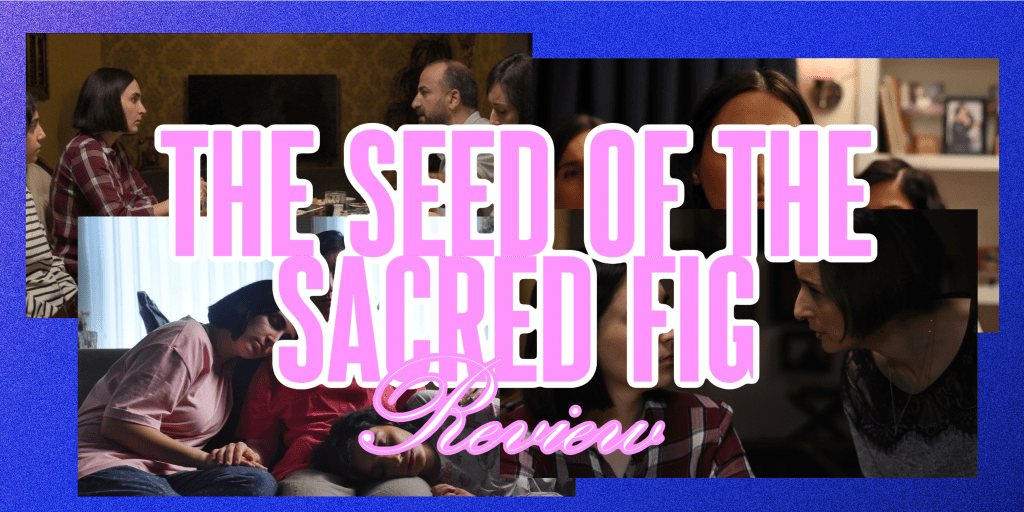
A defining film of bravery and the power art has in times of unrest, The Seed of the Sacred Fig focuses on the universal foundation of the family dynamic in the most severe circumstances.
Following Iman (Misagh Zare), the patriarch of the family who has just been promoted to judge in the Islamic Revolutionary Court, a role that requires complete secrecy. He is required to carry a gun around at all times and signs a death sentence without opening the file. His wife Najmeh (Mahsa Rostami) is the connecting force to keep tranquility in the home between Iman and his young daughters Resvan (Mahsa Rostami) and Sana (Setareh Maleki) amid protests in Tehran for a youth movement ignited by the death of Masha Amini. Iman’s paranoia drips into his personal life as events occur that could risk the safety of the family.
The Seed of the Sacred Fig poses the question of who can be trusted. In a nuclear picture-perfect family, it’s taught how family is everything and will accept you no matter what. For this family function in an absolutist rule country, a divide erupts on what can and can’t be shared. This family can’t be open with one another as they have to be careful with what they tell them because at any point it can be flipped on them. Rezvan and Sana’s sinister bond is enhanced through doomscrolling and eye-rolls giving the full Gen Z aura that could easily resonate with younger audiences being in similar spaces with their parents. Though they share this bond when Iman’s work gun goes missing there is a crack in the relationship as it hits that they can’t even trust each other in their shared room.
Distrust grows as the family dynamic changes to Iman’s torture tactics to his always guilty suspects. The daughters knowing their parents as parents and the parents knowing each other as people before and after parenthood, the many layers that go into crafting a fleshed-out humanistic portrayal of a family runs so deep to twist the metaphorical knife as things get more tense. Iman goes as far as ripping out the family’s happy memories recorded on a camcorder to use the same device to interrogate his wife as a stranger. His hardship to understand the decisions his daughters make like wanting blue hair emphasizes his distance from the family. Thinking he is keeping them safe by dragging them the the outskirts of an empty town with no cellphones or no one aware of where they are causes more harm than what would be if they stayed home. He thinks only on impulses to protect himself because that to him means he is protecting his family.
Iman is not explicitly all evil, he is written as having many dimensions making his manic state interesting to navigate as it becomes alarmingly aggressive. This one man is not the reason for the entire authoritarian regime of Iran for all blame to be placed on him. He is simply a cog in the system ordered to follow suit in protecting his credibility above all. Yes, he loves his family but standing in solidarity with the government and god means more for his livelihood. He has grown up in this system as a product that one day will project onto his offspring but as social media and more liberalism have reached the country the great divide begins throwing everything he knew into jeopardy.
What is so evident is the unbreakable bond between mothers and daughters and no matter how rough it gets a mother will always protect the image of a father to their children as long as she can. Najmeh has the trickiest task of keeping both sides happy while never fully indulging in their ideas, a mother is many things both a carer and mediator. She is going through her transition like Iman of what she holds right and wrong versus the traditions of her upbringing. Always showing signs of sympathy for both sides as the family is a strong cultural value with how the man is respected. In public, she stays silent not wanting to undermine his authority but her curiousites take over when husband and wife are alone. She tries to keep up these appearances until Iman reaches a point where her shadowing can no longer support her. Her children have seen the monstrous insides of their father seeing what he prioritizes and the fearful looks when they realize it’s not them as he chases them around empty sandy ruins so far gone from society physically and in his head.
The two young daughters find themselves as bystanders in the protest when one of their friends is injured at a protest by the police. Their father, with the belief this young woman is the problem and not the police where the daughters want to do anything they can to help their friend, puts Najmeh at the center to please both her husband and her daughters, helping the young girl stitch up her face and then quickly leave their home. This young woman was doing as she expected being at school following the rules till getting caught up in a crowd and suddenly getting a mark on her back by the government as a possible aggressor. They don’t see a woman being beaten as a systemic issue in society but as a confession to being guilty of not following orders. The inclusion of the friend paints the picture of how this could happen to anyone even their daughters and even if she wasn’t set on being a target it was the time and place she found herself in. These violent acts can happen to anything whether they are provoked or not and as it gets closer to someone it becomes a harsh reality that no one is safe.
The three different perspectives of the generational divide between Iman, his daughters, and his wife, He is a cog in the Iranian government believing everything he has been told at his job. He is in a tough spot of having to obey the new responsibility where one slip up like a missing gun could get him in deep trouble. On the other hand, his wife who has been at his side for most of the film until she sees signs herself gets her information from the propaganda on the news and her husband’s stress from work. Knowing the stakes of his role impacting their family. As for the daughters, the younger generation living this new reality of uprising and protesting where people their age are being villainized for freedom see it all in a first-hand perspective exchanged with the tool of a cell phone. Any family of differing ideologies has gone through a family meal where a disagreement has come up as the older generation tells the younger generation they are foolish and don’t understand what is happening the younger generation responds with stats and examples that poke holes in the sentiment quickly dismissed by the older figures.
Given the context of how this was filmed in secret miraculously adds to the rising tightness of the story. Camped out in the solemn family apartment with closed blinds only peeking into the outside through phones. The world is constantly trying to force its way in through their door whether the news or the young girl, they can’t hide from what is occurring around them to Iman’s dismay. They are positioned exactly in the middle of it all and the way they move when they do go out is swift with no other bodies around always watching to make sure they are not being tailed. When Najmeh goes to check on the girl’s injured friend’s whereabouts at any moment it feels like she will be caught. The closing effect on the environment mirrors the constraints of being in this society when one must move with no attention to avoid getting in the crosshairs or worse being caught at the wrong place at the right time. Anything is on the table to occur and the film makes that a point.
Seamlessly, the film shifts into one of horror, something a horror film would sure be inspired by in the end. A family is ousted to the edge of society when its spherical figure goes mad and locks the women up with one escaping to try to pull the father out to rescuee the other two. It’s watching the horrors the government is doing to its women being replicated in a family unit seeing them as vigilantes instead of his daughter and wife. On top of a generational divide, it’s a gender divide of women coming together to protect the last freedom they have. An ominous nighttime sequence into the sunrise of a dusty maze as only footsteps make up the nose not knowing whose belongs to who and what is coming around the corner. It’s horrifying to see all this happen in a modern-day society where cell phones exist and the hope that people will know wrong from right. Allowing someone to be able to whisk their family into danger in complete exile is daunting as the worst floods into the minds of those watching. The film shows it’s not holding back on these harsh realities, so why wouldn’t it go all the way?
Rasoulouf risked so his life and safety in order to push the limits of what the camera can capture for an impactful example of the intersection between film and politics that the world should know.
Grade: A
Oscars Prospects:
Likely: Best International Feature
Should be Considered: Best Director, Best Original Screenplay, Best Editing, Best Supporting Actress (Setareh Maleki)
Where to Watch: In Select Theaters
Jillian Chilingerian
she/her @JillianChili
Lives in LA. Loves Iced Americanos and slow burns.
Favorite Director: David Fincher
Sign: Leo




 offscreencentral.com
Leave a reply to ‘The Seed of the Sacred Fig’ – Interview with Editor Andrew Bird Cancel reply