
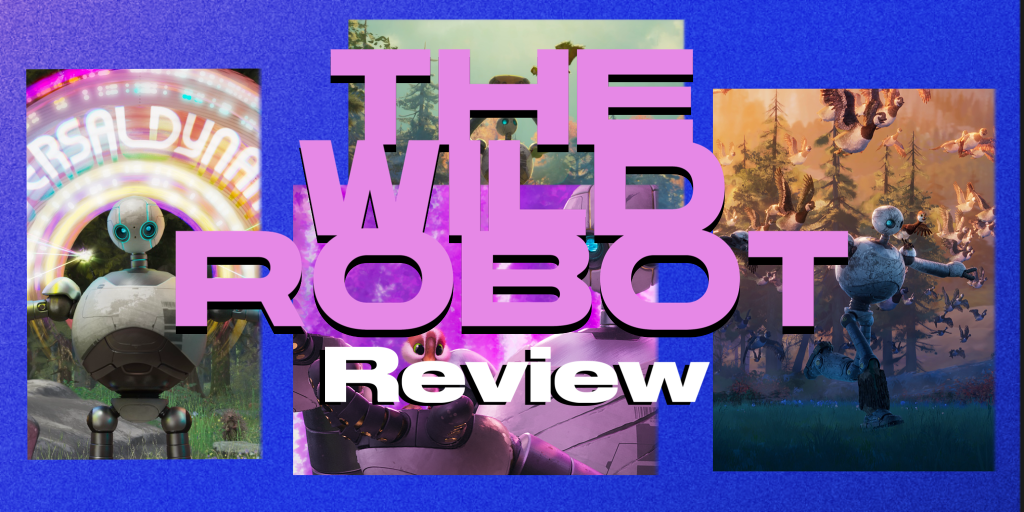
A testament to kindness, The Wild Robot is a sophisticated soliloquy of lush layers and aural awakenings that will make you want to hug your mother and tell her ‘I love you.’
ROZZUM unit 7134 has washed ashore on an uninhabited island. There is no trace of who bought her so she clumsily stumbles across the beach until an oncoming wave forces her to quickly adapt to walk up the mountain like the island’s crabs, the first of her many survival tactics to come. The robot only equipped with the knowledge of “always complete its task, just ask” disrupts the everyday routine of the island’s wildlife, causing her to earn the label of a monster. Roz’s genuine curiosity in her new space sadly leads to the crushing of a Goose and its many unhatched goslings with one singular egg left that Roz is now tasked with helping grow.
Roz’s overindulgence in serving leads to more harm than help as she becomes a pariah on the island. Not understanding her sudden isolation from the rest of the wildlife as they continue with their predator versus prey genetic predispositions, Roz finds acceptance from orphaned Brightbill and enemy-turned-friend Fink. With no programming to love, Roz must open her mechanical heart and wires to the terrifying yet rewarding task of motherhood to best prepare Brightbill for life as a goose before the fall migration. In return for instilling survival skills like eating, swimming, and flying, Roz learns how to love.
The Wild Robot heeds the themes of found family mostly seen in the filmography of Chris Sanders making this adaptation another signature addition to his cinematic universe. Roz and Brightbill are both coming up in an environment so strict on how one must behave based on their genetics and how that impacts who they can be seen with. Roz labeled as the island weirdo immediately marks anyone that comes around her as also being different. Brightbill noticeably the runt of his gaggle worsens his island reputation even more by associating himself with Roz and taking on some of her robotic mechanisms to “process” the other animals around him. Though they are of different species there is something that brings them together in their care for one another along with Fink, another outsider, when they are three magnetically brought into each other’s lives for a reason it allows them to better survive in life when not alone.
Using animals to depict ideologies often associated with humans like nature versus nature positions it in the context of the life cycle that doesn’t guarantee survival but the tools to live another day. Roz and Brightbill represent two different species with Roz lacking the common knowledge to pass down onto the young goslign for him to fit through life as expected. She understands the mechanisms of swimming, eating, and flying, but it’s the journey of how to do each that is where she is stumped and must bring in outside influence to complete her task. Roz, the overzealous helper, has her limitations in what she can achieve and it’s a part of her learning and those of a parent who does all they can for the success of their child. Roz puts her health below the wellbeing of Brightbill as her programming malfunctions from robot to human so that mothers will do what they need to and sacrifice whatever for their child. What Roz lacks in similar genetic makeup to Brightbill she makes up for in the ability to teach kindness.
Sander’s film never shies away from the reality of not surviving, pretty early on when Roz takes out Brightbills’s mother her lifeless body sprawls across the debris. Even the robots meet fatal fates with the massacre of their bodies post-shipwreck spread through the beach as Roz discovers she was never alone. This world understands the nature of life as people, animals, and even robots must be trained to make it through. This added urgency of time passing makes Brightbill’s story more compelling seeing him put in the work to be accepted by the gaggle of Goose’s prepping for their yearly migration. Though he has a different upbringing, Brightbill can still do all that was expected of his species even if he learned it differently and in a smaller-than-normal body.
What Roz teaches Brightbill and the rest of the animals might be the hardest skill: Kindness. She is often mocked for her method of kindness but when conditions get harsh and lives are at stake the other animals that once rejected her finally come around to what she has been advocating the entire time. The warm voice of Lupita Nyong’o activates Roz’s brightened optimism which develops over time into something close to human as she becomes more flesh and bones. Nyong’o is called to voice a robot featuring no expression except for her two round eyes that communicate everything needed to the audience. Changing colors as they zoom in and out like a camera lens, when Roz becomes softer in her insides eliciting emotion that a robot is not normally capable of. Her fears, worries, and anxieties as a new mother are laced in her speech patterns hearing her grit get worn down but continuing the strong fight to finish with a successful customer. Her hard, perfectly polished exterior wears down as life has its dance with her and she learns what the meaning is through her task of keeping Brightbill alive. In her moments of distress, she musters up the power backed by the support of her animal friends to fulfill her calling that she is where she needs to be in a tearjerking sequence of declaring “a wild robot”
The film’s emotionality is elevated by its breathtaking animation which is evidence of its animator’s appreciation for the natural world. A world untouched by humans and technology, free from drilling and digging. Diving into experimental animation has been Dreamwork’s recent motto and it continues here with apparent influence from Studio Ghibli and early Disney films in its designs. Swooping through the different seasons of the year from the summer sunsets to sepia leaves in autumn and the blistering cold of the winter season. The seasons travel from the screen invoking sensations of chill and breezes as their animation signals the proper human response to watching these environments onscreen.
There is not a need to make it as realistic as possible but a serene haven housing a field for the animal residents to play catch the prey and hide from their predators. Strokes of paint brushes illuminate the grass and winged goose in flight mixed with Kris Bower’s colorful soundscape that taps into the wavelengths of the brain in the exact right spot to emit emotion. The characters are vividly drawn crafting a bond between our protagonist and the viewers to add an extra layer of security on the safety of young Brightbill as he treks into the unknown of life.
The perfect enchanting entry into Dreamwork’s rich filmography, The Wild Robot is a lovable reminder of the importance of community and finding where you belong.
Grade: A
Oscars Prospects:
Likely: Best Animated Feature
Should be Considered: Best Original Score, Best Adapted Screenplay
Release Date: September 27, 2024
Where to Watch: In Theaters
Jillian Chilingerian
she/her @JillianChili
Lives in LA. Loves Iced Americanos and slow burns.
Favorite Director: David Fincher
Sign: Leo

 offscreencentral.com
Leave a reply to Our Favorite 2025 Academy Award Nominations Cancel reply