
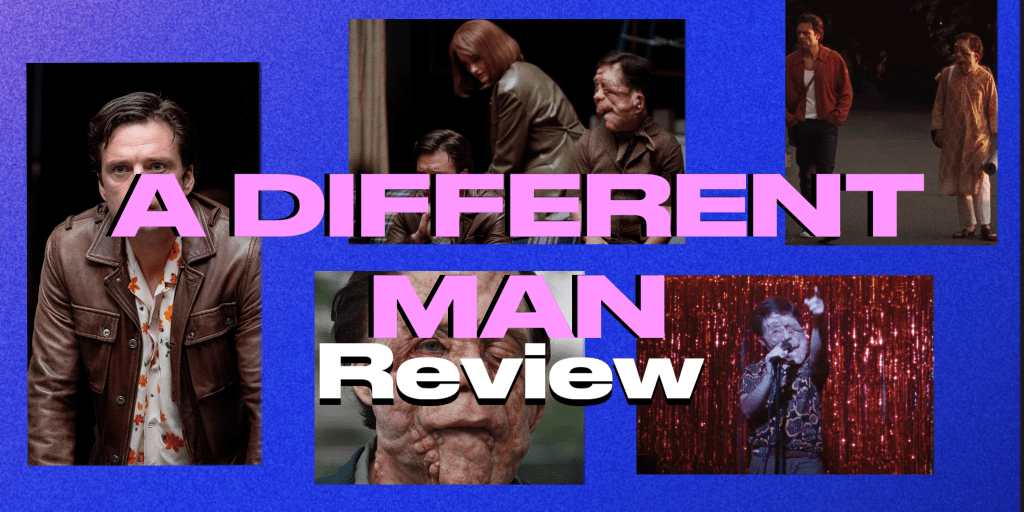
Aaron Schimberg’s film is a twisty fable on self-identity, complicit behaviors within society, and the yearning to belong. A Different Man explores how societal norms can drive anyone to the brink of manic behavior, but is that something we can control? Sebastian Stan has never been better, and the world deserves more performances from him that show the range he has. Beauty can just be skin-deep, A Different Man shows us just what looms underneath and asks the audience if we are intentional in our behaviors tied to how the public sees us or how we see ourselves.
Desiring a change in our physical appearance is something most, if not all, of us feel throughout life. A Different Man uses this to explore how no matter what physical changes we make, we’re still the same person inside. This theme has been covered in countless films, but there’s something so complicated, smart, and dark about the way Aaron Schimberg examines the notion of social conditioning impacting how we view ourselves. Quite literally, Edward (Sebastian Stan) sheds his skin to reveal a new face, but on the inside, he’s the same insecure, awkward person.
A Different Man is a blend of a dark comedy, body horror, and a bit of a romance. Schimberg balances these different genres to create a complicated yet smart film asking audiences to reconsider not only what they know about themselves but those around them. A Different Man never goes exactly where you think it’s going as there’s always an interruption and the film takes you somewhere else entirely, in the best possible way. Schimberg frames the story of the film as an almost house of mirrors.
The film follows Edward, who has neurofibromatosis, which has caused non-cancerous tumors to grow around the tissue inside his face. The focus of the film is not his appearance, but how Edward treats not only himself but everyone around him. Edward works as an actor, but his only work is appearing in HR videos for offices full of catchphrases meant to be inspirational but clearly are having the opposite effect on Edward. As he arrives home, his landlord gives him another inspirational quote, but this time from Lady Gaga, “All unhappiness in life comes from not accepting what it is.” Edward hopes to shut down and lock himself in his apartment until a new disruption appears at his door, but in the form of a new neighbor, Ingrid (Renate Reinsve).
He’s immediately attracted to her and while they form a very close friendship, Schimberg lets us in on the psyche of Edward constantly telling himself she could never be attracted to him. As Edward constantly holds back despite their friendship growing more and more intimate, he sees Ingrid have many suitors come in and out of her apartment, as single people do. He not only yearns to be one of those men but to have that situation for himself. He can’t stop thinking if Ingrid just doesn’t see him that way or maybe she does and she’s denying herself because of the social conditioning of how it would ‘look’ to others. With impeccable timing, Edward’s doctor tells him there’s a new cutting-edge medicine that could reverse his condition. A Different Man shifts genres again and slightly becomes a bit of sci-fi with notes of body horror as Edward takes the experimental drug and quite literally sheds his skin. Stan delivers the performance of his career in these moments as Edward is in physical pain, processing emotional trauma, and is just confused as to what is happening as he quite literally rips his own skin off his face. The make-up work from Mike Marino is out of this world. Not only does the make-up look so incredibly real as it represents what neurofibromatosis causes to the skin, but we watch the prosthetics be ripped apart by Stan and the texture is just so realistic that it’s not for the weak stomached. As he sheds his skin, it’s revealed this whole time Edward was actually one of the most traditionally handsome men of all time.
As Edward disappears, he fakes his own death and becomes ‘Guy,’ the titular different man if you will. Looking like Stan clearly has its perks as we cut to the future and Guy is a successful real estate agent and has the parading casual hook-ups he yearned for before. So why isn’t Guy happy? As Guy learns Ingrid wrote a play about him, Edward, he can’t stop himself from auditioning. Ingrid is insistent on finding an actor who has the physical attributes of Edward, but Guy gets through to her and he lands the part. The script itself asks, “do you cast someone with a condition even though it’s not the right fit?” A Different Man takes the conversation regarding casting consciously and appropriately and brings into not just the theme of the film but the plot itself. It’s not even simply asking the question if this is wrong to cast him without the attributes of the character he’s portraying. The film is looking into the soul of Edward, what is his core identity now that he’s ‘Guy?’
In comes Oswald (Adam Pearson), who actually has neurofibromatosis, just like Edward. Oswald is the complete opposite of Edward, he’s outgoing, he’s loud, he’s funny, he’s charismatic, and he’d beloved by all he meets. Oswald is the life of the party. Edward chose to live in hiding basically. He worked, went home, and made no friends until Ingrid. He avoided all human contact and interaction because he felt he had to. What of that was from society telling him his whole life he needed to? How much of that was internal and from his own mind? Schimberg’s screenplay presents these questions for the audience but never answers them. It’s not forcing us to be complicit but to reckon with our behaviors, our thoughts, and our actions.
The rest of the plot is better experienced, but A Different Man becomes an almost Charlie Kaufman-esque film as it dives into identity and performance or attraction and revulsion. The writer/director explores an interesting aspect that is unique to the character of Edward as he felt avoided most of his life, people actively avoiding him, yet then when he transforms, he knows what it’s like to be ogled for the exact same reason, his appearance. The exploration of beauty and how it is perceived by others is not only a common theme throughout many films but especially this year.
The cinematography is breathtaking as it was shot on beautiful 16 MM by Wyatt Garfield that provides a lived-in texture to the grainy world of New York Schimberg captures. It feels suffocating and isolated at times but also full of life, especially when Oswald is in the picture. Garfield and Schimberg deliver an essential New York film with how they capture the city. Umberto Smerilli composed one of the best scores of the year as it’s striking and reflects the ever-changing tone, and genre shifts throughout the film.
A Different Man is a transcendent experience because of the performances. Stan delivers not only just career-best work but one of the best performances of the year. The prosthetics never bog down the emotion he gets out as Edward and he becomes Guy, he carries the same posture and physical performance as Edward while making a clear distinction of a new confidence Guy wants to have. There’s an imposter syndrome carried through Stan’s eyes and body language as he looks like Guy but is still Edward confused as to how to operate in the world. Reinsve evolves throughout the film as Ingrid’s motivations become more and more clear. She ranges from manic pixie girl to confused woman navigating her feelings to maybe a monster. She brings such a trustworthiness approach as she slowly becomes someone else entirely. Reinsve makes Ingrid a woman we all know, and maybe like at times, and she transforms her with her body language and natural charisma. There is not enough to say about Pearson and his performance. He is so unbelievably radiant as his confidence dominates the screen and not just through how Oswald is written, but Pearson’s own screen presence. He brings such an inquisitive, dazzling light to the screen and creates Oswald as a man you understand why everyone wants to be around him. The chemistry between all three actors is electric. Each of them delivers amazing performances on their own but as a trio or each as a pair are perfection.
Schimberg’s film is a twisty fable on self-identity, complicit behaviors within society, and the yearning to belong. A Different Man explores how societal norms can drive anyone to the brink of manic behavior, but is that something we can control? Stan has never been better, and the world deserves more performances from him that show the range he has. Beauty can just be skin-deep, A Different Man shows us just what looms underneath and asks the audience if we are intentional in our behaviors tied to how the public sees us or how we see ourselves.
Grade: A
Oscars Prospects:
Likely: None
Should be Considered: Best Lead Actor (Sebastian Stan), Best Make-up & Hairstyling, Best Supporting Actress (Adam Pearson), Best Original Screenplay, Best Original Score
Release Date: September 20, 2024
Where to Watch: In Select Theaters

Kenzie Vanunu
she/her @kenzvanunu
Lives in LA. Misses Arclight, loves iced vanilla coffees.
Favorite Director: David Cronenberg
Sign: Capricorn





 offscreencentral.com
Leave a reply to Kenzie’s Top Ten Films of 2024 Cancel reply