
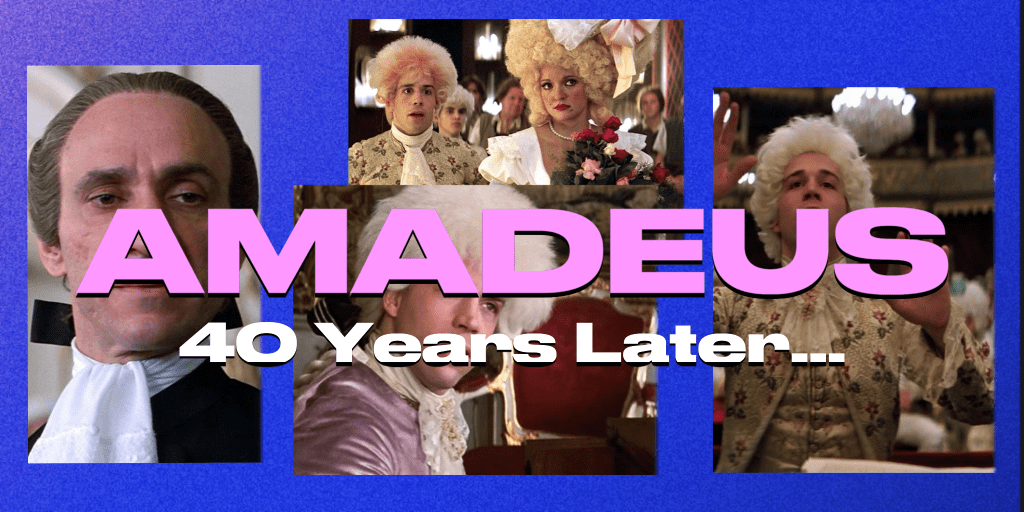
There comes a point in every instrumentalist’s life where they are introduced to the immortal name, Wolfgang Amadeus Mozart. Likewise, for any movie buff, one usually comes across the film Amadeus. Released in 1984, director Miloš Forman managed to create a masterpiece that showcases the genius and often tragic life of the composer in one of the largest and lavish period films captured on camera. For myself, as someone classically trained on clarinet and a self-proclaimed cinephile, it should come as no surprise that this film holds a special place in my home.
Based on the play of the same name by Peter Shaffer, which in turn was inspired by the 1830 play, Mozart and Salieri, by Alexander Pushkin, Amadeus follows the fictionalized rivalry between the historic composer (played here by Tom Hulce) and Italian composer, Antonio Salieri (F. Murray Abraham) while working at the court of Joseph II, Holy Roman Emperor.
Salieri is an average composer with a superiority complex larger than the largest opera house in Vienna. However, despite his monotonous talent, he’s able to recognize the greatness of Mozart. Similar to any band or orchestra kid that feels intimidated by a younger player who is seemingly able to learn new passages with ease, Salieri cannot believe how young, salacious, and silly his hero is. A devout Catholic, Salieri refuses to accept the possibility that God would instill in him such passion for music with little success yet bless such an immature young man with virtuoso talent and popularity. Furious, he vows revenge on God by doing whatever it takes to sabotage Mozart.
Spanning across multiple decades beginning in the late 18th century allows the massive scale of the production design and gorgeous costumes to really shine. Not to mention, the variety of wigs used for each character is enough for any viewer to be amazed. The film is shot on location in Prague, with the city even granting permission for scenes to be filmed in the iconic Estates Theatre where Mozart’s Operas Don Giovanni and La clemenza di Tito (I had the honor of playing 2nd clarinet and 1st clarinet respectfully in the orchestra pit for both!) made their debuts.
Like the production, the acting is perfectly sublime. Hulce is delightful and heartbreaking as the titular composer. Having taken multiple Music History courses during my undergraduate and graduate studies, not only was Mozart’s compositions deeply taught, but so was how his personality and upbringing influenced his work. Within the classical music world, it is widely known that he had a very…peculiar personality. Hulce’s portrayal is likely the most accurate we have of Mozart. With his mad-hatter-like laugh and intense focus on composing everything he hears, it’s a delight to watch. F. Murray Abraham became the first actor of Middle Eastern descent to win an Academy Award for acting yet is largely forgotten about by even the most devout Oscar fans. A shame considering how nuanced, layered, and incredible he is in this film. From the beginning, the audience is tempted to believe that Salieri was the one responsible for Mozart’s early death, yet through Abraham’s performance we still want to see him win while simultaneously wishing for his downfall. It is one of the most captivating portrayals of envy, humiliation, and selfishness on film.
Perhaps one of the film’s most underrated aspects is how the use of the music helps further the story. It is well documented that Mozart claimed to hear all his works in his head prior to writing them down. There are a multitude of shots where we hear the music in full while he’s composing. It’s a small gesture but a great glimpse into one of the greatest minds of classical music. As a clarinetist, I also appreciated the touch of having the musicians on camera holding, what appeared to be, a variation of the clarinet that would have been used at the time. There were discrepancies within the audio that was playing and what we were seeing on camera as the clarinet heard in the audio was what we know of the instrument today, but the composer was fond of an earlier variation called the basset horn, which produces a deeper sound almost similar to a modern bass clarinet. Am I aware that most non-classical musicians will not notice something so trivial? Yes, of course. Did watching this film bring back the many memories I have of the countless hours I spent studying and practicing Mozart’s works I was assigned in school? Absolutely.
Amadeus is fun, hilarious, and suspenseful even film on the grandest of scales. Stuffed with beautiful music, historic sets and costumes, religious subtext, a murder subplot, and humor that ranges from subtle to raunchy. Amadeus is a now 40-year-old film that, like Mozart’s work, has aged beautifully. Hopefully, the more people revisit this film, the more they will demand films about other well-known composers!


 offscreencentral.com
Leave a reply to Kourtney Cancel reply