
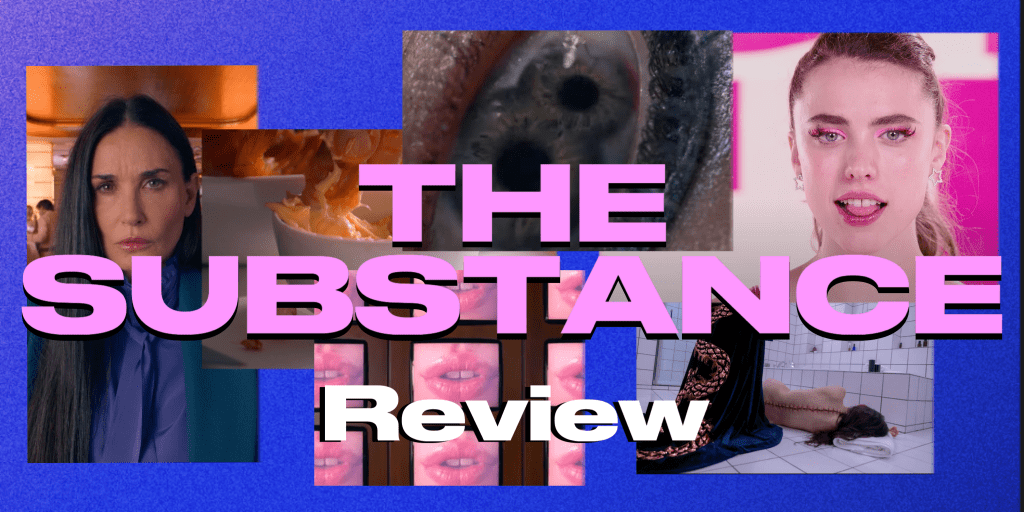
Coralie Fargeat’s The Substance is the defining film on the female experience. Fargeat truly captures the anger that eventually comes from the self-loathing strictly due to the way society forces women to think their beauty and youth define their worth. The Substance exceeds all expectations you may have headed in as this is truly the most fucked up film of the decade with the performance of a lifetime from Demi Moore.
In a post #MeToo world, the discussion of how people, society, and the entertainment industry not only treat women but consume their work has become some sort of a never-ending cycle but finally a movie nails the rage and sadness consuming women as they maneuver society’s expectations of them. The Substance may be easy to dismiss for some with how unsubtle it all is from the over-the-top performances, exaggerated production design, and pulsating score, but every part of this film’s ‘in-your-face-ness’ is on purpose as it finds a liberation within all of the excess thrown on screen. If you’re uncomfortable, this movie may be about you.
The Substance leans into what Fargeat does best; taking tropes and metaphors audiences already know and maximizing them to transform them into something deeper. She never holds back on the satirical yet gruesome themes as the film evolves into something you could never explain. Fargeat truly captures the anger that eventually comes from the self-loathing strictly due to the way society forces women to think their beauty and youth define their worth. The Substance exceeds all expectations you may have headed in as this is truly the most fucked up film of the decade.
Fargeat’s film follows an award-winning actress Elisabeth Sparkle (Demi Moore) in her post-peak era as she’s now the host of a fitness television show. She soon overhears her boss Harvey (Dennis Quaid) discussing her fate as he bullishly says she’s aged out and he needs someone younger, hotter, better. The verbiage used here is something many women have feared as discussed about them or even overheard themselves. Eventually, Elisabeth is fired, and she knows deep down it’s because of her age and she’s no longer of value, not just to Harvey but to the network and its viewers; society no longer finds her desirable. As she heads home, she’s not just upset, she’s fuming and gets into a car accident as she’s distracted. Once in the emergency room, she learns of a mysterious, black-market drug simply known as ‘The Substance.’ The drug promises to create the ‘best version’ of yourself, which we all know is code for younger, hotter, sexier. Once you take ‘The Substance,’ you have seven days as the younger you and seven days as the older you. The instructions are vague, but one thing is certain: there are not two people, you are one. As Elisabeth embarks on her journey with ‘The Substance,’ Sue (Margaret Qualley) is born as another version of Elisabeth.
The Substance acts as a bloodcurdling scream about society’s impositions and unforgiving expectations put onto women. The frustration women experience attempting to achieve and maintain beauty we’re conditioned to uphold in order to receive validation from those around us. There’s both a fear and a lust Fargeat captures as Elisabeth explores balancing seven days in her true form and seven days in the form of Sue. As we spend time with Sue, it becomes clear she’s in no hurry to return to her aging form in Elisabeth. She’s the new ‘it girl’ in town and very booked & busy. Fargeat and Benjamin Kračun, the director of photography, capture Sue and Elisabeth slightly differently. Elisabeth is often in the dark, with an uneasiness that builds upon Elisabeth’s palpable anger and self-loathing. The manner in which Elisbaeth is captured shows she’s always recuperating in order for Sue to go out and live it up; her existence is simply to supply Sue with what she needs. Sue represents the fantasy, not just of society’s lust for younger women, but Elisabeth’s memory of what once was that drives her self-hatred. Sue is never in the dark, always lit in an almost candy-coated coloring in bright backgrounds. Often in playful, girly colors, everything on Sue is exaggerated including fake boobs and a wide lens to intensify her feminine features. An embellished scene of drinking a Diet Coke becomes entirely erotic with the intense angles used and performance from Qualley. The objectification in which Sue is filmed is quite literally the point Fargeat is making. We, the audience, can be just as responsible as the cartoonishly evil men in the film if you end up preferring the time spent with Sue.
As the film goes on, it becomes clear there’s a message about accepting what you already have. Following some ‘misuse of The Substance,’ Elisabeth begins to long where she started before Sue came out of her (literally). Fargeat explores the defeat in chasing something that ‘is better’ when in reality you already have what you need. It’s so easy as an outsider watching Elisabeth to think she’s perfect the way she is, but everyone knows how easy it is to be at your ‘peak’ and still longing for something more. There is always something you want that you don’t have and this pining for perfection becomes a self-inflicted abuse on your body and mind. Many will feel sick to their stomachs over the grotesque imagery of body horror throughout the film, but the truly sickening part is how Fargeat brings to the screen the self-loathing and hatred aging women feel due to society’s impositions and vision of what women should look and act like.
Fargeat smartly frames the film effortlessly to fit the narrative of any woman, not just a woman in the entertainment industry. While women in the industry have the layered negative of experiencing the demoralization from the same people who consume their work and celebrity, The Substance accentuates all women feel this way. There’s always someone younger, more beautiful appealing to the masses. Something no one prepared me for with my first viewing was just how sad the film is. There are times it’s absolutely heartbreaking to watch what Elisabeth is going through. An interesting angle to the film is not female camaraderie but what the absence of it does to someone. Sue is surrounded by people, agents, managers, her boss, friends, and random hook ups, but Elisabeth is always alone and isolated. Sue’s relationships are entirely transactional and contingent on her offering to society. As soon as she’s not deemed ‘perfect,’ no one is there for her. Elisabeth being entirely alone and isolated stems from her true younger self fixating on relationships that only wanted the exterior of her, not who she truly was. With both Sue and Elisabeth at odds with each other throughout the film, The Substance plays even further into exploring female friendships as they’ll do anything to destroy each other despite needing each other to survive. For decades, women have been programmed to think of one another as the enemy instead of working together and there’s an interesting angle to look at Fargeat’s screenplay that shows how young girls are conditioned to navigate relationships of any kind with other women.
Body horror is much more than a genre to women as we experience some sort of body trauma throughout our lives as we get our menstrual cycles to giving birth, there’s a cycle of pain inflicted on our bodies and instead of being celebrated for being resilient, women are typically scrutinized for their bodies and our inevitable aging. Fargeat bottles the anger and sadness that comes with this and captures how our very existence not just forces us to view the world differently than our male counterparts but how women are conditioned to navigate different sections of their lives.
The entire film is actually heartbreaking when you get to the center of the bitterness, anger, and self-loathing many women (me included) feel as they age. While you resent the men for their nonconsensual advances and their judgements based on your appearance, there’s a sadness in knowing you’re no longer something deemed desirable by society at large. The societal fetishization of youth breaks you down no matter how confident or beautiful you are. In a devastating scene, Elisabeth, feeling depressed after spending her seven days in her body in the dark after seeing all the fun Sue gets up to, makes a desperate decision and calls a former high school sweet, but nerdy classmate. She had taken his number to be polite and truly had no intention of calling, but her loneliness takes over; she wants to prove to herself she still has something to offer, she can still be desired. Elisabeth puts on a sexy, yet ‘age appropriate’ kind of sexy dress for their date, that he’s all too excited for. She puts on the perfect make up and does her hair the best you can imagine. When she looks in the mirror ready to head out, it’s not just that we the audience love how she looks, you can see Elisabeth loves what she sees too. That is until she catches a glimpse of a billboard of Sue outside her apartment window. Her perfect body, her bouncy skin, and youthful appearance make Elisabeth doubt herself. She heads back to the mirror, but this time, she hates what she sees. She attempts to add more make up, fixes her outfit, and redoes her hair, only to hate it more. She keeps adding to the look, putting on more make up and by the time she thinks she’s ready, you can feel the hatred fuming off of her. She hates what she sees. She feels defeated, unwanted, and furious at herself, so much that she can’t bring herself to leave for the date. She falls in her bed, ignoring the texts of a man who yearns for her company, and I just know so many women watching has felt this exact amount of self-loathing after experiencing something similar. Fargeat is bringing a reckoning to the screen of facing your own insecurities head on and in a film that everyone finds so disturbing, it’s one of the most human, relatable stories of the year.
Moore delivers the performance of a lifetime in The Substance. The film only works as well as it does with someone delivering a go-for-broke performance that fires on all cylinders and she knocks it out of the park. There’s a meta to seeing Moore in a film with so much nudity and a camera lingering on her body for so long after so many discussions over the years of her own body and appearance as well as many discussions of her nudity in previous films. Moore brings such an emotional core to Elisbaeth that when the film lingers in its sadness, you want to just reach out and hug her. Moore has always been this good and there are so many layers to the weight of her finally being given a role worthy of her talent. Qualley knows exactly how to play up Sue from vapid to conniving to relatable. When Sue begins to panic, you forget that she’s been bringing harm to Elisabeth because you do feel for Sue just as much, which comes from the masterful way Qualley brings her to life. The Substance rides or dies on the performers operating on the same level as Fargeat’s screenplay and operatic direction and they deliver on every level.
Fargeat uses a bubbly, rich color palette throughout the film but uses it with almost sterilized imagery through both ultra wide-angle shots and close ups. The hyper feminine colors throughout the film contrasting with the bloodiest violence creates a unique experience that feels like a perfect exploration for the multitudes women contain within them. Combining the visual style in front of the camera, the sound work and original score create an ominous, alarming world despite how beautiful it can appear. The production design (Stanislas Reydellet) is perfect as it intensifies the loneliness and over-the-top feeling of the themes of the film. The long corridors, the furniture that feels like you shouldn’t sit on it, and the soon to be iconic bathroom, which acts as the sterile environment for many of the isolating moments for Elisabeth and Sue. The score by Raffertie is one of the best of the year and will be ingrained in your mind even after you leave The Substance. The writer/director never loses her footing in the film; no matter how much is going on or what is being communicated either through the dialogue or actions by the actors. Fargeat delivers the directorial achievement of the year in The Substance. She pushes the audience to get to the same level of anger, frustration, and sadness she’s experiencing.
The Substance is an essential film on what it’s like to be a woman. Fargeat sounds a fiery alarm on the bleak reality of society’s perception of a woman’s worth. What is a woman to not just the entertainment industry but society at large as she is no longer young, beautiful, perfect? There will be many comparisons to other films from any David Cronenberg to Requiem for a Dream to Death Becomes Her to The Picture of Dorian Grey or my own personal opinion would be mother!, but this is entirely a unique vision from Fargeat. The Substance plays a different form of body horror than most films in the genre as the violence is self-inflicted by the hand of Elisabeth. The self-hatred and insecurity are palpable as Fargeat showcases the sadness of how women drown in these feelings driven by how society consumes and throws away women when they no longer look ‘desirable.’
Grade: A+
Oscars Prospects:
Likely: Best Make-up & Hairstyling, Best Sound
Should be Considered: Best Director, Best Lead Actress (Demi Moore), Best Original Screenplay, Best Film Editing, Best Production Design, Best Cinematography, Best Original Score
Release Date: September 20, 2024
Where to Watch: In Theaters

Kenzie Vanunu
she/her @kenzvanunu
Lives in LA. Misses Arclight, loves iced vanilla coffees.
Favorite Director: David Cronenberg
Sign: Capricorn







Leave a Reply