
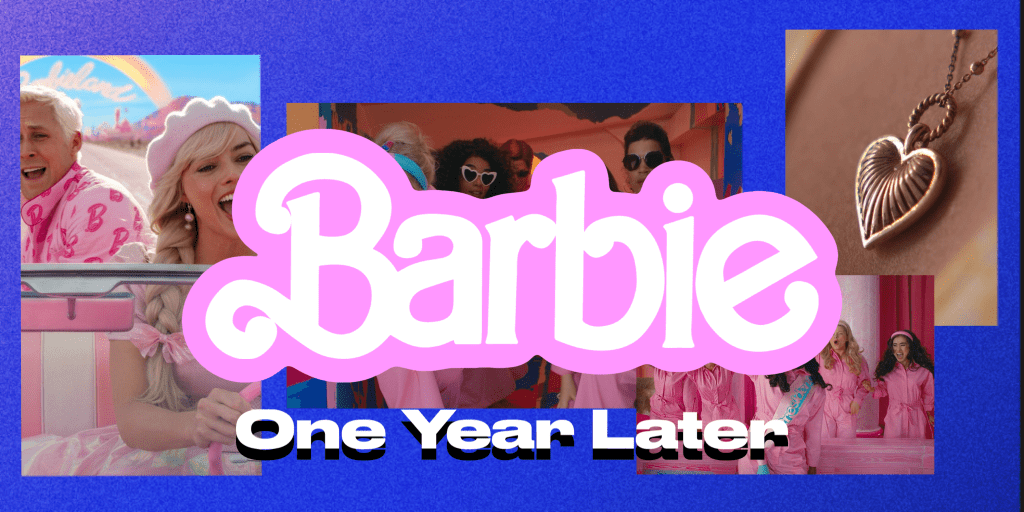
Do you remember seeing Barbie for the first time? I mean, it was simply last year, but a lot has happened. (*Vaguely gestures at never-ending unprecedented times.*) Barbie premiered in the middle of the Writers Guild of America (WGA) strike, and at the beginning of Screen Actors Guild-American Federation of Television and Radio (SAG-AFTRA) strike. But before it would be 2023’s highest grossing film, making almost $1.5 billion worldwide, Barbie was just the latest film from filmmaker Greta Gerwig. Sitting in a sea of pink, the excited buzz in the theater was palpable. Like many, as a fan of both Lady Bird and Little Women, I had extremely high expectations for Barbie. Gerwig is a fantastic filmmaker, but how could she make a movie about a doll?
What Gerwig and her co-writer (and real life partner) Noah Baumbach gave audiences was a revolutionary film. Sure, it is Feminism 101, but considering how many women had the realization their boyfriends sucked and promptly dumped them after this film, the refresher was certainly needed. Barbie explored what it means to understand your own humanness and womanhood. Barbie (Margot Robbie) comes to the real world, a place constricted by patriarchal societal standards, and learns what it means to be a person. Nothing quite like a little existential crisis dressed in neon pink! It is not an easy road to arrive at full self-realization. Barbie, malleable and tenderhearted, comes to see the shades of personhood. “Achy but good” is how she describes her first sense of the real world.
Barbie doesn’t come to the realization of what it means to be a woman in the world on her own. She has the other Barbies, and she has Gloria (America Ferrera) and Sasha (Ariana Greenblatt). She navigates the world with other women, which is more reflective of what happens to women. While our womanhood is completely our own, it is through community with others that help us learn and grow. I saw Barbie many times in theaters. Each time, I saw groups of friends and families laugh and cry together. People I know who rarely go to the movies made a point to see Barbie in theaters. It is hard to capture the feelings you have when you’re in a sold out theater, experiencing a film with an audience. There is nothing like it. It was a collective catharsis in each showing. People getting to see that their messiness, their insecurities are what make them human, and it’s what gives them superpowers. The power to empathize, to care, to be resilient, to be open. That’s what I see in the women of my daily life. And together in that theater, we were able to experience that in community.
The film is magic. It’s weird and funny and thoughtful and heartfelt. What other film has a music number on a plastic beach, a niche joke about fascism, and a powerful monologue about the double standards that come with womanhood? Only Barbie could hold all of those multitudes. Like Gerwig herself, the film wears its heart on its sleeve. In interviews, Gerwig has always said she has wanted to make a film and have the end credits read, “A film by,” then listing every person who worked on the film. She sees filmmaking as a collective art form. And while the technicalities of guilds and unions keep that dream from manifesting, the love she pours into her films radiates. When the Ghost of Ruth Handler (Rhea Perlman) shows Barbie all of the shades of what it means to be a person, we get a montage of home videos. All of these videos were submitted by the cast and crew. It is that kind of personal touch that sets the film apart from others.
Its year since its release, Barbie remains an incredibly important film. Women have always loved films, and we show up for films that get us. I wonder if the success of Barbie will aid in giving opportunities to not just white women, but filmmakers from other underrepresented communities. Filmmakers of color. LGBTQ+ filmmakers. Female and non-binary filmmakers. We witnessed what happens when people feel seen by art. So, maybe this will be the beginning of a paradigm shift that values artists and their unique perspective. Maybe it’s naive to think that, but one can hope. One can hope that perhaps a doll learning what it means to be a person in the world can begin to help others expand their appreciation for others and their humanness.
Some of the reflectiveness is not only about the film but the filmmaker behind the camera. Gerwig has been an actor I’ve followed for years. Before Frances Ha and 20th Century Women, I was watching her mumblecore films like Hannah Takes the Stairs and Indies like Lola Versus. I definitely watched Baghead expecting quirky fun and was shocked it was a straight up horror film. (That’s on me; I should’ve read the synopsis.) As a director, Gerwig knows how to craft a story that balances universal truths with deeply personal touches. Lady Bird, her solo directorial debut, was that ah-ha! moment people have when they see themselves fully reflected in film. “So it’s not weird or shameful that I think this way or feel like this.” She captured girlhood in a way that made precocious insecurity a completely normal mode of operation. With her adaption of Little Women, she expanded upon girlhood and followed a quartet of sisters from adolescence into womanhood, showing how the girls we once were never truly leave us, and how the women we become take care of her.
And then we arrive at her third film. A film that united people in a way that hasn’t been seen since the Kelly Clarkson season of “American Idol.” Barbie takes you on a journey of self-discovery. The film explores the impossible standards must live up to. In her monologue, Gloria denotes the double standards of beauty, being assertive but not too assertive to intimidate men, wanting to be a mom but not talk too much about your own children. She goes on, “You have to never get old, never be rude, never show off, never be selfish, never fall down, never fail, never show fear, never get out of line. It’s too hard! It’s too contradictory and nobody gives you a medal or says thank you!” Gerwig ends her trilogy of girlhood into woman with this opus. A film that pays homage to the works that inspire her while being wholly its own marvelous work of art. A film that challenges our foundational understanding of humanness and existing under the weight of the patriarchy.
Barbie was a phenomenon. One that captured and enchanted audiences. A film which cultivated conversations about society, about the film industry, about our art. A year later, I am in awe of the way in which a film about a toy from my childhood became such a profound work of cinema. I know Barbie will be a film I continue to rewatch. One I will be excited to show friends and family. Share in the joy and empathy, the community and love.


 offscreencentral.com
Leave a reply to Atomic Target Morecambe Cancel reply