
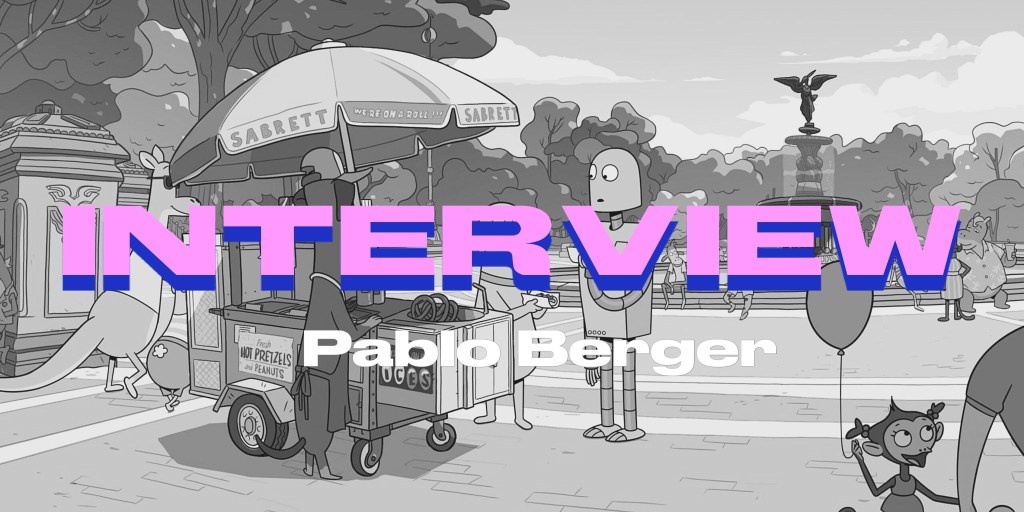
Based on the 2007 graphic novel, void of any dialogue the animated feature, Robot Dreams, fully immerses you into 1980’s New York for a timely tale of loss, memory, and friendship told through a Robot and a Dog. Offscreen Central had the opportunity to talk with Oscar-nominated director/writer Pablo Berger about adapting the graphic novel, recreating his memories of New York, and the emotional use of Earth, Wind, and Fire’s September.
Pablo Berger: Hello Jillian.
Jillian Chilingerian: Hi. So nice to meet you.
Jillian Chilingerian: I was very excited about Oscars morning at 5 am. I audibly gasped and screamed when Robot Dreams was announced for Best Animated Feature. So like, if that was my reaction, I couldn’t imagine what your reaction was.
Pablo Berger: I love to hear what was your reaction. In Spain, it got viral because we had a video camera. At the Oscars luncheon nominees, they included one of Robot Dreams.
Jillian Chilingerian: I caught this at the end of last year and it was the film that I needed. I want to start by knowing that this is a graphic novel. I’m always curious, when people are adapting material, what about it spoke out to you, and were there different elements in the story that you were like, Oh, I want to bring out this theme or make this my own?
Pablo Berger: So I think I had never thought about making an animated film until I found this graphic novel. I started by collecting, I call it graphic novels, I have over 100 of them. So what happened to me is that I’ve read it, I loved it and it became one of my favorites, but I put it on the shelves with my other graphic novels. I made two live-action films so it’s a long, long time later, and one day like this, at this time of the day, I was just having a coffee and I went through the pages again. This time when I got to the end, I was so deeply moved and my eyes were in tears. I was visualizing the film and more than that, I was thinking about all the people that I lost, but they’re still alive because I have memories with them. So I thought about the theme of the film, there are many themes in the film, but for me, the main theme is how memory helps to overcome loss and how people we lose for one reason or the other. If you have memories of them, they’re still with you. If I wanted to tell this story with anthropomorphic characters in an anthropomorphic world I had to make an animated film, but I honestly have never thought about it so I’m lucky that my producers spoil me and they know that they pushed me to go further. My producers were not surprised and five years later and many adventures we are here at the Oscars.
Jillian Chilingerian: I love that you mentioned memory because I feel like that is such a core of it as well as the idea of grief. This film is really special because it doesn’t use dialogue and it reminded me of one of my favorite shows Bojack Horseman with the Fish Out of Water episode. There is so much happening through the music, sounds, and the sites. It is so cool to see how to communicate these ideas without necessarily someone saying I’m sad. So I want to talk about that approach as well of going back to like the detail of it’s not super exaggerated, and you use a lot of like the city and as a character.
Pablo Berger: Many themes that you that you brought in, but we start with this dialogue-free film. So everything has to be read with images, but that’s also something that I love about the idea of making this film is that over 10 years ago, I made a film called Blancanieves that was also wordless and I learned so much with that film. Somehow, doing an animated film, it was something that it was connected to. They were like sister films, but they’re very, very different so that was something that I felt very close to that. I like the idea that a film is like an essence story and experience more than an intellectual experience. I like that the audience watches a film of mine, they kind of dream awake while they’re watching it, and when I talk about emotion, when I started this project I asked myself, what can I bring from the live-action world to the animated world? I love directing actors so I wanted to bring amazing performances to animation, truthful, believable, emotional, and heartbreaking performances so in live action, less is more. That’s kind of like something that just to feel it, you bring it and you only think about the eyes. This is when I’m working with actors in live action, I get next to the camera, and I’m looking at the eyes. So I just did the same working with an animated film. Of course, they had to work with animators, instead, with actors, I had to make a substitution and make actors become animators. In a way, I communicated the same way and I was looking for the same results. The other thing is that you’re talking about the background, the big thing that I brought up making this film, is that the book itself is very, very simple. The design and the characters and the background. We kept the character design. It was an evolution, but definitely, the backgrounds are very, very different. Once I decided that the three main characters in the film were going to be Robot, Dog, and New York, it all clicked. I wanted to make a love letter to New York and New York that has vanished. I live in New York. Dog’s apartment is my last apartment. I fell in love in New York, my heart was broken in New York and I’ve fallen in love again. My friends left the city so there’s an element of nostalgia in this film.
Jillian Chilingerian: We go through each different block of New York and there’s so much attention to detail giving each neighborhood its aura, it does feel nostalgic, but the themes are so timeless. I love that mixture with that nostalgia because it’s a reminder that everyone goes through grief, everyone goes through the memory.
Pablo Berger: I’m happy. Yes, praise all those things, I made it for you.
Jillian Chilingerian: I don’t think I can ever listen to the song September again without crying. In another life, I wish I was a musician because I just love music and it’s how it is used in film. You use different variations of the song September, talk me through the song selection, and then all those different versions.
Pablo Berger: I agree 100%. If I was born again, I think I would have loved to be a musician. I love music. Above anything. I think music touches your motion and feelings right away with three notes. So I love music. All my films are full of music. I would even say Robot Dreams is a musical because the music is present from beginning to end. I work with my music editor Yuko Harami and my closest collaborator since my first film composer Alfonso Villa Yaga. Alfonso has been working with me on my last three films so it’s a very fluid dialogue in Robot Dreams, the music becomes the voice of the characters and we have diegetic and nondiegetic music that appear in the film and they had to be very different songs because New York is a melting pot of races and ethnicities, so we had Latin music, punk rock, and new wave hip hop. The cherry on the top is September from Earth, Wind, and Fire, which is the theme of Robot and Dog. This theme of September, as you said, it’s very difficult to listen again, September if you’ve seen this film, because we give a new twist to the song. If we analyze the lyrics, the lyrics of September start “Do you remember the 21st night of September?” So do you remember that that was the movie about one of the main things and the 21st of September is when my daughter was born. My wife and I will remember the 21st night of September. For a director, films are like our children, and the rest of the music the nondiegetic originals, I worked with Alfonso we just thought that jazz had to be like cool. Jazz is the kind of music that best represents New York.
Jillian Chilingerian: I feel like this has to be added to like, the iconography of staple New York films it’s what I imagine New York to be.
Pablo Berger: In New York there are a lot of street musicians so in our film, there’s this octopus that is drumming. Some musicians in Central Park play steel drums so New York is noisy but there’s also full of music when you get to the streets so we wanted all this music to come in and out in the story in a natural way.
Jillian Chilingerian: When you have those natural sounds that kind of almost can also act as a score and those are my favorite type of movie experiences. Animation as a medium, we’re not necessarily watching humans, but it’s very humanistic. So like, I’m curious about your own experience of exploring animation and how it’s used to kind with these mature themes for such a broad audience, there’s something in the animated films that cut you so hard.
Pablo Berger: Animation is not a genre and our leader is Guillermo del Toro, that’s what he said at the Oscars last year. I met with Guillermo del Toro at the Annecy Film Festival, and we talked for a long time about animation and live-action. He loves and I love animation is that for a live-action director, it opens our mind. We will tell different stories and that’s something fantastic, but we have to make also an effort because traditionally, animation, in general, has been catered to children, and very few times, they deal with adult themes and emotion. Here, we have to look to Japan where the Japanese are so ahead of the rest of the world in terms of animation. Ghibli makes some of the most emotional films I’ve seen in my life, they’re made by the studio. I think there are very few things more emotional than the Graveyard of the Fireflies. I love to create a cinema, I think there’s such a fine line between tears and laughs and I love the tears of joy. Our goal was just to guide the audience to the finale, because for me, the film is the end, if there’s not a strong end, the only reason that I made this film is because I love the end. So I wouldn’t have succeeded if I hadn’t made a strong film that had an emotional catharsis.
Jillian Chilingerian: I can say that I feel that these films can help you in times of need.
Jillian Chilingerian: Thank you so much for this time. Again, I love Robot Dreams and I’m just very excited for more people to see.
Pablo Berger: I feel very honored to have your generous words and your praise. It is a small European and small French Spanish co-production. We are with an independent distributor like Neon and most of the audience they think is just for kids and animation can be for everybody, for adults for cinephiles, and of course, for kids. This film doesn’t want to exclude any audience. We want all kinds of audiences to share the catharsis in the cinema, children and adults together.
Robot Dreams opens in theaters on May 31, 2024.

 offscreencentral.com
Leave a comment