
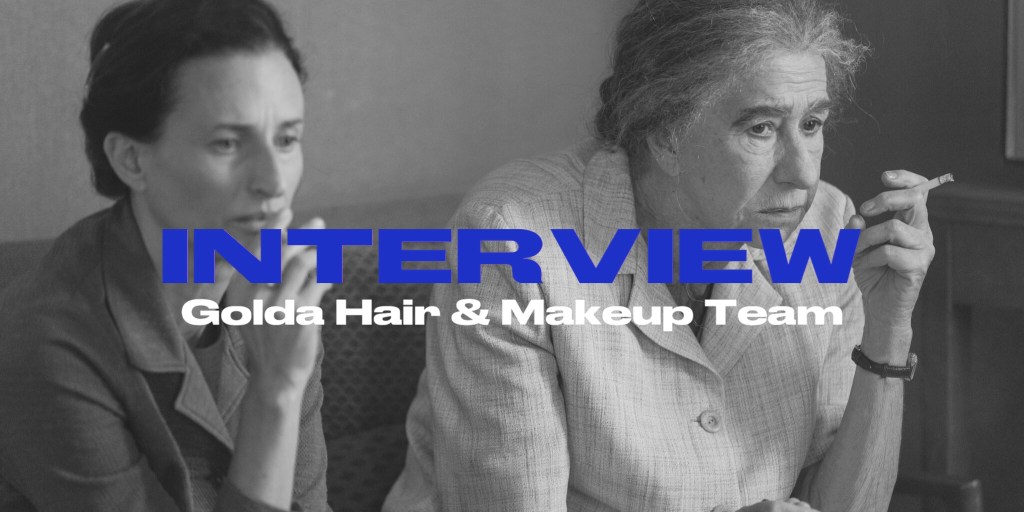
Golda is the story of Golda Meir, the Israeli Prime Minister, during the tense days of the Yom Kippur War in 1973. With the help of makeup, hair, prosthetics, and costumes, Helen Mirren transforms into the leader. She stars in Golda along with Liev Schreiber as Henry Kissinger and Camille Cottin as Lou Kaddar as they bring the snapshot of history to life.
The film, directed by Guy Nattiv and written by Nicholas Martin, premiered on the world stage at the 2023 Berlin International Film Festival (alongside 20,000 Species of Bees) in February of last year. Over Zoom, we spoke with the team that helped make Mirren’s transformation possible. Golda Makeup and Hair Designer Karen Hartley Thomas, Prosthetics Designer Suzi Battersby, and Prosthetic Makeup Artist Ashra Kelly-Blue are Oscar shortlisted for their work on the film and shared some insight into what made their work possible, their short timelines, and, of course, working with the immensely talented Helen Mirren.
Ayla Ruby: So first it’s wonderful to meet you all. I just finished watching the movie again, so I’m very excited to talk to you. And I guess this question is for each of you, can you talk about the moment you found out you were shortlisted? What was that like? Where were you? Anything like that?
Karen Hartley Thomas: I can’t, Suzy?
Suzy Battersby: Yeah. No. Well, I was at home. I think I’d actually just got out the shower. I’m pretty sure I was in my dressing gown. But yeah, when I found out I burst into tears, to be quite honest. I was really overwhelmed. I was so shocked. It’s my first time being shortlisted. So yeah, I was gobsmacked, to be honest with you. And my husband was on a work call, so I had to keep it inside for a while. But I messaged Karen immediately.
Karen Hartley Thomas: Did you tell me? I mean-
Suzy Battersby: I think maybe I did. Maybe, you probably heard from lots of people.
Karen Hartley Thomas: I’m not sure who told me. I don’t know. I’d looked at my phone, that was for the makeup and hair awards, I think. A producer I just worked with in America, she texted me, to say, “Congratulations.” And I said, “What on?” And then she told me, I thought, “Oh, fabulous.” And I think it was Suzy. I looked at my phone, it was Suzy and some of my friends saying, “Oh my gosh, you are on the list.” I was absolutely stunned. And the second one with the BAFTAs, because I looked down at my phone and my friend’s daughter who happened to be working on, said, “Congratulations, you’re on the list.” “Oh, am I?.” I never know when they’re coming out. I never know to look. I forget. I think Suzy, you kept her eye on it a bit better than me. So I’m going to look to Suzy in the future. I didn’t know.
Ashra Kelley Blue: I also had a missed call.
Karen Hartley Thomas: My first thought was definitely, it always is, that we have an amazing team. I’ve got an amazing team that I work with a lot as well. And it’s never just us, is it? It’s everybody. It’s the whole look of it, the whole film. Because I think actually I texted to you Suzy, I think when the BAFTAs, anyone else from Golda, anyone else? And it isn’t, it’s just us. So we carry everybody on our shoulders and are proud to do so. So that’s always my thought. But obviously it’s kind of is overwhelming and very nice to be coming back to Los Angeles, so that’s a big bonus.
Ashra Kelley Blue: Yeah, I had a missed call from Suzy just going, “Mate, mate, check your emails.” And I was just like, I almost just couldn’t believe it. And I think I looked at my emails and I was just like, “Oh my God.” And I think I had to go for a little run around the block because I had too much pent-up energy from hearing the news. But yeah, it’s been crazy.
Ayla Ruby: So again, for all of you, can you talk about how you came onto this project, your reactions to reading the script, why this was so appealing? And I think I read, Karen, that you were on board first and I might be wrong?
Karen Hartley Thomas: Yes, yes. I met up with Guy. It was very much a last-minute thing because I think the funding came in quite late for the film. And my agent phoned me and said, “Do you fancy this job?” And I read it and thought, yes, I do want that job. And then they gave me some time. She wanted to be first or last. And I hate to name-drop, but I was doing a film with Hugh Jackman, and I looked at when the lunch was, 6 to 6:30 or or on nights, and I said, “I can only do 6 to 6:30,” because I like to be with Hugh. So 6 to 6:30 was our lunch break. So that was very fortuitous in the beginning. Otherwise I might not even have been in there for it. Obviously met Guy and got the job. And then I wanted really to speak to Helen as soon as I could because I just had worked with Helen on a film called The Duke.
Ayla Ruby: Which is awesome.
Karen Hartley Thomas: Yeah, thank you. I’m really so proud of that. Helen had to play a dowdy cleaner in that, so that was enough of a challenge. Leave alone prosthetics and playing an iconic character. So I sort of phoned around people. I phoned to see if we could get the wig made in time, eyebrows, everything. I didn’t know Suzy, so I had to go. I phoned up Suzy and she said, “Well, yeah, okay, maybe.” So we thought, yeah. And then I had a chat with Helen and Sinead Kidao, our costume designer who I loved working with. And Helen said, “Well, I’m not really sure about this. I’ve never done this sort of prosthetic thing.” And I thought, “Come on, let’s just try it. Can you get in to do a scan when? Tomorrow.” Suzy had given me somebody to get in touch with in Los Angeles, and she said, “Yeah, okay.” Well we got that done quickly and sent over. So it was kind of hit the ground running really. And it just was Guy, I have to say Guy, I think it hadn’t have been for Guy, we probably wouldn’t have gone as far as we did with everything, but we chatted to Helen and she agreed. So we sort of started it from there. And it was mad. I mean, if we had four weeks, I think I’m being kind. It was just everybody just, we wanted to do something. We wanted to make, sort of create a look that all could be used or some could be used. It could have been just the wig and some pieces, just the wig and the eyebrows, wig and the teeth, which we didn’t use in the end. So it was a matter of we got the job quickly. I got everyone on board, like Suzy and Alex Rouse, who made the wig. Sarah Weatherburn, who did the eyebrows, Chris at Fancy Effects did the teeth. But as I say, we didn’t use those in the end, but I’ve worked with Chris a lot. And then we just sort of worked on getting all the components together and worked towards a test, which we did a week before shooting. So it was an absolutely mad, mad timescale, it was just sort of getting everyone together and seeing what we could come up with.
Ayla Ruby: As far as, so this is, Golda is obviously a very historical figure. How do you approach your research for that?
Karen Hartley Thomas: Well, there’s massive research goes on on something like that. We looked at all of the footage, we looked into everything we could possibly find, myself and Sinead, again. Mood boards everywhere. And also we were very fortunate that Golda’s grandson, who was very, very keen for Helen to play the part, he gave us a lot of info. He told us so much about his grandmother, small details, what her hair would look like when she’d just washed it and left it before she put it into the plaited bun that everybody knows that’s her look. That she had a manicure every week with clear nail varnish. You wouldn’t get those details. So as much as it’s all obviously looking at footage, looking at photographs, it was that information that really did help us as well. And you then have to sort of think, right, okay, that’s the look we want, but we’re doing it on Helen Mirren, who’s a world-famous actress. So it’s bridging the two and marrying the two up so as not to make a caricature look. That’s always what I go, I’m very, very keen on, making everything look as natural as it possibly can. So that although it is a lot of stuff goes on people’s faces, but it’s almost unnoticeable, one hopes.
Ayla Ruby: It was quite a feat too because there were so many close-ups in this movie and there’s so much focus on Helen’s eyes. You would almost expect to see something and it just came, it was very well done. So kudos to all of you for doing that. So I’m curious though, so Suzy and Ashra, I know you’ve worked on some projects like Willow and stuff, where there’s obviously more creatures. How is that different than working on a period piece? What is the different approach, because there’s blood and stuff in the other ones versus this is more subdued?
Suzy Battersby: Yeah, definitely. I mean, we love it all, right? I mean, whatever prosthetic can achieve, whether it’s sci-fi, fantasy, horror, or as you say, historical figures, it’s all really interesting creatively. But yeah, doing, like Karen says, a subtle sort of believable, naturalistic transformation is what we were trying to go for with this. And it is so difficult. If you have something like you said, bloody, or in the case of Willow, I mean, one of the applications I did on that where I was working for a friend of mine, there was lots of mud. And if you have a dodgy edge, everybody knows you can just flick on a little bit of muds carefully in that area and it can get you out of a lot of tricky situations. But you’re right, with Helen and those close-ups, we were working to a design that meant that we had a lot of exposed edges of our pieces. So because we didn’t want to overwhelm Helen’s face, otherwise you get into caricature territory, you get into mask-like kind of looks. So Ashra and I were having to glue on prosthetics that we’d made in the workshop that basically finished in the middle of her face. So the eye bags were two separate eye bags. We had a nose piece that was kind of on half of her nose and cheek pieces that again, were just on half of her cheek. And actually the neck as well, was half of her neck. So almost all of our edges were on show. So when you have nothing to hide behind other than just skin color basically, skin texture, skin color, then yeah, it raises the bar massively. But I mean, I know I was, I’m sure Ashra was as well. We’re both so excited to do a job like this because it is just such a creative challenge to pull it off technically. And yeah, I mean, I loved it.
Ashra Kelley Blue: Yeah, I think as well, when you have slightly mature skin as well, and you have all of the edges that are on show, you just have to be so meticulous with how you place everything and to make sure that nothing slightly pulls or tugs because it’s all going to be on show. It’s all going to show up on the screen. And yeah, all of the edges, you just have to make them so delicate and so fine, because yeah, like Suzy said, there is literally nowhere to hide, especially when you have such close-ups on Helen and throughout the film.
Ayla Ruby: So Karen, you mentioned that there was quite a short time period that you were getting this together. Can you talk about were there any other challenges and bringing this to life or was there anything really satisfying or gratifying to make happen that you did this?
Karen Hartley Thomas: Well? I mean, to be honest, every angle on it, every bit of it was a challenge because I’ve done things like this before and you always get, well, I’ve always had at least a month of testing because if you’re going to change things, you need time to change things. Suzy needs times to re-sculpt. And so really, the time we had was the time I would normally expect to have to make things better. So things, it’s really interesting because somebody interviewed me and said, “I thought the contact lenses worked well.” And I said, “Actually, thank you for noticing that.” Because brown contacts are so difficult. And they were off the peg contacts and they were close on those eyes. And that made me so happy that you just didn’t see anything. The eyebrows, somebody said, “Well, did you have pieces? And was it?” No, just hair lace eyebrows. It was the whole thing to be able to pull the whole thing together well, with all of us running at fast speed to get it all done anyway, leave alone that it comes together really well. Because when there are so many elements to any makeup like that, the danger is a caricature, as I always say. And that’s always my biggest fear. One thing could have pushed it too far. I mean the teeth were a bit, a step too far. Suzy made a chin piece. We didn’t use that. It was the whole thing, really, if you’d have said to us before we started, I think, “Can you do this?” Well, as I say, Suzy says I did have to twist around a little bit. I think we’d have probably said no. And this is a job of dreams, that’s why I want you to do it so much. But equally, it’s you don’t want to do it badly. So you’re either going to do it well, in my opinion, or don’t do it. And I’d have said no to the whole project because you cannot do such a massive transformation on somebody as, she’s a world-famous actress, Helen. And I personally adore Helen. It was, as I said, the second time I’d worked with her. And she’s just a person that you want to do your best for all of the time. That’s the thing. She is such a consummate professional, Helen Mirren, you couldn’t wish for anyone better. So there’s a lot of pressure going on. It is a massive pressure. And we pulled it all off. Everybody was on the top of their game, and definitely I got the right people in. And even Alex Rouse, I phoned her up and said, “Alex, can you do me a wig in four weeks?” She said, “No, sorry, I’m too busy.” I said, “I’ve got three little words for you, Dame Helen Mirren.” She said, “Okay.” So I was lucky she did a beautiful job on that wig. It was so important for me to get that right. So everything was a challenge. When I took it on, I knew it would be a challenge, but I just thought, you know what, just sometimes you have to have a go. And I also knew, of course I knew, that if there was something that we thought was too much, we could have discarded it. So it was a matter of get all the elements together with a view that some could go. But actually, they all came together and I think I can speak for all of us. We’re all very proud of what we did.
Ayla Ruby: So we’ve talked about a lot about working with Helen. Can you talk about working with Liev Schreiber, because I think there was a very, I think I read somewhere like the fitting for him was two or three days before filming. Is that correct?
Karen Hartley Thomas: You know what, we’re good and we’re cheap, aren’t we? That’s certainly what we’re getting out of this. Yes, he was the same. I knew it was going to be Liev, and so I got in touch with Campbell Young in New York and said, “Have you ever made a wig for Liev Schreiber?” He said, “Yes.” And I said, “Can I buy the shape off you, please? Send it over.” So we’ve got that FedExed over. And actually even before he was a 100% confirmed, we started it a very difficult wig again. So it was ready when he sort of stepped off the plane. I think he had three days between landing and we shot with him.
Ayla Ruby: Oh, wow.
Karen Hartley Thomas: Yeah, and we did have to adjust that wig, actually. Probably we did a little bit more on that than Helen’s. A little bit more gray was the wave in it. So intricate and quite complicated. But in the end, yeah, I mean, it worked really well. And it is as I always say, people like Helen and Liev, you are halfway there with them because they’re amazing actors. I thought his performance was, knocked me off my feet actually when I saw him. Because we know Helen’s going to be amazing as well, but I thought he was impeccable in his performance. So we are there to enhance it. And yeah, everybody was the same. We were like that with, we were getting people, actors from Israel, getting off the plane, having their hair colored, having their hair shaved off. I mean, and on camera the next day. So yeah, it really was like that. And just adapting our wigs. We didn’t have loads of money in any area, so we’re very proud. But I don’t think that shows with what you see on the screen.
Ayla Ruby: I mean, it’s amazing. I think the work is beautiful.
Karen Hartley Thomas: Yes, thank you.
Ayla Ruby: So I know we’re running close on time, but I wanted to know a little bit about, so obviously you have a plan and you can take things away from that plan. How does that work with coordinating with the actors, figuring out what works for them so they can move, so they can physically act and emote and all that? How does that work with the three of you?
Karen Hartley Thomas: Well, that’s the major thing. As soon as I get the contacts of the actor, immediately I was onto Helen. I had to shorthand obviously with Helen because I’ve worked with her before. But certainly with Liev, I emailed him straight away to say, look, I’m thinking this. It’s a very much a two-way conversation, three-way. You’ve got Guy, all of us and Sinead, but in the very, very beginning, it’s very much about that. That’s why when Helen was unsure about having prosthetics, that we listened to that. You wouldn’t ever do anything that they weren’t absolutely comfortable with. And as Suzy said, the prosthetics were made so that we could use all or nothing. We could have maybe just used a couple. And if Helen would’ve said, no, it’s all too much, then it wouldn’t have happened. It’s very much a collaboration between all departments. But on something like that, it really was all about Helen and Liev. You go with them, and they are always. I mean, with any show, any job I do, the actors are always my priority in that way, rather than my desires for an Oscar, it is about them. Unfortunately. No, I’m joking. How that’s just how it is. It’s always like that.
Suzy Battersby: To add to that, Karen, because I think I’ve always felt that way about prosthetics in particular because they are not easy to wear. And I think maybe a lot of people who aren’t actors assume it’s just part and parcel of the job, but it’s a real challenge to perform with prosthetics. Never mind the fact that they’ve got to sit through hours of application, but actually performing with them on. So likewise, whenever I take on a prosthetic job, and this was especially the case, you have to be so mindful of the person who’s going to be wearing them. And I knew about Helen’s reservations and the fact that she’d never done a job like this before. So when we created the pieces, we had that at the forefront of our minds that you can’t create something that she’s not going to be comfortable with a 100%, otherwise she can’t do her job. You want to work with your actor, you don’t want to work against them. And I genuinely believe that. I don’t think there’s any prosthetic makeup is ever going to be successful if you are fighting against each other. It’s just never going to work. And actually, one of the things we did as part of that, aside from the fact that we kept it as minimal as we could to get maximum effects, but something we tried to sort of engineer back at the workshop was the softness of the pieces, which is something that is very, it’s quite particular to what we’ve done. I think they may be some of the softest pieces ever made, possibly, I don’t know. But we ran them at 300%, which is insanely soft, using low viscosity dead nat. But it meant that the pieces, they could do whatever she wanted to do. And I remember on our makeup test, Helen was, once had glued down the neck. She was stretching her neck in every possible way to really believe in the fact that she could do whatever she wanted. And it’s the kind of thing that usually you put your head in your hands thinking, “Oh my God, please don’t stretch it too much.” But it was actually nice to see her really, she stress tested it, and I could see why. It’s because she needed to know and trust in the fact that this makeup wasn’t going to stop her from doing anything that she would otherwise be able to do. And it really was like a second skin for her. So I think that’s massively important, that relationship between actor and makeup artists and design.
Ayla Ruby: Well, thank you very much. I think this has been really wonderful. I appreciate your time. And again, thank you.
Karen Hartley Thomas: Thank you so much. Lovely to talk to you.
Golda is currently streaming on Showtime and available on demand.
 offscreencentral.com
Leave a comment