
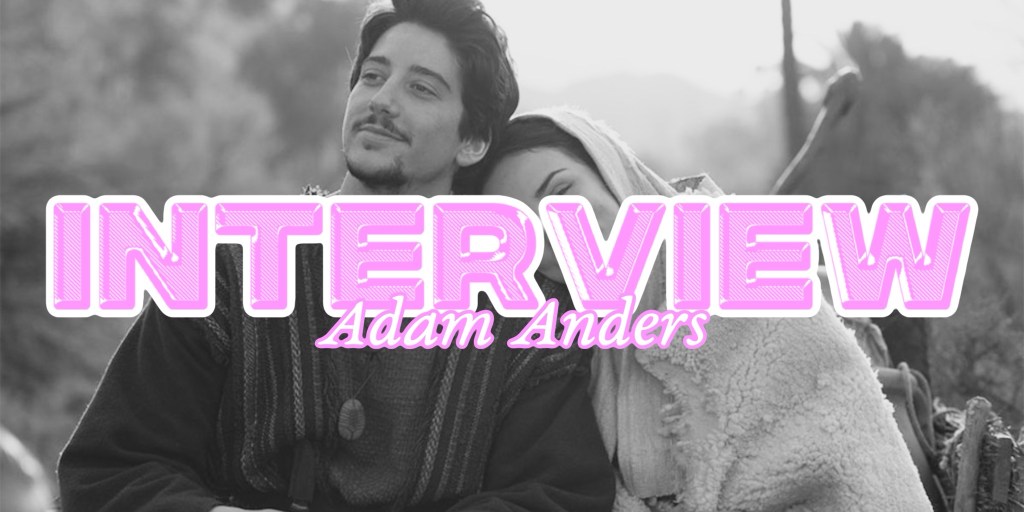
Journey to Bethlehem is a “Biblical musical,” as writer and director Adam Anders put it. It’s the Grammy-nominated and Golden Globe-winning producer’s feature directorial debut and tells the story of Christmas in musical form. Co-written with High School Musical’s Peter Barsocchini, Journey to Bethlehem stars Fiona Palomo, Milo Manheim, and Antonio Banderas. We sat down with Adam, whose name you might recognize from his work with Glee, the Backstreet Boys, and the Jonas Brothers, to talk about the film and music in the story.
Ayla Ruby: So congratulations. I just watched the film and it’s really impressive and really, it sounds beautiful.
Adam Anders: Thank you very much.
Ayla Ruby: So I have a lot of questions, but first, and maybe this is a chicken or egg question, which came first? The idea for the songs or the idea for the film?
Adam Anders: Both. Well, the idea for the film did come first a long time ago, just at its conceptual stage, and I wrote an 11-page treatment, then it was 17 years ago, believe it or not. And it was just kind of a realization that nobody had done a musical of the nativity. And I was actually watching Moulin Rouge and going, “Why is there nothing like this, but that tells the story of Christmas?” And I guess it’s really hard to do it. But I was young and ambitious and I was like, “Oh, we can do this.” So I wrote an 11-page treatment then. And in that treatment, I had several ideas for songs, but we actually didn’t start writing them then. But then it was like three or four, there’s the song where Herod sings Mine Is The Kingdom, which is a flip of the Lord’s prayer, and then it comes back as Mine Is The Kingdom with the Wise Men. That was in my original treatment. Several ideas just came to me in that time that have stuck with me and made it into the movie, which is crazy all these years later. But then we started, we wrote a few songs. I think maybe seven years ago, we wrote our first couple songs just to see, what is the musical language of this idea? And that kind of started it really moving forward. And I got busy with Glee and all these different things I’ve done. I just could never get it together. And then Covid hit and had all this time to just sit and really ponder, what do I want to do with this movie? And actually then wrote this version of the screenplay. And in that process, there were songs like that. We wrote a song, and I’m like, “I got to work this in the script.” But more often than not, it was like you’d write a scene and there’d be a line in that scene. And I’m like, “This is a song.” So that was probably the predominant thing that’s happened. A song like In My Blood. I wrote that line that Herod says, “You’re just like me, boy. It’s my blood in your veins.” And I was like, “Wow, that’s a song.” So then we wrote that. Mother to a Savior, which is magnum opus, if you will.
Ayla Ruby: I have a lot of questions about that one.
Adam Anders: Yeah, I mean that song, my wife and I have written…. our first date was writing songs together. We’re writing songs together. And that’s the song we point to and we go, this is our favorite song we’ve ever written together. Emotionally, the way it tells the story of Mary in such a unique way, but really sums up every emotion she’s feeling in a really powerful, emotional way. And we just love that song. So that song was special just in the way it was even composed, and it was a very inspired moment. So to answer your question, that was long-winded, at every which way. It’s music. You can’t really have a formula of how you write it and well, we’re going to sit down, we’re going to do, it just doesn’t work. The artistic process is so fluid, especially when you have this many songs to do. And I’m writing a screenplay and it was such a melting pot of creativity and just flowed.
Ayla Ruby: So this was, and I could totally be wrong, but this was the first big screenplay you’d done?
Adam Anders: I’ve written screenplays. It was the first that got made. I had a couple streaming movies made that I wrote.
Ayla Ruby: Was that Rosa?
Adam Anders: That, The Kally’s mashup, the movie, that I wrote that. And then I wrote some others that didn’t get green lit. But this is the first theatrical screenplay and my directorial theatrical debut.
Ayla Ruby: I mean, I don’t have enough nice words to say because I really enjoyed it. And I’m going to watch with my daughter later, now after I’ve seen it.
Adam Anders: Awesome. That means a lot.
Ayla Ruby: So for the screenplay, you worked with Peter, and I don’t want to mispronounce his name. Barsocchini. I didn’t want to say his name wrong. What’s it like working with a co-writer? How does that work? You said a lot of times, too, that lines would inspire songs, anything you’d talk about with that?
Adam Anders: He’s an amazing collaborator. We’ve written a lot of screenplays together, so we had a shorthand already, and I think he’s such a good partner. He’s a vastly more experienced writer than me, and I wanted to write screenplays, but I didn’t know what I was doing. And I just have stories to tell and I’m creative and I’m like, “Help me do this.” He’s just like, he’s such a great writer, but a great friend and mentor, too, in the process. And he really helped me shape the ideas I had. So I probably just wore him out, just bombarding him, “Is this good? Is this good?” And then over the years, we’ve just gotten a really great flow on how we write, and we’d toss things back and forth, and I said, “Why don’t you write this scene?” And then I’d write this scene, and then I’d come back and I’d work on that and he’d work on mine. And it became a very fluid collaborative process. But I think where he really shines and really helped me was with structure, among the main thing, and pacing. And a lot of writers want to overwrite and he wouldn’t let me do that. But yeah, he was very supportive of my vision as the filmmaker. He was just there to help me realize what I was trying to accomplish versus, because it was my idea and I’m making the movie. So it was a little different than other times. It’s been him driving the ship more than me that we’ve collaborated. But this one was definitely my baby, and he was an amazing partner. I don’t know that any other writer would’ve been as helpful and collaborative as he was.
Ayla Ruby: Are there any parallels between, so screenplays and structure and then songwriting and structure, that you were able to see or that were helpful to you?
Adam Anders: A lot. Actually, I was surprised at how much my pop sensibility informed my filmmaking. And that was actually a surprise to me. And that’s probably the first director’s cut that was shorter than the studio cut. So they added stuff in because I was so tight and just didn’t want to waste time. And that’s the pop songwriter mentality. You got to get to the point, and I don’t want to waste time. And people get bored easily and attention span all this stuff. And pacing.
Ayla Ruby: No four-hour director’s cut.
Adam Anders: There is not. There’s a shorter director’s cut if you’d like to see it. So I think it informed it a lot. And it definitely, from a storytelling standpoint, it’s really awesome to be the filmmaker, to be the writer and the songwriter because it’s it all weaves together so organically. So I could tweak a song or I could tweak the script, or it was all very fluid. I was surprised at how fluid the process was. Now it’s a musical, so if it was a James Bond movie, maybe it wouldn’t be this fluid. But the songwriting definitely informed the writing, the character development, and obviously the characters informed the songs and the lyrics. And so it was just a very organic process.
Ayla Ruby: So Mother to a Savior and a King, it’s a very epic song, conveys a lot of emotion. And you’ve said it was very special to you and your wife, and it’s kind of an interesting lens too, to see the movie because it’s very much Mary’s story. And I was wondering if you could talk more about that, just share more about the song and how that all came about.
Adam Anders: Yeah. I mean, we called it Mary’s Theme for a long time, which is probably an easier title. But she is the mother to a Savior and King in this movie, and that has so much weight to it and so many connotations. And the thing that I wanted to do was make Mary human and make her relatable. And I think this song and everything she sings about is so relatable, and it’s so many of us go through the same things that she’s going through, maybe not as crazy as her life was, and she should have been stoned then for this. And there was this, imagine being her for a minute. So that’s what we do. We just put ourselves in her shoes and what would she be feeling right now? And there’s this moment, so Gabriel, when he comes, he announced, The Annunciations, what they call it, and some people have asked, “Why didn’t you just have her say, the Bible says, she said, ‘Let it be done to me, as you have said.’ And that’s the end of it?” And I’m like, “Well, as a filmmaker and as a songwriter, I can’t let that moment go by without making it this song.” So we made that moment, this whole song and her whole journey and thought process. The beginning of this song has an arc of beginning and middle and end. It by end when she’s staying on that bluff, that’s when she says through song and through that image, “Let it be done to me, as you have said.” Right? But we use the song to get to that point for her to work through those emotions and figure out how am I going to do this? And it’s going to be through faith and through God’s strength in her, and she decides to do it. So that’s kind of what we wanted to do with this song. And I think it’s just really emotional. And my wife actually started this song. We were working on Herod’s song upstairs, Peer and I, my partner, my direction partner, and she came up and she’s like, “Hey, I want to play you something.” And I went downstairs and she sat down to piano, started playing that verse. And I was like, “Whoa, we have to stop everything we’re doing right now.” So I still get goosebumps thinking about it. So we’ve kind of called that our Oscar song, which is kind of cheesy and presumptive and all kinds of stuff wrong, but we just felt like that’s just the song that summed it all up for us. That’s the one we’d want people to listen to if you’re going to listen to one song.
Ayla Ruby: It’s such a great song. Now, so your actress for Mary, Fiona Paloma, she doesn’t have a musical background. Can you talk about that? Can you talk about finding her, knowing she was right, and just the process of getting from A to Z? She’s amazing, by the way.
Adam Anders: Yeah. I mean, look, number one, she’s amazing. And no, she didn’t have a musical background. Her mother is an artist, a recording artist. So she has musical genes. She’s never really sung. She dabbles on piano and she’s musical. And in her auditions she sang a little bit, and I could tell, okay, she doesn’t have a big range, but she has a beautiful voice. And it always came down to when I was auditioning, I went through 100s of Mary’s and I could not find anyone that embodied the strength of Mary, but also the humility and this kindness. There’s something about Fiona, she just embodies that spirit of Mary, who she’s just so kind and you can’t fake it. It’s just you look in her eyes and there’s a softness there. But then she has this inner strength as well that I wanted Mary to have, but then she needs to look the part, and then she needs to be a great actor, and then she needs to be able to sing this freaking epic song that has the biggest range of history. I’m like, “Oh my gosh, this is a big task.” And I couldn’t find anyone. And it was about three in the morning. I was in Madrid. I was prepping. It was a few weeks from starting rehearsals, and I had no cast. I had so much pressure from the studio to cast people that I didn’t think were right, frankly. And I was like, “I’m not doing it.” I’m like, “I’ve been doing this a long time.” Maybe my first movie as director, but not my first as a producer. And I’ve seen so many movies ruined by bad casting. I’ve seen it over and over. You get the leads wrong and the movie’s not going to work. So I was just holding out, and it was three in the morning. I get an LA casting email and know how it is now with these Zoom auditions. And I feel like I’m on Tinder. I’m swiping. Then Fiona’s came up and I stopped and I watched it, and I was, “Well, who’s this?” And I didn’t know who she was and watched it again and again and again. And I was like, “I found her. This is Mary.” And she had a little singing on there. I’m like, “Okay, she’s got a beautiful voice. I don’t see the range that I need, but we’ll figure it out.” And so then I actually emailed Sony in the middle of the night from Spain and said, “I want to cast this girl.” And we cast her with no callback.
Ayla Ruby: Wow, that’s incredible.
Adam Anders: She’s insane. And she’s a revelation. She’s phenomenal. I love her so much. She did such a great job. And I’ll tell you what, that song was always the Achilles heel with the casting. I’m like, how is anyone going to… Because I’m not voicing it. I’m like, “I refuse to voice this. I refuse to anyone in this movie.” So she just went to work, and I think we have over a 1000 tracks of vocals. We have eight full days of recording in three countries. We recorded in Mexico, we recorded in Florida, and we recorded in Spain. She kept building up her strength, working with a vocal coach, building her range, building her range, building her range, until finally in Mexico, she hit that end note, and it was complete. It was complete. And we kept working on it. She just killed herself for it and just bought in completely. It’s phenomenal. She’s incredible in it. So it’s very special, just how much went into the song that people don’t see. To make it seem that effortless is a lot of work.
Ayla Ruby: I mean, it comes off completely amazing. So first of all, when I was looking into it, I was totally shocked that she wasn’t like a professional singer because it’s amazing.
Adam Anders: But she basically would learn and she just kept getting better, and she worked so hard. She had the raw talent. She, she just didn’t know how to do it yet. So we had to teach her and get her there. And that’s a testament to my brother Alex, who worked with her tirelessly on the vocals. But we got her there and I’m really proud of it. She be proud, not me.
Ayla Ruby: Now, your Joseph, your Joseph did have a musical background, right? Because he was in Zombies. Can you talk about finding him and what that was like?
Adam Anders: Milo is amazing. So full disclosure, I have not heard of Milo Manheim. I’ve told him this as well. So it’s okay. It’s embarrassing, like what cave do I live in that I don’t know, Milo and Zombies? Maybe I’m the only one. I don’t know. But it actually made it more special when I cast him, because I didn’t know who he was, and I cast him completely on merit. I didn’t know he had millions of followers and was a huge superstar. No clue. And why would this big star audition for this little movie? I was like, right? So, well, it turns out he just loved the script and he loved the songs, and he wanted to be in it. So he auditions, and once I got Mary, two days later, I did 10 reads, with six Josephs, with Fiona. And the first one up was Milo, and I just circled his name and said Joseph. Because he said line in the movie, which you’ll know, “You were charmed?” They were having their walk and talk, their little fight. I was like, “Oh, my gosh, this is Joseph.” That’s what sold me on him. And their chemistry was amazing, even through Zoom, which is hard to do. So yeah, she was in Mexico. He was in LA, and I’m in Spain, and we’re doing this thing. But it worked. He’s phenomenal. And I obviously then did my reason, I’m like, he’s a great dancer, phenomenal dancer, great singer. He was the whole package, and they had this chemistry, and he was exactly that combination of voice, charm that I wanted that then would grow into a man, his arc. And he did an amazing job too. I can’t say enough about these two as the leads. They’re awesome.
Ayla Ruby: And I have to ask about Antonio Banderas. Can you talk about how he came on board, what that was like?
Adam Anders: Antonio, as you saw, he’s phenomenal in the movie. So much fun. He brought this character to life, literally the character that I’d written, which is rare because every artist brings their thing to it. He literally personified this character that I’d written that I had in my head. It was freaking me out when I saw him, I’m like, “Oh my gosh, he’s exactly what I had imagined, but even better,” because he’s such a great talent. But it wasn’t easy getting him. Again, we’re a small movie, this Biblical musical, which sounds like a terrible idea on paper. I know. But he was somebody I’d had top of my list for years, for three years since I wrote the screenplay, Antonio. And I’m a big fan of his anyway, and seen him in Phantom of the Opera. But he was an incredible singer. And again, I needed an amazing singer because his song’s really difficult. So we got ahold of the manager and got a quick no, as I thought we would, and we called again and then got a, “Okay, we’ll read the script.” Okay, that’s some progress. So the manager read the script. He’s like, “I like this for him, but he doesn’t want to be bothered with anything right now and you can’t afford them anyway.” I’m like, “Okay, I’m in Spain now. We have another big actor who wants to do it,” but I just again felt like, this isn’t the right person. It’s just not. He’s an amazing Oscar winning actor. And I was just like, “It’s wrong. It’s just not going to work. And he can’t sing the song.” So we’re like, “Let’s go back to Antonio again.” So we call again, and the manager’s like, “No, no, no.” We send him the song. He’s like, “Okay, the song’s awesome, but still, no, he’s writing. He’s directing and starring in a play, so there’s no way to bother him with this right now.” And I said, “I’ll fly anywhere in the world to meet with him for five minutes. Give me five minutes with him.” And he said, “It’s not going to work. He’s in Madrid, Spain.” And I said, “Well, give me the address. I’ll walk over, because I’m in Spain.” That’s not a coincidence in my mind. So we did not get a meeting with him. So we started buying tickets to his show. So we started going to the show every night and trying to figure out how to, and I kept texting the manager, we’re like, “We’re here. Tell him to come out and say hi.” And he didn’t. And I think it was the third or fourth night, my producing partner, Alan, he was talking to a guy at the bar and he was a close friend of Antonio’s, this guy. So he pitched him and that guy says, “He needs to be in this movie. I’ll get him to come out.” He said, “Come back tomorrow.” So we come back the next night and we sit with the friend and sure enough, long story short, seven hours after the show started, because it was Q&A. It was all in Spanish. I’m falling asleep, pinching myself because I’m so tired, didn’t understand a word they said the whole night. Again, here comes Antonio at two in the morning and he’s like, “Hey, what are we doing? I like the song.” And I gave him my pitch, elevator pitch right there. And I’d asked the manager, “What do I need to get Antonio to say at the end of this pitch to know I got him?” He says, “Talk to my manager, then you’ve got him.” I’m like, okay. So I’m doing my whole spiel and he goes, “Do I get to be the bad guy?” I’m like, “Oh, yeah.” And I pitched him my Herod, he kind of lights up. He’s like, “This is funny. I like you. I think you’re good. You know what? Talk to my manager.”
Ayla Ruby: So you got it.
Adam Anders: We got him. So we were floating home to our hotel at 2:30 in the morning in Madrid, we got Antonio. So it was pretty guerrilla style. I don’t recommend it, stalking people, but we had to go old school on it. And you just got to be tenacious sometimes. I had to have my producer hat on there and just keep pursuing him. But yeah, so he’s incredible. And then he showed up and he just loved what we were doing, the way we were doing it. He got to have so much fun. As you can tell, he’s just having a blast and he’s saying the crap out of the song. So he’s awesome. I can’t say enough about Antonio either. My whole cast. I mean, if I got anything right in this movie, it was the casting, I think.
Ayla Ruby: Yeah, I think it’s really, I mean, everyone is perfect. Just again, I don’t have enough good words to say about this one.
Adam Anders: Oh, thank you.
Ayla Ruby: So I know we’re getting close on time, and I always ask folks, is there something you want to leave people with? Is there an enduring message? Is there something that you want people to know about this movie? And then obviously about the song.
Adam Anders: It’s pretty simple for me. I just wanted to bring joy through this movie. Christmas is a tough time for many people, I know. And there’s not really anything like this that you can watch that makes you feel better after that tells the story of Christmas. And I think, so it was two things for me was to really make people feel better than they did before. And to just tell the story of Christmas. Pretty simple goals, but pretty hard to execute I guess. But I’ve gotten so many messages of people who are like, “I couldn’t stop smiling.” It’s just so amazing to see that reaction that we’re getting from it that maybe we accomplished it. There’s so much dark content being made. I didn’t feel like I need to do that. I don’t need to add to that. There’s enough that’s covered. So I just wanted to make a movie that makes people feel great, that spreads the joy of Christmas through a movie that actually is the story of Christmas. There’s really no major agenda in it. And to do it through great songs that move people. And I’ve seen people, I’ve screened this movie, seen people crying and laughing in it. And that’s what you want, just people to feel something through the art that you make. So that would be what I would want to leave people with, a sense of joy and happiness at Christmas. So watch Elf and watch this.
Ayla Ruby: That’s lovely.
Adam Anders: That’s what I would say. Yeah. And the song. It’s our favorite song we’ve ever written. I’m thrilled with it. I’m thrilled with Fiona’s performance. It was a several year journey to write it.
Ayla Ruby: 17 you said, right?
Adam Anders: 17, yeah. So it’s been quite a process, and that song sums up not only Mary’s journey, but our journey in making the movie.
Ayla Ruby: Fantastic. Well, thank you so much. It was lovely to meet you.
Adam Anders: No, thank you
 offscreencentral.com
Leave a comment