
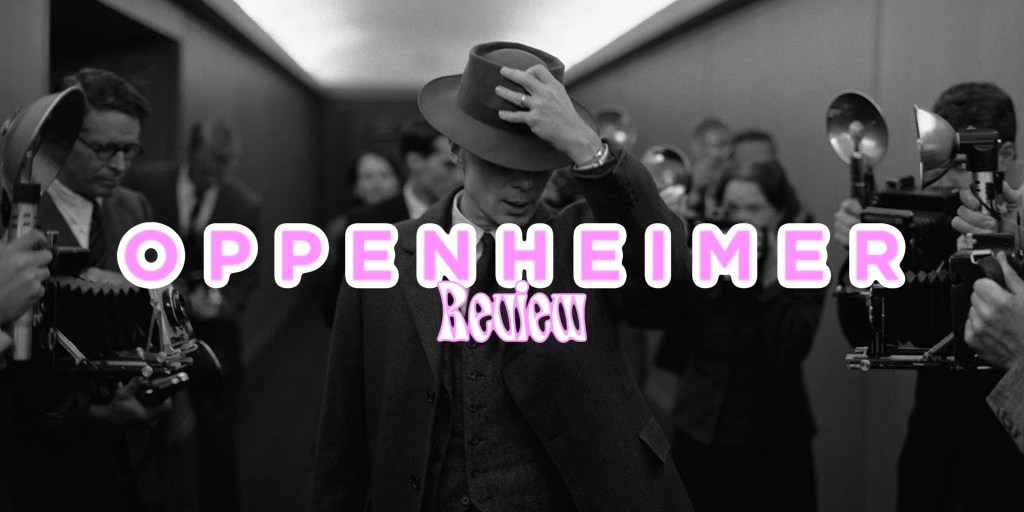
At Oscars Central, we stand in full solidarity with both the WGA and SAG-AFTRA. This piece was written during the 2023 WGA and SAG-AFTRA strikes. Without the labor of the writers and actors currently on strike, films would not exist. If you are able to, you can make a donation to the Entertainment Community Fund here.
Nolan’s historical thriller, Oppenheimer, not only serves as an invigorating, provocative plunge into the man behind the atomic bomb but a pounding horrific origin of nuclear power that would change foreign policy and humanity for the modern age.
Often when the atomic bomb is taught in American schools, the name revolving around it is most likely former President Harry Truman. Nolan follows a recent trend in filling in the blanks of American history by bringing J. Robert Oppenheimer to the screen in a thunderous thematic and cinematic style. Oppenheimer’s story greatly mirrors the tale of Prometheus, but also closely follows one we see with American female pop stars and starlets. Nolan uses the comparison between Prometheus and Oppenheimer to warn his audiences of what is to come in the next three hours. Like Prometheus, the quantum physics pioneer was tortured by thoughts of progress. It is a classic American tragedy that has been seen in multiple American icons as they are built up until they reach ultimate power only to be torn down by those who propped them up. At times we are supposed to empathize with Oppenheimer as we watch his life’s work taken away from him by a few upset bureaucrats but then we are reminded of the pain his actions caused to multiple generations making his vilification justified. Oppenheimer’s story is grounded in reality but possesses the ambitious scope of the Greek myth.
From the opening shot, Cillian Murphy is towering over the audience in IMAX 70 MM commanding their attention for the next three hours by hypnotizing them through his cornflower blue eyes and soft-spoken voice. This feels like a once-in-a-lifetime role that Cillian simply pulls off through his eyes. These blue orbs guide the audience through all the science and political jargon that with the wrong casting could have easily lost the audience along the way. When “transformative” is brought up to describe an actor’s performance Cillian Murphy as Oppenheimer should be the definition. He takes on Oppenheimer across decades from the 1920s to the aging 1960s fully wearing the pain this man has carried throughout his life. Murphy doesn’t make the mistake most actors do in trying to mimic the real person he is playing. He can interpret Oppenheimer through his structure that taps into the humanity of Oppenheimer that made him the force he was. He naturally fully embodies this man for all his flaws, brilliance, and instability that are eventually refashioned into destruction. It is as if he has been preparing for this role all his life.
Like an atom splitting, Murphy, like Oppenheimer, opens up a new portal of the universe for humans to access. Along the way, he dives into the center of who Oppenheimer was as a person supported by trembling imagery and an otherworldly soundscape that locks you into his inner mind as he takes on one of the hardest decisions made in humanity. Stuck in his mind, you walk through different decisions and thoughts he makes throughout the movie he passes the weight over to the audience to have to live with. Oppenheimer is a walking contradiction of brilliance and vanity. He is able to present himself where it matters but also crumbles under pressure when his actions and words come back to haunt him. He is a creator and a destroyer. Nolan decides to cover all sides of Oppenheimer which will have the audience going back and forth on whether they should be rooting for this man or not. He isn’t trying to make him likable, but present someone whose ideals of brilliance lead him to the ultimate death of civilization. It is a real rise-to-fall narrative of watching someone reach their full potential only to collapse from consequences.
This could easily have been a silent film with the moral paradoxes of its characters beautifully communicated through their faces and body movement to give the same effect as it was with sound. He leads his cast members through a controlled performance exposing himself to the vulnerability of the world around him. The film is truly an ensemble with Nolan managing to secure the three Best Actor winners from 2017-2019 into small roles that top their award-winning performances. Everyone fully understands the movie they are making and performs by any means necessary to make it work.
Christopher Nolan subverts the expectations for a historical biopic with explosives by creating his own rules for storytelling. Stitching crucial moments in Oppenheimer’s life taken from the book “American Prometheus” from his early university days to the security hearings, Nolan sheds the biopic identity to set a non-linear timeline of a political thriller, heist, and courtroom drama. At the core of these moments are the relationships between Oppenheimer and the people he meets along the way. The order in which Nolan chooses to place these moments adds an experimental quality in getting the order correct to reach a satisfying conclusion amongst a chain reaction of interaction and choices. The time-hopping makes the true story feel fresh and different from its fellow biopics in that its selected moments end up having major impacts as Oppenheimer’s life continues.
With the help of his collaborators, Nolan expands this moment of Oppenheimer’s life into one gargantuan slow-burn epic that submerges the audience into the world of the tortured physicist. He takes a risk by splitting up his story into a black-and-white timeline and color timelines to play with the perspective of his characters. The moment these two timelines converge creates an enthralling conclusion to how the political game is played. The dreamy, apocalyptic visuals of Hoyte van Hoytema contribute to the film’s thesis on showing versus telling this story. At Oppie’s beginning, his mind is littered with planetarium-like images that communicate the possibilities of science constantly flourishing in his crowded mind. There is beauty in the sparks about what humanity can be capable of. As Oppie is older, there is a slow transition to unsettling nightmares of the destruction of what is to come from a mistake only an intellect like Oppenheimer can make.
Instead of three hours of loud noises, Nolan opts for quiet moments that heighten the fragility of Oppenheimer’s point of view. Looming in the background is a claustrophobic score by Ludwig Göransson that transcends the screen for the audience to feel every beat putting them right into the room. Göransson adds tension to the sound of violins that fit the high-strung nature of Oppie, taking it to a level of manufacturated disorientation. Most movies do not understand the use of sound during explosions, but Nolan conveys his brilliance in the subject through his growing build-up with a haunting pace that feels as if history has been captured in real-time. The Trinity test scene is truly a work of art on its own thanks to the editing and score that slowly pieces it together that allows the characters to settle with the weight of what they are witnessing. The silent moment is squashed with a mind-blowing sequence to follow that will be studied by film studies classes for years to come.
Oppenheimer reminds audiences of why they go to the cinema as it crafts a contradictory story of the man behind the atomic bomb presented in a truly immersive theatrical experience you can never experience at home.
Grade: A-
Oscars Prospects:
Likely: Best Picture, Best Director (Christopher Nolan), Best Lead Actor (Cillian Murphy), Best Supporting Actor (Robert Downey Jr.), Best Adapted Screenplay, Best Sound, Best Original Score, Best Cinematography, Best Editing, Best Visual Effects, Best Production Design, Best Make-up & Hairstyling
Should be Considered: Best Supporting Actor (Benny Safdie), Best Supporting Actor (Rami Malek), Best Supporting Actor (Josh Hartnett)
Release Date: July 21, 2023
Where to Watch: In Theaters

Jillian Chilingerian
she/her @JillianChili
Lives in LA
Favorite Director: David Fincher
Sign: Leo




 offscreencentral.com
Leave a reply to 2023 New York Film Critics Circle (NYFCC) – Winners Cancel reply