
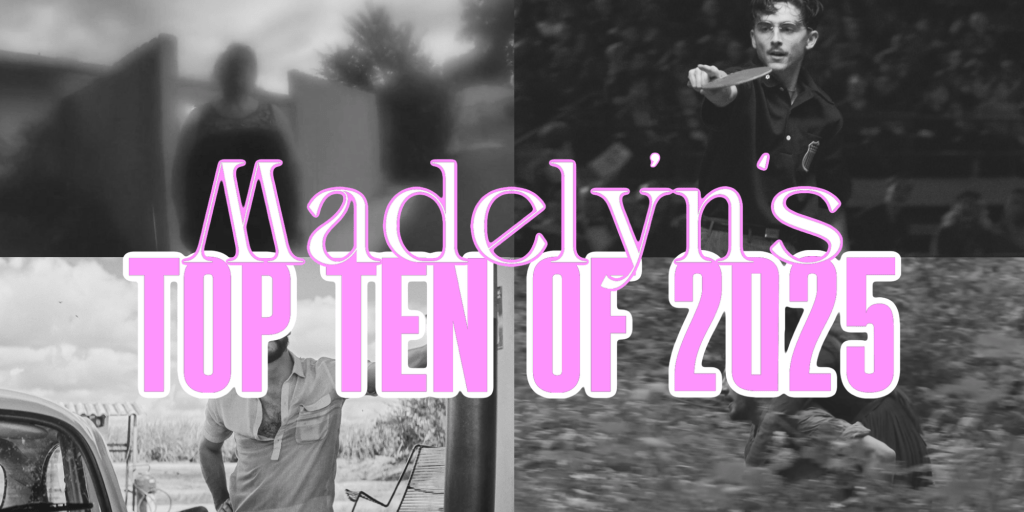
When crafting a top ten list for the year, I try to include different genres, countries of origin, and form. As my list shows, I am obsessed with films that have strong world building. I feel that if you as a filmmaker are able to make me feel like I have been to a place that I have never been to, you have accomplished something incredible. From 70’s Brazil to a lonely, bounding stretch of road in California – these filmmakers created detailed worlds that I will return to for years to come.
10. Weapons (Dir. Zach Cregger)
I admire films that follow multiple characters whose lives intersect within the narrative. Weapons’ clear inspiration from Magnolia makes this horror film so much more interesting and narratively exciting. One of my favorite choices of the film– one I can’t stop thinking about– is the choice to show a giant floating assault rifle during a character’s dream. It’s a non-sequitur as we later learn, but a remarkable way of playing into the audience’s own underlying fears and anxieties. The choice to turn this film into a good-old-fashioned witch story– much in the same way Sinners employs vampire tropes– makes this film that much more interesting. I’m still thinking about Amy Madigan’s chilling threat to her nephew to keep him quiet. Weapons feels epic, and its cultural relevance gives me hope for original storytelling in Hollywood.
9. The Naked Gun (Dir. Akira Schaffer)
In a healthy movie ecosystem, we would have five studio comedies a year that are akin to The Naked Gun’s silly slapstick. I admire the filmmakers behind this reboot for their commitment to shoving as many jokes as they could within this 85 minute runtime. I was smiling and laughing the whole time, the breakneck speed of this film doesn’t allow for any dead air if a joke doesn’t quite land. One of the funniest choices of the film was to– intentionally?– only make quite old references. An extended bit about the Black-Eyed Peas? Why not! This is a comedy that never punches down; it is never intentionally regressive or mean-spirited. It was quite refreshing to leave the theater with my face hurting from smiling so much.
8. Hamnet (Dir. Chloé Zhao)
I love a movie that wants to make me cry. Hamnet is a weepie, in the same way Titanic or the films of Douglas Sirk are. Is the film cheap in its emotional beats? You can be the judge of that. For me, I could feel something honest, something uncorrupted in Chloé Zhao’s work. Jessie Buckley commits to her performance, taking this character to new heights with every scream, cry, and inquisitive stare. Buckley bodies this role, and she takes this film to another level.
7. Sorry, Baby (Dir. Eva Victor)
My general philosophy is that a filmmaker’s debut film is best served by making something that is deeply personal. Eva Victor’s debut is so clearly of their specific voice. This alone is the mark of a strong writer and future auteur. Victor’s humor is dry yet warm, and the film’s tone is that of a sort of lilting sadness. I’m still thinking of John Carroll Lynch’s heartbreakingly simple question he directs to Agnes – “Are you ok, in your house?” With such a small budget – about $2 million – I admire how the filmmakers manage to create visual interest through references to Edward Hopper, the use of blue, and an incredible static shot of a home as the night changes around it. The tone of Sorry, Baby is so specific to Victor, and I am excited to see what world Victor’s writing takes to us next.
6. Marty Supreme (Dir. Josh Sadfie)
Josh Sadfie’s script for Marty Supreme is one of the best of the year. Plot points fit together like puzzle pieces, perfectly snug. Character decisions reverberate throughout the narrative, making each plot point sing. Simple moments, like Marty’s wait outside his lover’s home for a necklace, take on intense meaning for the film’s next steps. You constantly feel this tension as an audience member. The final tabletop tennis match is one of the best constructed matches in sports movie history. I have never felt so many conflicted feelings watching a dramatic final sports match. That is the magic of the film – the filmmakers put the audience on edge, on watch.
5. The Perfect Neighbor (Dir. Geeta Gandbhir)
Ajike Owens, the victim at the center of this documentary, was a close friend of director Geeta Gandbhir’s sister-in-law. In an interview with Film Comment, Gandbhir explains that she and her husband traveled to Florida to document what was happening in the aftermath of Owens’ murder. The couple later requested police body cam footage through the Freedom of Information Act to contribute to the legal case for the victim. Incredibly, the documentary organically grew out of this deeply personal moment for Gandbhir and her family. It is an apt origin story for a film that feels incredibly grounded and personal. There is a deeply devastating moment that is still on my mind, in which the father of Owens’ children has to tell the kids that their mom is dead. Watching this moment was one of the hardest scenes I have personally ever watched in a movie. I could see myself in both the child and father’s shoes. It is so personal I felt I was invading this family’s privacy, watching worst moments of their lives. The Perfect Neighbor is essential for depicting the kind of anti-social behavior that is killing this country, and it does this through a revolutionary form.
4. The Secret Agent (Dir. Kleber Mendonça Filho)
An incredible homage to 1970’s political thrillers, The Secret Agent is an unwieldy, refracting tale of identity and mystery. The film itself is a puzzle, demanding multiple viewings and a rapt audience. The worldbuilding of 70’s Recife, Brazil is supported by perfect casting; its casting is some of the best work of the year. The cinematography from Evgenia Alexandrova is gorgeous, luscious, and colorful. Wagner Moura’s performance is one of the best of the year. He plays multiple characters; you trace the film’s timeline through his face and appearance. He is always interesting and never overdone. As I’ve said, this film can be cited with many superlatives: some of the best casting, cinematography, music supervision, directing, and acting of the year. This makes this film a clear stand-out of 2025 for these many accomplishments.
3. 28 Years Later (Dir. Danny Boyle)
As with the next selection on this list, cultural specificity to British life makes 28 Years Later the greatest project Alex Garland has written since 2014’s Ex Machina. The world of this film is incredibly detailed, with some of the best visuals of the year. The use of red night vision, iPhones, and Snorricam pair with clear visual references to the films of Ken Loach. The filmmakers morph old Britain with new Britain, showing how an isolated community holds onto cultural institutions in the face of massive fear and strife. More than anything, the film’s bonkers ending is the mark of true masters of their craft. The ending is the perfect example of filmmakers making choices in an industry that isn’t always open to unruly endings.
2. Sinners (Dir. Ryan Coogler)
From the moment Autumn Cheyenne Durald Arkapaw’s camera takes in the Louisiana landscape as Sammie drives up to a white, weathered church, it is so clear you are watching an instant classic. Ryan Coogler is one of the best filmmakers currently working. His collaborations with Michael B. Jordan are always exciting, always dynamic, and always deeply emotionally felt. More than anything, Sinners is unafraid of genre – the filmmakers’ mastery of the tropes of the vampire flick is a jumping off point to a poignant story about history, culture, and trauma. Beautiful in its cultural specificity, Sinners hopefully represents the next phase of Hollywood filmmaking.
1. One Battle After Another (Dir. Paul Thomas Anderson)
This is the undeniable movie of the year, perhaps the best American film of the 21st century (so far). As One Battle After Another steamrolls its way through awards season, it feels important to remember that Paul Thomas Anderson has been writing this film for the past twenty years. While the film is prescient of our current administration’s creeping fascism, none of this is new. This violence against immigrant communities has been a growing stain on our country since the creation of the Department of Homeland Security post-9/11.
This is why the most invigorating, heart-wrenching portion of the film is the story’s excursion with Sensei’s (Benicio del Toro) underground network for undocumented immigrants. Watching Sensei’s boots-on-the-ground protection of his community made my heart soar. It is shocking to learn that this plot point was never part of the original script. Benicio del Toro contributed all of this worldbuilding to the landscape of One Battle After Another. This thirty-or-so minute portion of the film is an essential snapshot of 2025. This stretch of the film shows real community work isn’t watching The Battle of Algiers or memorizing code-speak. It is showing up for our communities under attack, putting our bodies and freedom on the line.
More than anything, what I admire about this film is how hopeful it is. Hearing “American Girl” as you watch Willa (Chase Infiniti) go out into the world is invigorating. It is a reminder that this film is not being made from the young kid who made Boogie Nights. We are watching a father create a film about the energy he hopes still exists out there in our country.

 offscreencentral.com
Leave a comment