
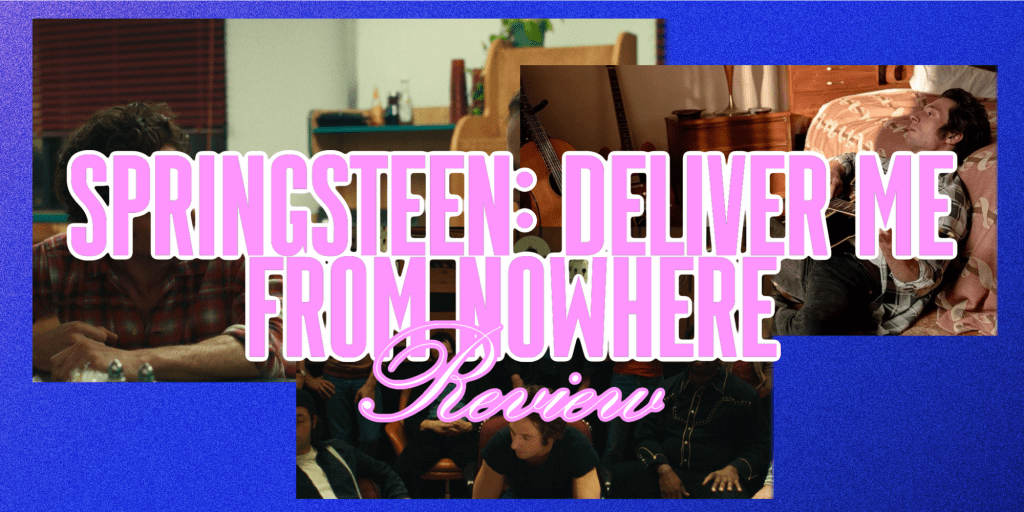
Springsteen: Deliver Me From Nowhere is a bit slow and falls for some cliches of the music biopic. But, the performances and focus on the intimate, internal world of the icon make this a worthwhile watch.
‘Nebraska’ has always been a unique point in Bruce Springsteen’s discography. Sandwiched between chart-friendly ‘The River’ and Springsteen’s massive work ‘Born in the U.S.A.’, ‘Nebraska’ has always been viewed as an oddity in Springsteen’s oeuvre. Dark, crackly, and atmospheric, ‘Nebraska’ rejects hit-seeking rock, and instead tells stories of modern folktales. Nevertheless, ‘Nebraska’ does have the essential themes of Springsteen’s storytelling – growing up working class, struggling to accept your father’s role in shaping you, and escapism from small town life. If you want to tell a story about Springsteen’s creation and personal trauma, ‘Nebraska’ – not the scrappier ‘Born to Run’ or avalanche of ‘Born in the U.S.A.’– is the album to do it.
Springsteen: Deliver Me From Nowhere is about a lowpoint in Springsteen’s life: 1981-1982. This is unique from many music biopics: most films in this genre follow the rise and the fall of a musician. ‘Nebraska’ starts low and goes lower. Springsteen struggles with unchecked depression, and the film’s high point is not when Springsteen overcomes it and has the biggest year of his career in 1984. No – the climax of ‘Nebraska’ is when Bruce’s suicidal ideation gets so bad he seeks out therapy. Springsteen: Deliver Me From Nowhere becomes a film about depression, masculinity, and fathers.
My father’s house shines hard and bright
It stands like a beacon, calling me in the night
Calling and calling, so cold and alone
Shining ‘cross this dark highway, where our sins lie unatoned
“My Father’s House” from ‘Nebraska’
Springsteen: Deliver Me From Nowhere is filled with stark, black-and-white flashbacks to Bruce’s working-class childhood. Childhood flashbacks are a trope of music biopics. Springsteen’s working class childhood is so essential to not only depicting his life, but also his artistry. You cannot make a movie about Bruce Springsteen without showing his childhood. Sure, there are maybe one too many flashbacks in this film, but a childhood growing up worrying about money never really leaves you. Bruce’s guilt at leaving his working class background comes in pieces in the film, if expressed in a bit of a didactic manner. The film is much more interested in Springsteen’s relationship to his father. “Daddy issues” are ultimately another cliche of music biopics. Much the same as the childhood flashbacks, Springsteen’s relationship to his father is essential to his storytelling. The essential image of Springsteen’s storytelling is his father sitting alone at the dinner table. Springsteen describes this in a legendary 1985 opener to “I’m On Fire”:
“I remember, growing up, at night, and my dad would sit in the kitchen with all the lights out and he waited for me to come in, and he’d sit there and drink, and I’d stand in the driveway and I’d look into his screen door, and I could see the light of a cigarette, and then I’d rush up on the porch and try to get by him but he’d always call me back. And it was like he was always… always angry. Always mad. He’d be sitting there thinking about everything that he was never gonna have until… until he’d get me thinkin’ like that, too. And I’d lay up in my bed, at night, and be staring at the ceiling, and I’d feel like if something didn’t happen — if something didn’t happen soon — it felt like I was just gonna…”
Fatherhood is all over this film. John Landau (Jeremy Strong)– Springsteen’s manager– fathers Bruce. Bruce remembers his father in childhood. Bruce fathers his girlfriend’s kid. In the end, Bruce goes through the strange process of fathering his own father. Stephen Graham as Springsteen’s father wrangles all the nuance he can out of this script. He can be volatile and aggressive, or isolated and vacant. His best work is when he is staring off into space, smoking at a bar or the dinner table. It is so easy to understand all the complex emotions Springsteen would feel watching his father in these moments. How it feels to watch a parent in their own world as a kid; you’re wrapped in childhood naivety, unable to understand why our fathers do the things they do. This is further dramatized during a climatic moment in which Bruce enters his own childhood memory. Jeremy Allen White stands in his childhood kitchen, trying to understand his father. It is a beautiful representation of childhood trauma and what it can metastasize in people when it remains unchecked.
Jeremy Strong is incredible in his role as Springsteen’s manager. Instead of a broad depiction of the role of a manager, Landau is a protector, therapist, and father-figure. He is also a realist who questions and supports Bruce in his creation of this unconventional project. The highlight of Strong’s work is during a scene in which he is advocating for Bruce in a room with a record executive, played by the always wonderful David Krumholtz. Strong states, “But in this office, my office, we believe in Bruce Springsteen.” In another actor’s hands this line would be cheesy, but Strong manages to conjure all the sincerity needed to deliver it. Landau is gentle but firm with Springsteen, and the warmth Strong captures with his fun accent work is impressive work. He also looks very cool listening to Nebraska on all this old 80’s equipment.
Well baby, everything dies, that’s a fact
But maybe everything that dies someday comes back
Put your makeup on, fix your hair up pretty
And meet me tonight in Atlantic City
“Atlantic City” from ‘Nebraska’
The cliche of this film that can’t be forgiven is the broad depiction of Springsteen’s girlfriend. Odessa Young plays Faye, a working class mom from Springsteen’s home-town who Bruce starts a relationship with during the making of Nebraska. She is given little to work with in terms of dialogue – she has some of the most cliche, didactic lines of the film. She murmurs “I’m going to regret this” before kissing Bruce for the first time, argues with Springsteen and shouts that he isn’t “letting her in”. These are all cliches of “the girlfriend” in not only music biopics, but films generally with softly defined girlfriend/wife/partner roles. One of the reasons why Monica Barbaro was so refreshing as Joan Baez in last year’s A Complete Unknown was her distinctness as a character – her relationship with the musician is partly sexual, partly competitive. We could have followed Monica Barbaro for an entirely new movie.
Faye is given none of that intrigue. Even the sex scene between the two is without passion or intimacy. She sort-of represents Springsteen’s guilt at leaving New Jersey and his community behind as he finds success– she says as much– but this is barely fleshed out. Part of the reason why Faye may feel so underdeveloped is that she is an amalgamation of several women Springsteen was dating at the time. She is a Frankenstein’d approximation of a woman, defined by her role as The Girlfriend. She only exists to get Springsteen out of the house while making Nebraska. Quite frankly, I would have preferred they did not include this character.
They declared me unfit to live
Said into that great void my soul’d be hurled
They want to know why I did what I did
Well, sir, I guess there’s just a meanness in this world
“Nebraska” from ‘Nebraska’
Musician biopics are an actor’s playground. While the storytelling of these films can leave something to be desired, they allow actors to shine with technical work. I think part of the reason why actors clamor for these roles is because Hollywood does not make as many musicals these days. Musicals force an actor to challenge themselves – dancing, acting, singing. Music biopics allow an actor to stretch some of these muscles that are underused in today’s Hollywood landscape. Unique to the music biopic is that one of the essential questions of the film is how much the actor “disappears” into the role of this real-life figure.
For Springsteen: Deliver Me From Nowhere, White doesn’t quite “disappear” into the role. His performances onstage are impressive, representing the scrunched-up, almost pained intensity of a Springsteen performance. White’s singing is extremely impressive; it is one of the best music biopic performances I have seen from the genre. His Springsteen speaking voice leaves something to be desired. Springsteen’s voice is so distinct, raspy with a sort of drawl at times. White has some of the markers of the voice – paired with accurate hair and distinct eye contacts– to represent his outline of Springsteen. Springsteen doesn’t necessarily have the markers of an icon that other musicians have: the distinct hair and prosthetics used for Dylan, the Everything of Elvis or Elton John, the teeth for Mercury.
Regardless, this slow, intimate film isn’t a movie for actors to get buried in prosthetics. White’s strength in the film comes from his depiction of depressive episodes. The script doesn’t allow White much in the way of versatility; we don’t get glimpses at a silly or light-hearted Boss. But where Springsteen collapses or rages, White is quite successful. The highlight is when Bruce seeks professional help from a therapist. White’s tearful breakdown is a beautiful, emotionally affecting moment. Unfortunately, it is buried in a lackluster score that haunts the entire film.
When I watch music biopics, I’m often left wanting more looks into the artistic process of these artists. Springsteen: Deliver Me From Nowhere is invested in showing the process Bruce went through to make Nebraska. Sure, some of the depictions of Springsteen’s research are a bit on-the-nose, but it’s a welcome depiction of how internalized writing and creation can be, to the point of being isolating. For the filmmakers to choose to focus on one particular album, one particular moment, in an artist’s life is making a distinct choice in the landscape of music biopics. When making a movie about a pop culture figure like Springsteen, the filmmakers have to balance multiple audiences.
They have to consider the fans, the real person, and a wide audience. I can imagine fans wanting more depictions of Springsteen goofing off on stage with Clarence Clemons, or more of Springsteen’s silly sexuality onstage. But ultimately, Springsteen: Deliver Me From Nowhere is focused in its depiction of depression, and is heartfelt and empathetic to those who struggle with the mental health condition.
Grade: B
Oscars Prospects:
Likely: Best Lead Actor (Jeremy Allen White), Best Sound
Should be Considered: Best Supporting Actor (Jeremy Strong, Stephen Graham), Best Casting, Best Make-up & Hairstyling
Where to Watch: In Theaters

Madelyn Land
she/her @maddiexdrew
Lives in Seattle with her large earring collection.
Favorite Director: Sofia Coppola
Sign: Aries




 offscreencentral.com
Leave a comment