
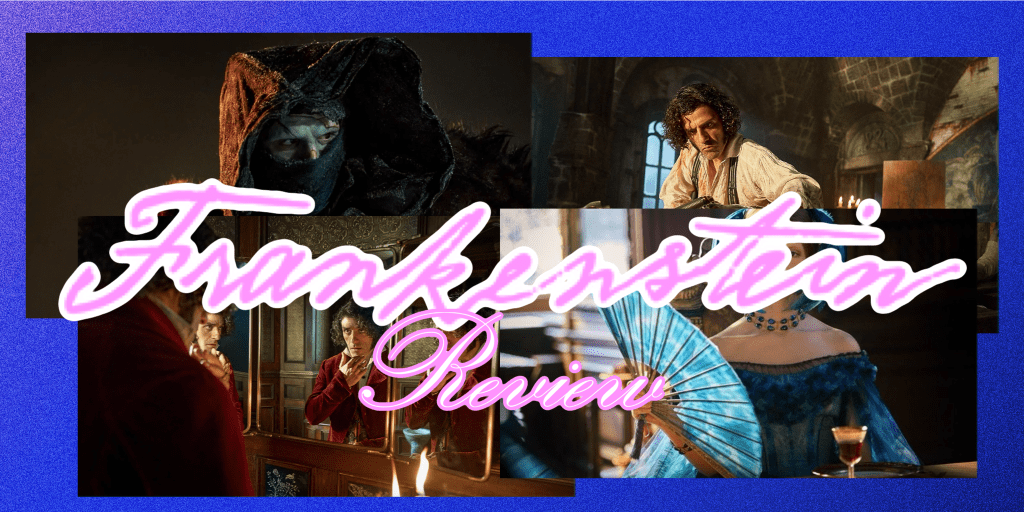
Guillermo del Toro creates his masterpiece with a fairytale that indulges in every emotion and asks its audience to do the same. The challenge of landing all of these powerful themes while adapting such a famous story cannot be understated but del Toro delivers the best cinematic adaptation to date of Frankenstein all anchored by Jacob Elordi delivering the best performance of the year.
Mary Shelley’s masterpiece, Frankenstein, has inspired hundreds of various film, TV and even other novels over the years and been adapted for the screen time and time again but Guillermo del Toro’s long-awaited screen adaptation is one for the ages. The writer/director has been dreaming of bringing this story to the screen with his unique vision and it was well worth the wait. Del Toro has made no secret of his yearning to adapt the classic creator/creation tale, and he finally has with a film all worth the wait. Frankenstein is one of his strongest films to date with a tale he doesn’t simply adapt but pours his soul into. His retelling of Shelley’s story is structured with creator and creature’s tales allowing for the film to not feel we’re watching what happened but how it felt for each character. Del Toro brings such an empathy and soulful take to deliver a mesmerizing adaptation.
Shelley began writing a short story that would become a full novel after Lord Byron proposed they both write ghost stories. Night after night, she was unable to come up with a story until their conversations turned to a discussion of the nature of the principle of life. Shelley later in life described that summer as the moment when she “first stepped out from childhood into life.” Del Toro may be a lover of creatures, and that reasoning enough may be why so many people assumed the writer/director would be a perfect pairing for the material, but the idea of stepping out of childhood into life within a story of creator and creation is what I think lingers in del Toro’s strongest connection to the source material. Frankenstein explores the perspective of both the father and son character types in the story and allows del Toro to examine the failures of a parent, effects it has on both father and son, and how to move forward. While many have said del Toro makes the beloved story too different and personal, I actually think he keeps very much in line with the blueprint and heartbeat of Shelley’s work. What many see just as a horror story is much more a story of sorrow. The yearning to belong and to feel seen by those who should be closest to you, the all-consuming burden of never feeling like you belong to those you’re ‘meant to’ and most of all, the potential for self-love leading to acceptance from those around you. The challenge of landing all of these powerful themes while adapting such a famous story cannot be understated but del Toro delivers the best cinematic adaptation to date of Frankenstein.
Del Toro splitting the film into two parts allows you to see how easy it was for Victor Frankenstein (Oscar Isaac) to become his father’s son. When he loses his mother (in some incredible casting Mia Goth) at a young age, the nurturing, kind figure in his life eludes him and is replaced with only a hateful, vindictive father putting success above all else. A young Victor wrestles with ideas of his father, the perfect doctor, couldn’t save his mother… Without the compassionate, tender teachings of his mother, Victor follows suit with his father’s ways, a spiteful path to prove his father wrong. Even when we cut to an older Victor, he’s telling his tale with a preface, “some of what I will tell you is fact, some is not. But it is all true.” Del Toro’s interpretation of Frankenstein is that he’s aware of his shortcomings and mistakes at the end. As we live through his retelling of his life and birth of the creature, we see different parts of him fighting to beat the spiteful, vengeful half of his identity. He yearns to fall in love, effortlessly, with Elizabeth. Victor and Elizabeth are kindred spirits, in love with science and written to share a deep intelligence beyond their peers, and Victor’s brother, William (Felix Kammerer). However, their morals deeply differ causing a reluctance on Elizabeth’s end, she sees the darker side stemming from the father within Victor. Much like how del Toro frames the story within Frankenstein, Victor is equal parts violent and sentimental. He on some levels yearns for acceptance and belonging. While he prefers to work alone, he can’t escape the searching for recognition, even in the form of someone he isn’t sure he can trust, Christoph Waltz’s Harlander. Harlander seems to exist to only attempt to push down the humanity left in Victor to bring forth the creation, the creature. Harlander is almost a representation of the evil pull from his father in human form. When Victor is finally able to finish and bring the creature to life, the Creature (Jacob Elordi) takes a new physical manifestation of the halves of Victor, but this time it’s mother’s kind, curious, mystical attributes. These two halves of being physically manifested at different times essentially mirroring his upbringing allows for an exploration of undisclosed grief of the loss of a parent. What if Victor hadn’t lost the better parent…. What would he be? What kind of man would he be? This allows for us and Victor to reflect on now essentially, what kind of parent can he be to his creation? Can he right the wrongs of his father? Or will he continue down his path…
In an interview, Elordi expressed concern before reading the script that the part of the creature could be treated as a prop, as the iconic character has been many times before, but he sensed what del Toro was doing was a call back to the original text, the creature was a fully developed, real entity with soul and tenderness. Elordi has said it’s the most at home he’s ever felt playing a character. Not only is this a testament to how the creature is written but with the care of all departments to bring him to life. The brilliant prosthetics never hinder his performance, Elordi is one with them allowing for him to deliver the best performance of the year. He’s everything the creature was always meant to be. While he contains rage and fear inducing fury, del Toro has written the Creature to start with toddler-like impulses. We watch as he discovers the world and nature around him. His curiosities for the world and vulnerability all come through Elordi’s eyes and mannerisms. While many actors would lose the ability for such earnestness and purity to come through this massive frame and pale skin with grotesque markings, Elordi only uses it to his advantage to bring to life this sincere, vulnerable, sweet creature who yearns to belong and learn about the world around him. He’s only violent out of necessity to protect those he loves. It’s the best portrayal of the Creature on screen with del Toro’s writing and Elordi’s perfect performance, it’s truly a performance for the ages.
At the same time, Isaac spoke at length about how del Toro saw Frankenstein more as an artist versus a scientist. Through inspirations such as Prince and Jimi Hendrix, costume designer Kate Hawley allowed Isaac to find the ‘pleasures of the character’ and his artistry. Original conversations between del Toro and Isaac, before he even landed the part or knew about it, were about fathers and sons, the need to run away from it, the fear of repeating the mistakes of your parents, and ultimately, learning to forgive those mistakes. Isaac spoke about how personal it all felt for del Toro just in those meetings and later on set it translated to the final scene between creator and creature. A yearning for del Toro to verbalize feelings and emotions he learned to get to but never expressed directly to his father. The emotional and personal connection to the story and the themes of Shelley’s original text are what make this del Toro’s masterpiece.
As in typical del Toro nature, Frankenstein is treated with the utmost care on every single detail. Hawley’s beautiful costume designs bring new life into an era you thought you already knew. While every design feels perfectly period accurate, they’re also entirely modern and fresh. The most beautiful details in her design transport you into the world Shelley never imagined would be brought to life in such vivid ways. A sheer glove on Elizabeth that allows the creature to almost see her fully, giving her the decision to remove the glove and truly let him see and feel her touch. Tamara Deverell is a regular del Toro collaborator and as the production designer on Frankenstein, her work is staggering and breathtaking. Each set feels lived in and built to such scale (the power of miniatures!). Each piece feels touched by blood, moss, or ice and lit by the dreamiest candlelight or only by the sun. The attention to detail from the lab to the classroom to each character’s home is unreal. All of these designs are brought home by Alexandre Desplat’s dreamiest score with haunting melodies and romantic themes that are always harmonious to the story and never overpowering; one of his best scores to date.
The personal thread from del Toro to highlight the undertones of Shelley’s text as parental trauma and how to move forward, for both parent and child, is what allows for this sorrowful tale to wind from something deeply depressing and overwhelming and end on such a lovely note. There’s a reason to live in spite of all these consuming feelings of unwantedness from the very people who are supposed to love you. When it feels too much to go on after someone continues to reject you and not truly see you, you can find recognition through someone who isn’t blinded by their own issues. Part of what makes del Toro’s telling so powerful is this feeling of Victor not entirely being a hateful man. He’s torn and doesn’t want to be his father; he just can’t help but fall into the trappings laid out for him. It’s the mirroring of how the creature is set up to be this terrifying figure, with his size and disfigurement. The father son mirror image, child only living to be the extension of their parent, however, what if they aren’t guiding them on how to be? Del Toro explores how having the right person be there to guide you, the blind man with the creature and his mother with a young Victor, can shape you and allow you to grow into a person you can love yourself. There’s a beautiful message of finding family elsewhere but learning how important self-love is not only to move forward but to forgive those around you. Del Toro brings such an empathy and soulful take to deliver a mesmerizing adaptation. It’s hard not to feel everything while watching Frankenstein. Where other filmmakers could have been so bleak, del Toro creates his masterpiece with a fairytale that indulges in every emotion and asks its audience to do the same.
Grade: A-
Oscar Prospects:
Likely: Best Picture, Best Supporting Actor (Jacob Elordi), Best Adapted Screenplay, Best Make-up & Hairstyling, Best Costume Design, Best Production Design
Should be Considered: Best Director, Best Lead Actor (Oscar Isaac), Best Original Score, Best Sound
Where to Watch: In Select Theaters Now
Netflix Release Date: November 7, 2025

Kenzie Vanunu
she/her @kenzvanunu
Lives in LA. Misses Arclight, loves iced vanilla coffees.
Favorite Director: David Cronenberg
Sign: Capricorn

 offscreencentral.com
Leave a comment