
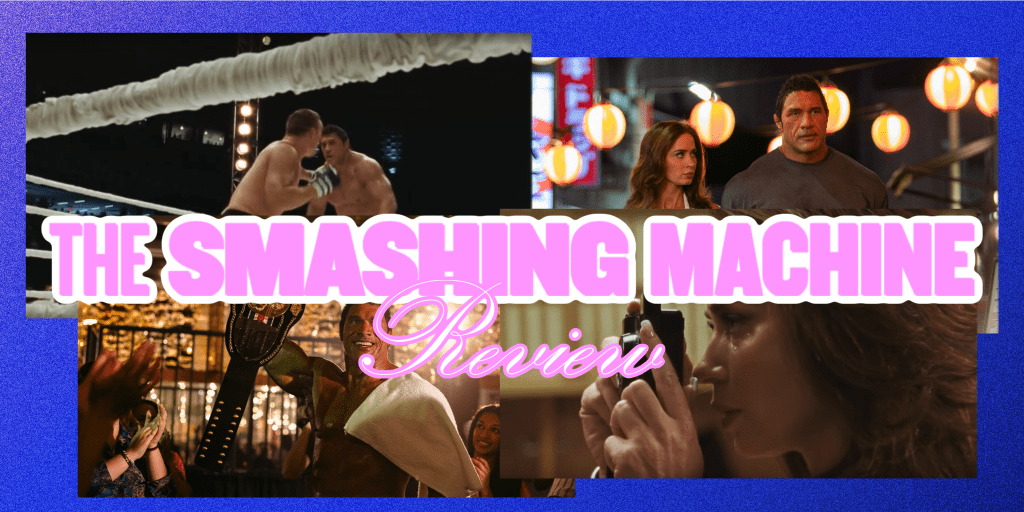
The Smashing Machine is anything but the stereotypical sports drama and focuses on a story of empathy and human vulnerability. A story full of blood, sweat, and tears exploring how obsession eats away at a person until all that’s left is the man in the ring performing for those who don’t know the insecure, tender man underneath. Paired with brilliant direction and clever writing from Benny Safdie, Dwayne Johnson is able to deliver a gentle performance exploring the idea of trying to find a peaceful balance between what makes us or breaks us in a body that is treated as spectacle and becomes a prison.
On some level, The Smashing Machine is Benny Safdie’s Marie Antoinette. Not simply through the style or music cues, but an exploration of the claustrophobia of fame and the troubles that accompany it. Stories of toxic fame and trappings stemming from celebrity have always been of a personal interest for me but there is something so fascinating at the way Safdie captures Mark Kerr (Dwayne Johnson) in the film. The audience watches in the same manner we consume pop culture, but The Smashing Machine puts us in the ring alongside our subject, figuratively for both the octagon fights and martial spats, we’re always a fly on the wall in a documentary style sense of watching. A modern master in the making, Brady Corbet, has jumped in on the imprisonment of fame and what the celebrity mindset does to a fictional subject over multiple films but there’s something so harrowing about watching a study on a real-life figure, particularly one who was failed by celebrity circumstance. Toxic masculinity often prevents men from discussing emotions freely and in various sports biopics, we see how this creates the harshest of downfalls of these icons. There’s a mayhem within Mark as on the outside, he presents as a softspoken, gentle man, yet you can sense he’s haunted. In the opening voiceover, he’s talking about the feeling of nothing else mattering when you win, yet it’s clear he’s talking about the thrill that accompanies the violence of the sport. However, as the film explores, there’s a clear detachment on Mark’s end of the pull of the ugly, viciousness of the violence and the sweet man struggling to hold it all in. Where a film such as The Iron Claw focused on imposed or forced masculinity and parental chasing of success through fame, Safdie with Mark focuses on the (mostly) self-imposed chase for glory, fame and fortune and not only what it does to the man but how it impacts all those around him. Especially with his eventual wife, Dawn (Emily Blunt), who pushes him in the worst possible ways but is also the one who is always there for him.
While it’s not new to see a film, specifically a sports film, about losing, it’s interesting with Mark in this period of time in his personal life and career. with winning, either in sports or with your personal milestones, you’re left with a “now what, what’s next” feeling. with losing, it’s where you learn the most about yourself. Losing a match, you push yourself to become stronger, faster, bigger. losing the love of your life, most people look into where it went wrong, how can they work on changing for the better another chance with the same love or for the next person, a new chance at proving yourself worthy of love. Losing pushes you in a way winning doesn’t.The Smashing Machine pairs back in a nice way with Lenny Cooke (Safdie’s documentary co-directed with his brother Josh) for all these reasons but where this narrative film differs is an insight into Mark’s undoing… how the love of his life can also be his undoing in combination with his drug use, loneliness and obsession with not losing. Dawn and Mark have a consuming, hurricane of a relationship and it feels true to a marriage to watch two people not always act as you want them to but also not as they’d like themselves to act towards someone who is their partner, their biggest supporter. For all the good Dawn does for Mark, she also seems to do more harm as she chooses the worst possible moments to rightfully call him out. Safdie crafts a brilliant approach at both being both right and wrong, a true relationship of two people who wanted it to work but simply were just not good for each other.
There’s an idea throughout the film that isn’t really about losing or winning but just the attempt itself, trying over and over. It’s an interesting approach with the sport as you continuously get new fights, however, in a relationship or a marriage, how often can you just keep trying? With professional athletes, their work truly never ends. Their bodies are constantly on the job and while that creates a physical and emotional burden on the person themselves, The Smashing Machine allows a glimpse into how that takes a toll on the person they share their life with. While Dawn is not always portrayed as the perfect, dotting partner to Mark, she does take a brunt for the downside of Mark not being able to clock out the second he steps out of the ring. The strict routine, the pressure on the body and eventually the mind is always eating away at Mark. The mental anguish, pressure and injuries lead to him turning to drugs and an eventual addiction untreated for years. It’s not just his intense training periods she puts up with but opiate-induced binges that trigger him furious over how she prepares his meals to him lying unconscious on the floor. Yes, wives and partners of athletes understand on some level the dedication required of their partner to their craft, but living with it is a different reality. Safdie brings a sense of realism to the entire film, but the surreal relationship moments set The Smashing Machine apart from many other sports biopics.
Johnson is not typically associated with losing and is typically always playing some sort of likable character. Pairing beautifully with the approach of a slice-of-life almost documentary style film from Safdie, Johnson delivers a tender, intimate performance that has completely changed the way many will look at him as an actor. Johnson is able to bring an interesting perspective to Mark as Johnson is from a similar athletic background, however, he’s spoken at length in interviews about how his wrestling career was performative combat and MMA/UFC is all real violence. His experience in wrestling allows for space awareness in the ring, rope-to-rope and knowing where other bodies would be. Safdie and cinematographer Maceo Bishop keep us out of the ring, as a spectator, and Johnson’s physical performance is all him. There’s no trick of a close up and switch to a stunt double, he’s really taking it all and that physical impact makes for an even heavier emotional one. Johnson is the perfect vessel for the subtle, yet turbulent tale Safdie is presenting. Blunt, who has worked with Johnson before, is the perfect partner throughout all of this. Johnson’s transformation is quite massive, with extensive prosthetics from the brilliant Kazu Hiro, weight gain, and a softer voice, Blunt brings a familiar comfort and emotional bond that feels years in the making. It’s easy to see why they have an electrical draw towards one another, their chemistry is palpable and the glances between them are truly enough to feel their bond. Dawn is almost the biggest threat to Mark throughout the film, their domestic life, while filled with some moments of bliss, is anything but perfect and Blunt brings a warm intimacy to a complicated person. While Dawn starts out with good intentions any girlfriend would have for their boyfriend, as the domestic sparring gets more intense, she becomes overcome with resentment and edges Mark on with the worst tendencies. Dawn could so easily be disregarded as a throw-away wife, but Blunt ensures audiences see Dawn as the real woman she is. No one else could have played her and Blunt has truly never been better.
The Smashing Machine is entirely shot from the outside looking in; for domestic and octagon fights, Safdie and Bishop keep a documentary-style as the audience is always watching at a distance, much like we’re in an arena. The film is getting a limited IMAX release as it was shot on 16 mm film but features full frame 65 mm and even VHS work blown up to IMAX size. Bishop and Safdie had a brilliant collaboration with IMAX to pull this off and make it work as you feel the scale of the budding fame of Mark, yet the humanistic story never loses its place. The opioid highs always present as lows with the handheld, docudrama-style camera balanced with steady long-lens zooms and Nala Sinephro’s atmospheric jazz score. You can feel Safdie was never going for a replication of The Wrestler or Raging Bull, his film is truer to the documentary it’s based on and honoring the mentality and personal legacy of Mark Kerr versus being a sports biopic. While the film hits some of the cliché notes of a sports film, The Smashing Machine features more of a daydream approach to the fragility of life’s turns through addiction, loss, and the art of trying to lead life with a tender nature.
The star of The Smashing Machine is truly Safdie. From the approach to keep the film more interested in the spaces between the big fights, both in the ring and with Dawn, to the deviation from sports biopic to character study, the writer/director/editor keeps the focus on the man Mark Kerr is versus the career he had. Everything from the editing (entirely different from any Safdie Bros film you may have been expecting) to the music selection is perfect to serve the introspective approach he’s taken. You can feel how important the song choices were with every needle drop, but clearly, the most care was taken with the selection of Elvis’s ‘My Way,’ as it feels entirely deliberate to use this specific version of the song with how Elvis struggled with painkiller addiction just as Mark was at this point in his life. The focus shifting to how different the outcome was for Mark with the people who surrounded him caring more for him as a person versus a performer, a stroke of brilliance from the storyteller Safdie is.
The Smashing Machine is anything but the stereotypical sports drama and focuses on a story of empathy and human vulnerability. A story full of blood, sweat, and tears exploring how obsession eats away at a person until all that’s left is the man in the ring performing for those who don’t know the insecure, tender man underneath. Paired with brilliant direction and clever writing, Johnson is able to deliver a gentle performance exploring the idea of trying to find a peaceful balance between what makes us or breaks us in a body that is treated as spectacle and becomes a prison.
Grade: A-
Oscars Prospects:
Likely: Best Lead Actor (Dwayne Johnson), Best Supporting Actress (Emily Blunt), Best Make-up & Hairstyling
Should be Considered: Best Director, Best Film Editing, Best Sound, Best Cinematography
Release Date: October 3, 2025
Where to Watch: In Theaters
Kenzie Vanunu
she/her @kenzvanunu
Lives in LA. Misses Arclight, loves iced vanilla coffees.
Favorite Director: David Cronenberg
Sign: Capricorn


 offscreencentral.com
Leave a comment