
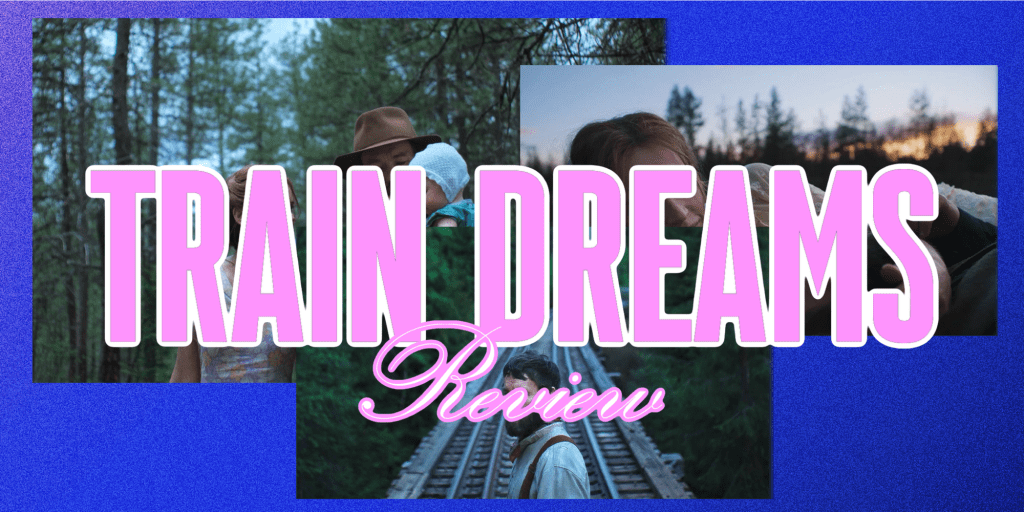
Train Dreams is something utterly beautiful and timeless—a film that doesn’t just tell a story, but holds space for memory, grief, love, and reflection. It lingers in the mind long after the final frame, reminding us why we turn to art in the first place, and why, sometimes, the quietest moments can leave the deepest marks.
“This world is intricately stitched together […] every thread we pull, we know not how it affects the design of things.”
I grew up in a quiet, small town, surrounded by endless boreal forests and shaped by the steady pulse of the forestry industry. Lumber defined much of daily life, and the town’s place on the national railway made it feel remote, connected to the world only in small, distant ways.
Most of my life, I was held by this forest, its hush of branches in the wind, the resin-sweet scent of pine heavy in the air, the kind of stillness the city could never offer. The low hum of sawmills, the distant rumble of trains passing through — those sounds were as constant as birdsong. For years, it felt like home: steady, familiar, a place where time slowed and life seemed simple. Those forests did more than shelter me; they taught me to notice the quiet patterns of life, the invisible threads connecting people, work, and land.
But when I became a teenager, that calm began to feel suffocating. There was nothing to do, no pulse beyond the slow rhythm of the town and the surrounding woods. I no longer felt I belonged; the place that had nurtured me could no longer give me what I needed or aspired to. Leaving felt like escape, as though stepping into a bigger, louder world would set me free. But I realized the forest had never released me; it waited.
Over time, I returned occasionally, whenever I needed to disconnect and recharge and to touch that quiet I had once known. Always for short times, as I never truly felt I was meant to go back there, but now, the pull is different; urgent, insistent, impossible to ignore. I don’t want to go back; I need to. How long? I don’t even know. I don’t fully understand why, or what I’m searching for, but the forest calls me with a force I cannot resist, even as life keeps me away.
The truth is, I miss home. I miss it so deeply, and Train Dreams carried me back there. Few films have affected me this profoundly — it hit me viscerally and left me raw in ways I didn’t know a film could. You know how they say that everything happens for a reason? Attending the International Premiere of Train Dreams at the Toronto International Film Festival felt like one of those rare moments, as if life (or Netflix) brought me there for a reason. The film struck a chord in me with the weight of a tree falling in the forest — sudden, resonant, impossible to ignore. Its echo threads through my thoughts like a refrain I cannot silence. Whenever I pause long enough to let it reach me fully, my eyes blur with tears, as if the film itself is still unfolding inside me.
For decades, most of my family worked either with the train company or in the forest, and Train Dreams brought that world to life with staggering intimacy. Watching Robert Grainier (Joel Edgerton) carve railroads through the endless wilderness felt like witnessing an echo of my own family — men who spent their lives with axes in hand (now operating harvesters) and on the tracks, their labor intricately woven into the land I grew up in. I’ve never felt such a deep connection to my own life and my family through a film before. Its power is undeniable, raw, immersive, and haunting in the way it makes every moment feel alive.
In its quiet way, Train Dreams reminded me that the places we come from never truly loosen their grip. They live on — in memory, in family, in art — and sometimes, if we’re lucky, in the darkened glow of a theater.
After Jockey (2021) and Sing Sing (2023), Clint Bentley and Greg Kwedar reunite to bring Denis Johnson’s novella to the screen, delivering perhaps one of the most beautiful films of the year, if not of the decade.
Logger Robert Grainier devotes himself to the monumental task of expanding the railroad across the United States, a pursuit that carries him far from home for months at a time, leaving his wife, Gladys (Felicity Jones), and their daughter, Kate, behind, and forcing him to navigate the delicate, fragile threads of family from a distance. As he moves through forests, across rivers, and along tracks that stretch endlessly toward the horizon, he wrestles with his place in a world quietly but inevitably shifting, where old ways of life are slowly disappearing.
Grainier is more than a man of duty; he is a man haunted. Orphaned as a child, he carries with him a deep, unshakable loneliness, a sense of being unmoored that shadows even his most tender connections. When tragedy strikes, it breaks him in ways that feel almost unbearable. His grief is so heavy that the line between memory and imagination begins to blur: visions, dreams, sounds, perhaps hallucinations take hold, leaving us to wonder whether what he sees is real or only the echo of guilt and love. The forests and rivers around him often feel less like landscapes and more like extensions of his grief, mirrors of memory and loss. He wasn’t there when his family needed him most, and that absence lingers like an unhealed wound, threading through every choice he makes and every bond he tries to hold.
Caught between duty, ambition, and the quiet ache of longing, Grainier must reckon not only with the true cost of progress of the world around him and of the life he holds closest to his heart, but also with the ghosts of all he could not protect.
Train Dreams is quiet and modest, yet its impact is immense — resonant in every subtle gesture, every lingering glance, like sunlight slipping through the trees or the distant rumble of a train across the plains. A beautifully heartbreaking meditation on life, grief, and guilt, it inhabits that fragile space between nostalgia and humanity. The film’s measured pacing allows grief, longing, and fleeting joys to unfold slowly, so that even the smallest moments carry quiet, monumental weight. It reminds us that art does not need to be extravagant or loud to leave its mark; in its quiet simplicity, it can pierce the heart, linger in memory, and stir emotions you didn’t even know were held within you. Watching it feels like returning home for the first time in years — familiar, yet breathtakingly new — and its echo stays long after the final frame, breaking you over and over in the most profound, unforgettable way.
Visually, the film is nothing short of breathtaking, and Bryce Dessner’s score elevates every moment, weaving a haunting, meditative layer into the experience. Adolpho Veloso’s cinematography transforms each frame into something you want to live inside — towering forests that seem endless, rivers shimmering under shifting light, wide open skies that feel both infinite and intimate — while Dessner’s subtle yet aching music draws the audience deeper into the quiet power and poetry of this world. The interplay of light, shadow, and landscape mirrors Grainier’s inner life, turning the wilderness into both a refuge and a space that echoes his grief and longing
No matter their screentime, every actor in this film delivers one of the most touching and deeply human performances I’ve seen this year. Even in the briefest moments, they move us to tears, whether it’s Kerry Condon, Felicity Jones, or William H. Macy. Each brings a quiet honesty that lingers long after their scenes fade, shaping the emotional landscape of Grainier’s journey as much as Edgerton’s own towering performance. A single glance, a fractured smile, or a few words spoken with restraint become enough to pierce through, reminding us that this story is not just Grainier’s but a tapestry of lives, each one fleeting, yet profoundly felt.
Joel Edgerton delivers one of the most affecting performances of his career, disappearing so fully into Grainier that it feels less like watching an actor and more like witnessing a man quietly unravel. There’s nothing showy in his approach — his grief, longing, and bewilderment at a world slipping away are conveyed with such restraint that it somehow hits even harder. It’s the kind of performance that breaks you not with grand gestures, but with the weight of silence, with the way his eyes hold a memory, or his body seems to carry years of unspoken sorrow. Kerry Condon was right: “he’s consistently been very good,” but here, he’s transcendent.
Train Dreams creates space for reflection, allowing viewers to pause and consider the quiet significance of everyday life. Even amidst the routines and struggles of daily existence, there is profound beauty in simply being present. Ordinary moments, often overlooked, carry their own stories and meaning, and Bentley and Edgerton emphasize that a life lived through these rhythms — though unremarkable on the surface — can be quietly heroic. The extraordinary, in this sense, resides in the ordinary, revealing the depth and value of a life fully experienced.
It is precisely this ability to illuminate the extraordinary within the ordinary that makes cinema so powerful. I’m endlessly grateful for films that can offer both escape from the realities we live in and a deeper connection to the people, moments, and feelings we’ve lost, cherished, or still long for. Train Dreams is one of those rare works that does both at once. Bentley has crafted something utterly beautiful and timeless, a film that doesn’t just tell a story but holds space for memory, grief, love, and reflection. It lingers in the mind long after the final frame, reminding us why we turn to art in the first place, and why, sometimes, the quietest moments can leave the deepest marks.
Perhaps, the forest calls me back now because, as I grow older, I’m beginning to understand that the true beauty of life often resides in the ordinary — quiet rhythms, simple presences, fleeting moments — more than in anything grand or extravagant. That understanding also helps explain why Train Dreams struck me so profoundly: it reflects that very realization, celebrating the weight and wonder of ordinary life, the hidden poetry in everyday labor, love, and longing. For me, it resonated with the pull of my own childhood; the place I once found suffocating, yet could never truly leave, and reminded me that even in simplicity, there is depth, resonance, and an aching, unforgettable beauty.
Grade: A+
Oscar Prospects:
Likely: Best Cinematography
Should be Considered: Best Lead Actor (Joel Edgerton), Best Adapted Screenplay, Best Film Editing
Release Date: In Select Theaters on November 7th and Streaming on Netflix on November 21st

Mar Tremblay
she/her @_martremblay
Lives in Montréal, can recite the Cerulean Monologue from The Devil Wears Prada word for word, and rewatches Mamma Mia at the slightest inconvenience
Favorite Actresses: Cate Blanchett & Gena Rowlands
Sign: Leo





 offscreencentral.com
Leave a comment