
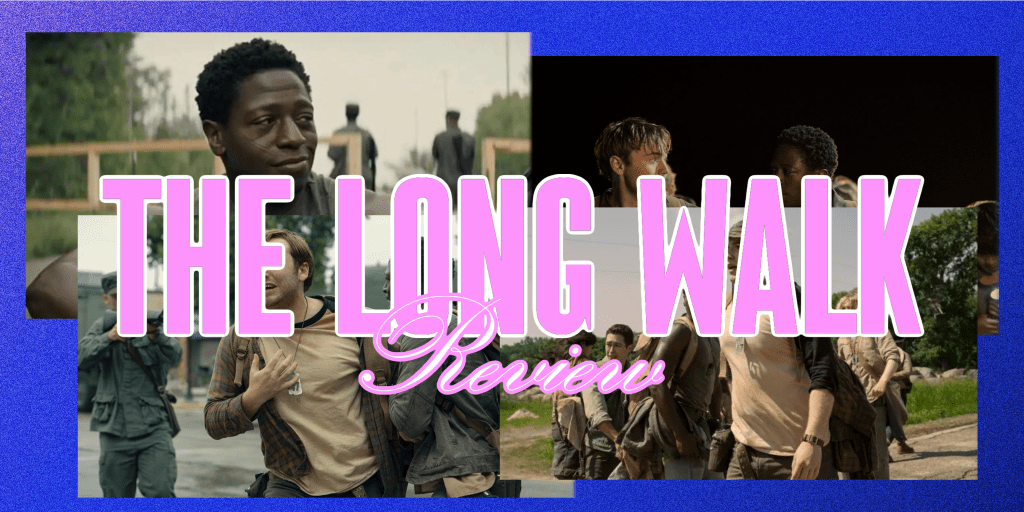
Stephen King’s The Long Walk has long been considered ‘unfilmable’ with its relentless repetition seemingly resistant to a cinematic adaptation. However, with Francis Lawrence at the helm and talent of his ensemble, this film transforms King’s tale into a suspenseful, horrifying, and deeply human experience.
The Long Walk contains graphic depictions of violence, blood, bodily functions, and suicide that may be disturbing to some viewers. Help is always available whenever needed with the 24 hour Crisis Lifeline available in English and Spanish. Call or Text 988 to speak with someone today.
Francis Lawrence’s The Long Walk adapts one of Stephen King’s earliest and most unsettling works. On paper, the premise sounds almost unbearably monotonous – a group of young men walking until only one is left alive. yet, Lawrence proves why he is one of Hollywood’s most skilled genre directors. Through sharp blocking and purposeful camera placement, he transforms such endless stretches of dialogue and trudging footsteps into a cinematic pressure cooker. Each frames builds dread, every movement of the camera reminding the audience that survival on the walk is not just unlikely, it is inevitable only for one. What might have been tedious instead becomes suspenseful, claustrophobic, often horrifying, and in the end absolutely tragic.
The screenplay by JT Mollner takes risks, particularly in diverging from King’s original ending. Rather than a betrayal of the Novell, the changes breathe new life into a story many fans thought they already knew. The film still retains its allegorical sharpness, though Mollner occasionally leans too hard into the political commentary (or perhaps it seems that way due to recent events). It’s a tricky balance: King’s novel, written in the 1970s, comes with a cultural baggage that doesn’t always translate seamlessly to the present. molder does what he can to update certain aspects, but some of the bluntness is baked into the material itself. Fortunately, when the commentary may stumble, the human drama as well as the fabulous actors keep the film on track.
Visually, The Long Walk is stunning. Jo Willems’ cinematography brings unexpected. beauty to a grueling premise. His nighttime compositions shimmer with penance, cloaking the walkers in both mystery and despair. By contrast, his daytime sequences leave no room for escape the camera lingering on the agony etched across the young mens’ faces. Willems balances the horror of the violence with painterly restraint, ensuring that the. brutality never feels gratuitous, only devastating. It is an approach that respects both text and the audience, refusing to sanitize the material while still elevating it above mere shock value.
As good as the direction and visuals are, it’s the ensemble cast that elevates the film into something extraordinary. Cooper Hoffman and David Jonsson carry the heart of the story, their chemistry anchoring the film into something deeply human and personal. Jonsson, in particular, emerges as the emotional core, his performance both vulnerable and unflinchingly raw. Garrett Wareing and Tut Nyuot provide heartbreaking turns, while Ben Wang injects much-needed humor without undermining the bleak tone. Joshua Odjick and Charlie Plummer add further texture to the ensemble, each making their short time on screen unforgettable. Mark Hamill, as The Major, is having the time of his life portraying a menacing yet charismatic villain who is much more prominent here than in King’s novel, becoming the embodiment of the walk’s cruelty.
One of the film’s greatest strengths lies in its ability to sustain tension over such a narrow narrative scope. The repetitive structure of the walk could have drained the story of life and momentum, but Lawrence constantly shifts perspectives and energy. Sometimes the horror is external with the relentless enforcement of the rules and the sudden eruptions of violence. Other times, it is internal, found in the despair creeping across the walkers’ faces or the bonds they form knowing those friendships will soon be severed. It’s a masterclass in pacing, with long stretches of silence punctuated by moments of brutal shock that leave the audience as breathless as the characters.
There’s also a hauntingly contemporary resonance to the film. Even though King’s novel comes from another era, the themes of spectacle, control, and public appetite for cruelty feel chillingly relevant today. The story’s dystopia doesn’t seem as far-fetched when placed against modern obsessions with reality television, competitive sports, viral spectacle, and violence. While Mollner’s screenplay sometimes underlines these points too boldly, Lawrence wisely lets much of the commentary sit in the background, allowing the viewer to connect the dots without constant prodding.
Ultimately, The Long Walk is not an easy film to watch, nor is it meant to be. It is grim, unrelenting, and shocking in its brutality, but it is also brilliantly crafted and deeply affecting. The cast and crew have turned what could have been a plodding adaptation into one of the most suspenseful and horrifying King films in years – a march towards death that is impossible to look away from. The result is both faithful to King’s vision and daring enough to strike out on its own, leaving viewers shaken, haunted, and strangely moved.
Rating: A-
Oscar Prospects:
Likely: None
Should Be Considered: Best Supporting Actor (David Jonsson), Best Cinematography, Best Film Editing
Where to Watch: In Theaters

Sarah Abraham
she/her @sarsaraaaaah
Lives in Orlando with her mom & dog. Clarinetist that loves movies, EDM, yoga, hot girl walks, and tzatziki.
Favorite Actor(s): Omar Sharif, Danielle Deadwyler, Hiam Abbass, and Daniel Day-Lewis
Sign: stereotypical Taurus
 offscreencentral.com
Leave a comment