
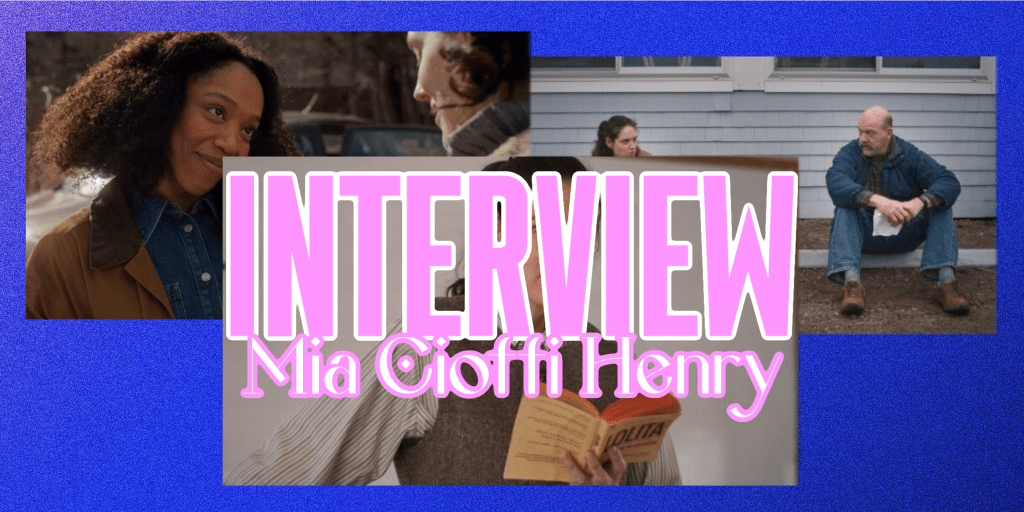
*Warning: This interview contains spoilers for Sorry, Baby*
The major event that happens in the second chapter of Eva Victor’s quietly shattering directorial debut Sorry, Baby isn’t shown. In fact, the camera simply sits outside a house as day turns to night, with the audience left to suspect what is taking place behind closed doors.
It’s not until the protagonist, Agnes (played by writer/director Victor), walks out of the house, the camera fixated on her in one unbroken take as she hurries into her car and takes in what just happened, that the audience begins to understand something horrific has just occurred at the hands of her English literature professor (Louis Cancelmi).
For cinematographer Mia Cioffi Henry, it was important to “lose the audience” when depicting the sexual assault. “I think demanding an active viewership of the audience and letting their gears turn, providing space for them to really be thinking about it and what could be going on — those are the same questions racing through Agnes’ mind as she leaves the house,” Cioffi Henry explains.
All of the department heads on the film were women or non-binary, which was important in creating a safe space on set. “I think that you would be hard pressed to find one of them who hasn’t had some sort of experience in this realm — myself included,” Cioffi Henry admits. “And so I think it became a very personal story for all of us to be able to depict this kind of violence and assault in a way that doesn’t glamorize or glorify it. It also doesn’t put it on this pedestal as this big coming-of-age moment, but lets it be this back-burning, simmering thing throughout somebody’s life.”
To explore that “back-burning” effect, Victor has structured the film into five different chapters (including an epilogue), with details and moments that remind Agnes of her trauma layered into simple, everyday moments. Offscreen Central had the opportunity to break down the visual language at the center of the film with cinematographer Cioffi Henry, including the happy accident that brought the car scene to life and why Certain Women and Saint Omer were major contemporary inspirations.
This interview has been edited and condensed.
Matt Minton: Congratulations on this incredible film! To start off, could you speak about how you and Eva wanted to visually explore the subject of assault and trauma?
Mia Cioffi Henry: For not having gone to film school or really been on a feature film set before, Eva had such a great sense of visuals in the writing. So it was actually quite easy to pull out, because it was written right in there — this sense of staying outside. The hardest part was really just figuring out how to make it feel significant. As a cinematographer, we ended up talking a lot about how to treat time differently in the rest of the film, between the different chapters. Particularly, in what we counted as the sequence leading up to that long shot outside the house and all the way up through the description of the assault. So we really reverse engineered that. We wanted the camera to feel as lost as Agnes is in moments following what happens in the house. We wanted to feel intimately close, while also withholding information.
We created a long tracking shot that would go straight from the house into the car, and then that long car drive up until the bathtub scene. There’s that kind of interstitial scene when she walks into the house and Naomi [Ackie’s character] says, “What happened?” And so that was sort of like, “OK, let’s stay outside. Let’s keep the camera outside in that moment.” I really stressed the visual language and the temporal pacing before all of that. We needed to slow the film down in that sense and create a visual language, almost like we were taking a magnifying glass on that moment in time.
Matt Minton: To pull off the long take in the car, what were some of the practical considerations that went into shooting that sequence?
Mia Cioffi Henry: That was really tough because we shot all of that on the same day. There was a scene that got cut from the script that took up a lot of time as well. So we basically had two takes to do that car driving shot. We planned out a route, knowing that we wanted street lamps. We were in a pretty sleepy area of North Shore, Mass., so a lot of the streets don’t have street lamps. We found a route that was basically continuous from all of the house, the school, the parking lot — all of that was in one block. You’re very lucky to find that. And then we plotted this route that we knew would get some shadows, would get some light. But what we didn’t plan for was a car pulling in behind us. I think that was our second take. We had a follow car further back, but this car pulled up right behind and ended up getting quite close. It creates this really blown-out effect because the headlamps go in the mirror and across Agnes’ face. I felt like it was such an amazing build up to that scene.
The secret of that scene that Eva and I like to whisper is that I’m in that scene too. I’m in the trunk of the car watching on the monitor because I was the only one who could see what was going on. We had gone so far from base camp that the signal didn’t go all the way back. So it’s really the two of us, and every once in a while, I do whisper from the trunk. There’s a few scenes in the film where it’s really just Eva and I, or Eva, Naomi and I in a very small space, which was very special, especially considering the collaboration that blossomed between Eva and I over the years of prepping the movie.
Matt Minton: I always love hearing about those little secrets that bring these scenes to life. I also think it’s interesting to look at Sorry, Baby as part of the evolution of how film can depict trauma. Were there specific tropes you knew you wanted to avoid or push past in telling Agnes’ story here?
Mia Cioffi Henry: One of the biggest things that we were interested in exploring was how it makes you question everything — not just the act itself, but all the things that follow, all the decisions that one makes. Kind of the lingering question, “Is this because of that, or would I behave differently if this hadn’t happened? Would my decision still be the same?” There’s a rested pensiveness throughout the film that was important to capture, more so than even trying to think about the assault as the central character or the central piece of the story. Thinking about it from this humanistic level and letting the intimacy of the camera and the visuals that we chose really highlight these gears turning in someone’s head.
From an academic standpoint, I’m always wondering about the female gaze and what that brings as a cinematographer to my work. Kind of this idea that I’m going to photograph something differently than a man because of the experiences I’ve had in the world, or because of the way the world treats me, or I look at the world. It’s often hard to define what that is because, try as I might to color something differently, all of my examples from the last 100+ years of cinema, for the most part, have involved men behind the camera. I consciously have to sift through that and see what’s serving me and what is not. Being able to emotionally connect with the material from a place of experience, and in particular in this moment, was able to provide the audience with an experience of questioning and not knowing what’s going on or what has just happened. “Was that right? Was that wrong? Where did that come from? What led up to that?” I think that being participatory is defining this newer gaze.
Matt Minton: I love what you said about the female gaze. And it’s interesting how the film interweaves these different ideas and motifs throughout the different chapters, from introducing the idea of Agnes lingering at the door in the first chapter. That’s something the audience doesn’t fully understand until later. How did you think about capturing these different chapters? It almost felt like a collection of short stories, but they still connect thematically.
Mia Cioffi Henry: When we think about the film as memory and an ability to look back on these specific moments, why we’re kind of joining Agnes in each of these vignettes, we had to give it a shape overall. We started giving colors to each of the chapters so that it would refine their purpose in the story, and how to make sure we were staying true to their purpose from scene-to-scene within them. Each chapter got a theme in our minds about why we were there, what it’s bringing, and we were able to then kind of create small and subtle visual language between each chapter.
So with the courthouse, we’re shooting it in this very particular way. It’s a lot of wide wides and a lot of tight tights. That feeling of anonymity that Agnes craves is there, but also being spotlighted and suddenly having to answer for her past — putting her on trial, as it were — exists in that scene as well. So we were kind of looking for that. And the first chapter versus the last chapter, which are the closest in time, but also have these big leaps in character between them, were really important.
Matt Minton: You mentioned having 100+ years of reference points from men, or coming from people who don’t understand the female perspective. Are there female or non-binary filmmakers working today that have really inspired you, or make you feel excited about the future of filmmaking?
Mia Cioffi Henry: Just in terms of references, we were heavily living in the world of Kelly Reichardt. Certain Women was a really big reference for the types of stories and the way that women are portrayed on screen, how central they are. We love that feeling and sense of a world beyond just the story that happened to be happening on screen in that moment. That had a lot to do with female filmmakers, for sure. Someone like Alice Diop and Claire Mathon, that’s an amazing collaboration that’s not necessarily the classic way of creating films, but comes from this very emotional, interior-life perspective. So I’m always just excited to see what Alice is up to, and I got a chance to spend time with her this year and kind of live in her world for a little while. Saint Omer was absolutely a reference as well for the film, but was a strong favorite even before that.
Matt Minton: And I know it’s been a journey with this film having its world premiere at Sundance, getting acquired by A24, and recently screening at Cannes. What have been some of the big takeaways in how people have responded in different places around the world?
Mia Cioffi Henry: It was my fifth film at Sundance, but my first time at Cannes. So those are very different experiences. Sundance feels a little bit like home turf in a lot of ways. It was a really different experience, though, with this film. As soon as the credits rolled, I knew it was something very special. We got to premiere at the Eccles Theatre, which is just a massive screening space with 1300+ people, and you could feel the entire audience the whole film. Then there was like a two minute standing ovation afterwards, which just doesn’t happen at Sundance. So I knew it was a very special film in that moment, and then to have what felt like a really classic Sundance experience that doesn’t seem to exist anymore, with multiple companies vying for the film and an overnight bidding war. It just felt very like, “Oh my gosh!” And then to end up with A24 was beyond my wildest dreams because that’s obviously such a groundbreaking and important distributor — It brings so much behind their own name to the film and people who want to see it just because.
Cannes was very different because we had already been sold, we had already played at some other festivals. But to be there on a kind of international stage was very different and special in its own way. My whole anxiety there was, “Is it going to play well with the French audience?” Because there’s so much that’s very funny about the film, but you wonder because sometimes — my husband is French, so I can definitely say this! — the French laugh at very different things than we do. I just thought, “Oh my gosh, is there going to be any laughter in the theater?” And there was. And I was sitting with the French distributors at that screening, and had said that before. As soon as it was over, they were like, “See! The French find things funny.” So every screening has been different and special, but it’s all felt very positive and celebratory, which is great. It’s definitely out in the world!
Matt Minton: That’s awesome. I’m genuinely so excited to see what you do next, congratulations on the film!
Mia Cioffi Henry: Thank you so much!
Sorry, Baby is currently playing in theaters, with a nationwide expansion on July 18.
You can find our review of the film here.
 offscreencentral.com
Leave a comment