
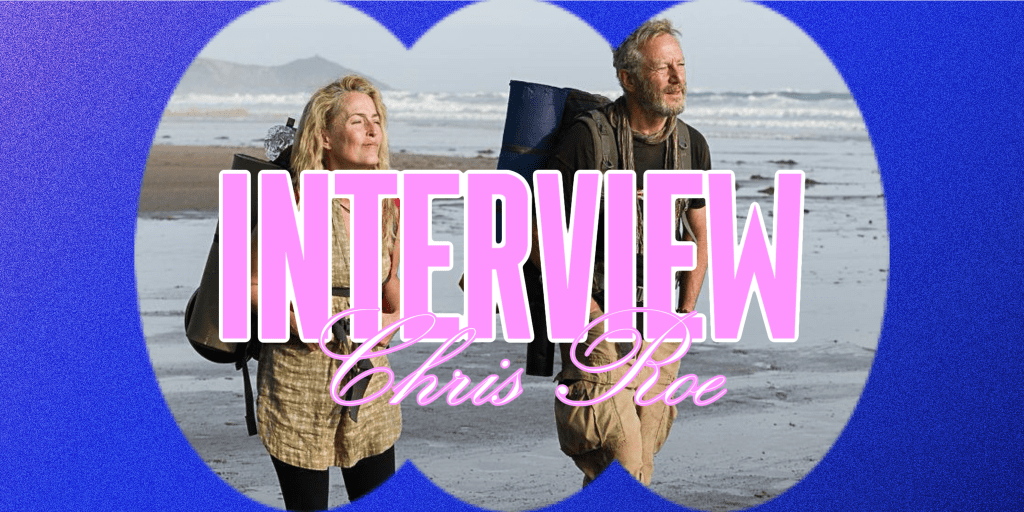
Composer Chris Roe sits down with Offscreen Central to discuss his work on the upcoming film The Salt Path (starring Gillian Anderson and Jason Isaacs). He discusses how he prepared to create a minimalist yet emotionally impactful score, giving the mandolin and contrabass flute their moment in the spotlight, and much more!
Sarah Abraham: Hi, Chris! I’m excited to talk to you about this film because I know we mentioned it in our last interview. So, what led you to this project? work on this film.
Chris Roe: I got an email out of the blue from Liz Carson at Number 9 Films, and I think Marianne (Elliott), the film’s director, had seen some of the films that I’d score before, like Blue Jean and After Love, and I think she liked the sort of minimalist approach. She’s a theater director and this was her first film. She’s done some amazing theater projects, but she started, I think, not wanting any score when she started the process, and so that was where she was coming from, and seeing films like After Love that are very emotional, but also have quite a minimal amount of score, I think she liked what I did on that. So, I listened to the audio book, I got really into it, and we had a great meeting.
Sarah Abraham: Awesome. I was going to ask if you had, because I know it’s based on autobiography, if you had read the book, and if you did any other research with preparing for composing the score? Like, did you look into the music history of the region that it’s set in? What all did you do for that?
Chris Roe: Yeah, in the kind of interest of time, I’d heard a lot about the book, but I hadn’t had time to read it, and so I got the audio book for time, but I was actually really glad that I did that rather than reading it first, because it’s narrated by Rainer (Winn) herself, and so you kind of get the way that she delivers it in quite an understated way. It kind of gives you an insight into their characters and the kind of people they are. It also meant that I could put it into my headphones and, like, walk around my local woods. I went on some really long walks just listening to this, can’t remember how many hours – maybe nine hours, 10 hours or something. It was a wonderful experience, getting into that kind of rhythm whilst walking, because a lot of the book and the way that Rainer delivers it, I think it was written originally as a just a diary of their time on the path of their journey that she would give to Moth (her husband) as a kind of birthday present. A lot of it is just describing their journey and who they meet and everything. Then suddenly there’s these knockout moments of flashes of poetry, and that really kind of inspired me.
It was a great way into the project before I’d seen the script, before I’d seen any of the cut or anything. In terms of research, I didn’t do any, like, official research, I suppose, but I started to think a lot about the instruments that would be in like folk communities from Cornwall and Devon and where the film is set. I went out and bought a mandolin specifically for the project, like an English mandolin, rather than the Italian one, and sort of taught myself to play a little bit of that. I also got, we’ve done quite a lot of holidays in Pembrokeshire in Wales, which is like a similar landscape. So, I brought back some gorse, which is like a plant that grows kind of spiky, like a thorny bush that grows by the sea, and I experimented with that on the mandolin strings, and strumming the mandolin with that, and trying to create as many sounds like that as possible. I also got them with those mandolin strings like I tuned them to a chord, each string to a different note, and then scattered, like I got some flaked salt, and sort of scattered it onto the strings, because salt is a really important part of the book which is about the couple becoming salted and becoming part of the sea and a part of nature. So, yeah, I thought that would be a cool idea to try and it made a kind of really magical sound, which ended up in the film.
Sarah Abraham: I was listening to the score this morning while I was on my – I’m going to say on my bike. It’s a stationary bike in the living room, and where it’s stationed, I’m looking out onto a window of…it’s a parking lot. But, you know, it did set the mood. It has a very emotional feel, while possessing elements of the natural world, which I really enjoyed, and I loved. You mentioned the mandolin. I loved the use of that in there, and the folk elements I also heard some bits of a contrabass flute, and I love that. You already know, I’m a band kid, so I always love hearing wind instruments and then the violin as well. What drew you to using those two instruments, specifically the low flute, the contrabass flute, and then the folk violin?
Chris Roe: We wanted to find ways that we could mimic the sound design and mimic the nature around them. The contrabass flute…I’d always wanted to work with Carla Reese. She’s kind of known in London as being one of the best improvisers particularly on low, low flutes. Yeah, she’s an amazing, amazing player. You can put anything in front of her, and she’ll play it, but also comes up with amazing sounds and textures. We did a bit of remote recording first, where she showed me what was possible with the instrument. I was surprised actually, how for such, it’s such a big instrument, but it’s actually quite a gentle sound, but you do need to have a lot of breath through it. It’s very tiring to play and so a lot of the sounds you get ended up having that air quality, which I used for a lot of transitions in the film. So, like in the same way you might with a symbol swell, or where we go from one setting to the next, almost like a wave crashing over you. Carla’s really, really became like the sound of the wind and the waves in in the film.
Then Ruby Colley is an amazing composer and violinist with more of a folk sound, I would say. I gave her lots of ideas for themes to play, and she would always add her own spin on it, and add little grace notes around it, and she always played with real heart which is what I knew we needed for the score. There’s a recurring image of a peregrine falcon that visits them along the path, and Marianne had this idea that she saw the peregrine as being like the queen of nature that was overseeing them along the path. So, we knew we needed to have a really strong theme for that and so I wrote this soaring violin theme that goes up and up into really difficult territory for the violin, but it’s because it is so high it sort of has a fragility to it, like a tightrope act, you know? Ruby plays it with such heart throughout the film. Carla and Ruby were the two key kind of solo instruments in the film.
Sarah Abraham: I love that you mentioned the contrabass and that it takes a lot of breath work. I tried playing it in college because one of my friends was in flute choir, and I nearly passed out after maybe playing for five seconds. It’s takes a lot of breath work and a lot of skill and I love hearing it and it’s getting its time to shine here. It’s a lot more versatile than people would think looking at it. Also the violin, I know you mentioned last time we spoke, you mentioned Colley’s name, and you were excited for people to hear her work on the film. That’s so exciting, and… the higher register is called altissimo for woodwinds. I’m not sure if that’s the same for strings, but it is a very fragile area for them as they barely have any strings to work with, but it really it can set the mood quite well, especially when dealing with the subject of the film and what they’re doing. It’s a very interesting and specific choice that works well here. You already mentioned the salt on the mandolin. You had to learn how to play the mandolin, right?
Chris Roe: Yes, to some extent, and then I got an amazing player called Nik Ammar to play the more melodic material in the film. I learned it to demo with, but it’s the same as the violin, same tuning, although I kind of changed the tuning, but the original is the same. So, yeah, I had a way into it.
Sarah Abraham: What do you think the timbre of the mandolin specifically was needed for this film that other string instruments can’t provide?
Chris Roe: It’s a great question, because I also worked with…there’s a lot of harp in the film as well, with this brilliant harpist, Olivia Jageurs, who has worked with a lot of films, and the harp has a more rounded, more kind of mellow sound, which for the love theme between Ray and Moth, that’s where it shines, really, for those moments. It’s not sort of big harp glissandi, like you might get in an orchestra. Olivia is really great at the harp harmonics sound, which are very fragile. So, lot of the time the harp and mandolin actually play together, because I found they blended really well because they’re both plucked, but the mandolin is a much brighter sound, and particularly that idea of these two characters being salted, like the idea like salt is quite harsh. Like, both if you drink salt water, when you go swimming in the sea, that kind of feeling is harsh, but also kind of restorative, you know, like swimming in the sea, and these two characters could be becoming one with nature. So, I thought the mandolin, like that kind of harshness of the sound embodied that, and also it feels like it’s from that place. I mean, I think a lot of cultures have mandolins, but it’s quite a big part of English folk music from that area.
Sarah Abraham: I think the mandolin is underused in not just orchestra repertoire, but just in general. I think the tone is very unique, and it can be very beautiful, especially when used appropriately. So, because you have the film, and the story follows this couple walking this long distance, – also very appropriate that you were listening to the audio book while walking…very method, composer of you and I love that. These characters, they’re constantly moving and the scenery is changing with their locations. Did that impact how you went about composing, not just the orchestration, but also the counterpart used for your music?
Chris Roe: Yeah, absolutely! It’s always moving. We wanted the score to have a feeling like at the beginning, it’s almost like the score is a bit detached from the two characters, because it’s a bit far away. It’s like nature calling them in, drawing them in, and so once they’re kind of caught up in nature, it’s going along with them on the path, if that makes sense. So, it’s kind of at the beginning, it’s a bit more abstract, ethereal, and in the distance. Then, once we get halfway through the film, or once they’re really kind of into the walk and into their rhythm, the music becomes more rhythmic and has more of a flow to it. I found guitars and mandolin, again, quite useful, and the harp to give that strumming pattern to propel us forward on the path but still in a very gentle way. It’s a very gentle story and we didn’t want to overshadow the two central performances. Marianne didn’t want the score to ever become too saccharine, or like too glitzy or heroic, she wanted it to feel quite honest.
Sarah Abraham: It’s like a subtle underscore of what’s going on. The instruments, they’re soft, but they also are reminiscent of the sea or anything that is like nature. Like, it could just be wind making the leaves blow, so that’s very poignant. Do you have any specific tracks on here that stand out to you, that you were your favorites? Is it because of the instrumentation or the sound? Which ones were your highlights?
Chris Roe: I think one of my favorite cues is one called “Breathe” on the soundtrack album, and that’s one of the first as it’s about 20 minutes into the film. The picture of the film is actually squashed in at the edges. It’s not full, it’s not widescreen. It’s something you don’t really notice until it eventually goes widescreen. I think Marianne wanted to give this effect, that like when you’re walking and you’re not kind of enjoying it, you just have your head down and looking at your feet, and sort of they’re in shock for that first bit of the film. Then, this cue “Breathe” was when the first time the picture widens, because they start to look at the landscape around them and realize how beautiful it is. That’s their beginning of trying to live their journey into nature and it’s the first time that the music really picks it up. In the mix, we sort of pushed it. Also in the cinema, you finally get, sort of the base that and also it goes wider. It feels more cinematic. It’s the first moment it kind of does that. So yeah, and it’s the first time we hear the peregrine theme as well.
So yeah, that one and “Swim” was another favorite because it’s a really standout moment in the book, quite towards the end, where they go for a moonlit swim. They’ve completely left everything behind and are one with nature and with each other. So, it really stood out to me and was always one that I knew was going to be an amazing moment. Then, when I saw the footage, the cinematography, and what they captured, and Gillian Anderson and Jason Isaacs, it was so beautiful. Musically, it’s also a moment where these three themes come together. Like, the theme of nature with that kind of magical salt on the mandolin sound, and also the peregrine, because it’s sort of watching over them, and also their love theme. It’s quite a challenge to write, though, because it’s, I think, only about 25 or 30 seconds long that they’re underwater, it’s really trying to pack in as much as possible into that moment.
Sarah Abraham: That’s awesome. It’s always nice hearing highlights from composers about their work. I’m always curious, is there a certain element of your score that is maybe not on the forefront that you think audience members should keep an ear out for? For instance, I was listening to some of John Powell’s works a few days ago, and I noticed that I really liked how he has the bass line. It’s very subtle. It’s not the main melody, but it’s helping the horn line with the main theme really stand out. Are there any in this film, that you think are not quite at the forefront, but are equally as important, even though they’re in the background?
Chris Roe: Yeah, so Marianne from a theater background, and also musical theater. She has worked on Sondheim shows and these other huge things. I think when we first talked about the music, she really wanted this idea of hearing a theme three times and then the payoff from that. So, with their love theme, I really wanted to try and have something that you’ve sort of been absorbing throughout the film, but maybe haven’t fully understood it to be their love theme until you finally hear it more clearly, and that it’s sort of been building to that moment. That’s one that’s I suppose, a bit more hidden and something that hopefully does resonate, but probably isn’t a conscious thing, because it starts off as a baseline, sort of gradually three or four times throughout the film, but then after they go swimming and they’re in the tent, and there’s this kind of love scene that it’s played really clearly by just harp harmonics only. It sort of crystallizes as like the theme then. There’s that kind of hidden melodic or motivic kind of stuff. I think actually the salt on the mandolin strings is quite subtle. It’s sort of something that’s always there in the queues, but then isn’t really prominent, until towards right at the end, where they’re on the beach, and this woman says to them, “You’re salted,” and then it’s like it has always been there, and rises to the forefront. So yeah, hopefully it’s one of those things that it’s always there resonating, but it’s actually quite hidden.
Sarah Abraham: Then my last question, I know in our last interview, you teased this upcoming project. Do you have anything coming for the next year or this year that you’re excited to work on?
Chris Roe: Yeah, so I’m really excited! I have another film that will be coming out later this year, called Bad Apples, starring Saoirse Ronan and it’s very different. It’s a dark-comedy-thriller and it’s brilliant. I really love it as a film.
Sarah Abraham: So is there going to be clarinet in the score?
Chris Roe: There’s a lot of clarinet! I’m really excited for that to come out. Then, I’m also working on series three and four of Trigger Point, which is a really exciting show to work on. I’ve obviously done series two, but this is trying to dive back into the same sound world, but still keep it fresh and keep inventing.
Sarah Abraham: I’m excited! Oh, Thank you so much for talking. This is so niche, but talking about small stuff like the mandolin or the contrabass flute is very exciting for me.
Chris Roe: It’s great to have that attention to the music!
Sarah Abraham: Congratulations again! I’m very excited to hear your upcoming projects. Thanks for talking with me again. It was nice to see you.
Chris Roe: Great! Thanks, Sarah.
The Salt Path does not have a confirmed U.S. release date but is playing in select theaters in the U.K.
 offscreencentral.com
Leave a comment