
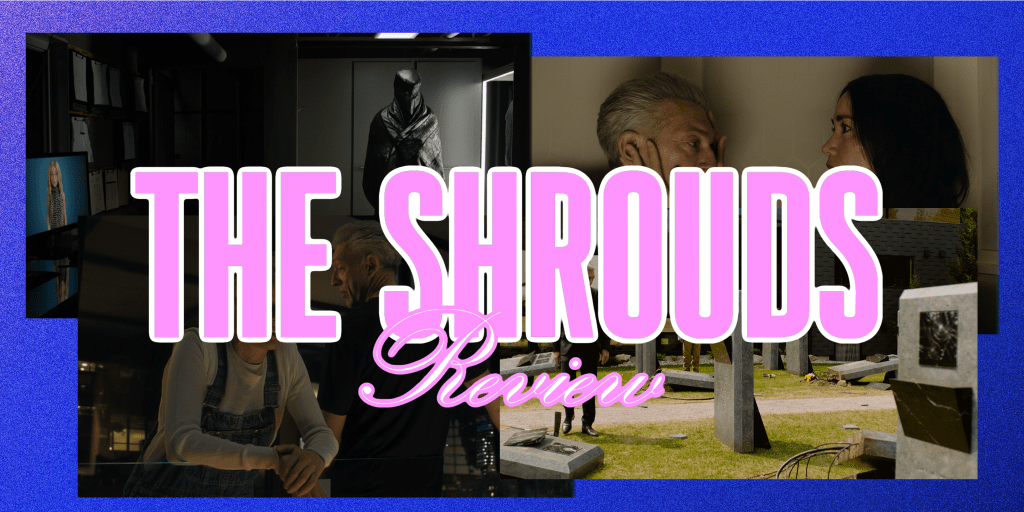
David Cronenberg is at his most vulnerable with The Shrouds as the film explores how we hold on to our connection with loved ones who are no longer here. While many exercises on grief are obvious and similar in what they’re saying, The Shrouds is more radical and complex as Cronenberg dives into an almost perverse romanticism.
The Shrouds opens with a dentist telling our film’s lead character that grief is rotting his teeth and Karsh (Vincent Cassel) immediately asks if that’s scientifically possible. The latest film from writer/director David Cronenberg focuses more on the connection we have with the dead and not only how technology can bridge that connection but its impact on us as we try to grieve. Cronenberg has described the film as autobiographical as he says it was inspired by his own grief at this loss of his wife in 2017. The Shrouds feels part techno induced thriller dealing with sex and politics but balanced by a vulnerable exploration of grief. Are the living truly meant to think this much about death? Cronenberg’s film brings together all the high-strung confusing emotions that follow after a traumatic experience, from lust to loss to insincerity. The brain going into overdrive trying to figure out how to truly grieve and be at peace with your life without the existence of another.
Howard Shore’s droning score transports you into the world of the near future full of Cronenbergian tech (in his home of Toronto). Karsh is the founder of GraveTech, a company who have, in tandem with a Chinese company named Shining Cloth, developed a new type of burial shroud which allows for the grieving to be in constant contact with their departed one by having cameras in the grave allowing the bereaved to see their… rotting, decomposing partner. The film is such a romantic exploration of lingering grief yet it’s still full of classic Cronenberg humor. Karsh goes on a blind date at a restaurant he happens to own that happens to be at a graveyard he also happens to own where his wife is buried. How could this blind date go any better? By Karsh asking if his date would like to see his wife…via the GraveTech app where she can see her body in 4K resolution.
The plot transitions into a political thriller as someone trashes the cemetery and hacks the technology allowing GraveTech users to see their loved ones. There’s a mystery element to who could have done and their political backings. The fear that someone is using it as a surveillance tool, something one of his operatives and ex-brother-in-law Maury (Guy Pearce) could possibly have a hand in. These are all plot points alluded to throughout The Shrouds, however, through flashbacks between Karsh and his wife, Becca (Diane Kruger), keep the constant focus on the idea of how you properly grieve someone. Karsh seems to have women constantly throwing themselves at him and Soo-Min Szabo (Sandrine Holt), while the wife of a possible investor, connects with Karsh the most as she’s also experiencing a similar pre-loss as Karsh went through with Becca. Karsh lost Becca to cancer and as we see in flashbacks, they both had to prepare for her death. He had to learn to almost pre-grieve her in a sense. Soo-Min’s husband is close to death and she’s preparing for what comes next, looking for a new distraction. Eventually, Karsh hooks up with Becca’s twin sister, Terry (also played by Kruger). Their conversation mirrors one from Crash as she asks how she and Becca differ, if they sound the same. A narrative throughout The Shrouds is that Karsh is learning to explore his desires again while connected and constantly thinking of another body, Becca’s. The only time he’s able to finally be with another woman is when the cameras are down, he’s unable to see her, out of sight helping to be out of mind. At what point is the technology preventing the living from truly living? How much connection is too much? What level of grief is okay and for how long? These are all ideas explored through Karsh while the film navigates plots of environmental political groups or Russian and Chinese hacking and AI interference (his AI assistant, Hunny, voiced by Kruger). Another theme touched on is how capitalism commodifies grief; at what point is Karsh exploiting mourning? Karsh himself uses GraveTech but he suggests men will always find a way to profit from suffering.
Cronenberg has always used the body to explore complex and nuanced ideas. An erotic kink could be presented as a form of voyeurism of watching your beloved decompose on your phone live from their grave or it could pre presented as chasing conspiracy theories down. The Shrouds explores both of these types of fetishes while the technology acts as something with potential but determined by its user and their motivations. Cronenberg delivers his most personal film to date with his own grief on display throughout the film. Karsh holds on to Becca through his technology of GraveTech and by watching her while Cronenberg is grieving through his filmmaking here. The Fly has always felt as the writer/director’s most affecting and tender film, but The Shrouds is his most vulnerable.
The film explores how we hold on to our connection with loved ones who are dead. While many exercises on grief are obvious and similar in what they’re saying, The Shrouds is more radical and complex as Cronenberg dives into an almost perverse romanticism in one of his best films to date that acts as a mediation on our morality as we learn to grieve and say goodbye.
Grade: A
Oscars Prospects:
Likely: None
Should be Considered: Best Original Screenplay, Best Original Score
Release Date:
Where to Watch: In Select Theaters
Kenzie Vanunu
she/her @kenzvanunu
Lives in LA. Misses Arclight, loves iced vanilla coffees.
Favorite Director: David Cronenberg
Sign: Capricorn

 offscreencentral.com
Leave a comment