
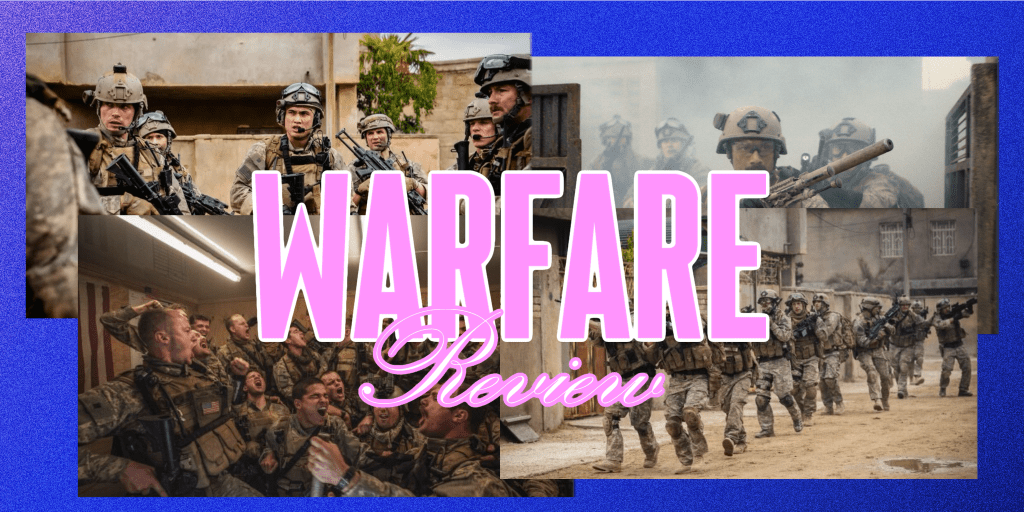
Warfare is a harrowing, horrifying, and alarming war film that depicts in real-time the traumatic experiences of what one platoon of Navy SEALs experienced in a singular event. What it lacks in character, the film undoubtedly makes up for it with gripping sound design, cinematography, and devoted performances.
Director Alex Garland is known for sci-fi thriller and dystopian films such as Ex Machina, Annihilation, and Civil War. His distinct style of filmmaking combines the exploration of the nature of reality vs humanity, and the psychological impacts towards humanity. When making Civil War, a film following war journalists traveling the country during a dystopian future, Garland employed Ray Mendoza, an Iraq War veteran and former U.S. Navy SEAL as a military supervisor. Soon before Civil War’s release, A24 announced it was once again collaborating with Garland on a war film, but this time he would be the co-director and writer, allowing Mendoza to take front and center, with the story based solely on his memories of the war of a singular experience that occurred with his platoon.
Warfare takes place back in 2006, where a Navy Seal team is currently based in Ramadi, Iraq. The team takes over a multi-storey residential house, with the frightened family being forced to stay under supervision in one room with translators Farid (Nathan Altai) and Noor (Donya Hussen). Mendoza (Emmy Nominee D’Pharaoh Woon-A-Tai), the communicator/Joint Terminal Attack Controller, monitors their position using air support while the team’s lead sniper, Elliot Miller (Cosmo Jarvis), is keeping track of the neighborhood market through a hole in one of the bedroom walls. The two notice an increase in activity surrounding the house, thus prompting officer in charge Erik (Emmy Nominee Will Poulter) to place leading Petty Officer Sam (Joseph Quinn) and gunner Tommy (Kit Connor) on watch. What follows is an evacuation of the building filmed in such an anxiety-inducing manner that will leave every viewer on the edge of their seat holding their breath in horror…and possibly wondering which character is which.
It’s only natural that many movie goers will compare this to other war films in the past such as Saving Private Ryan, Apocalypse Now, The Hurt Locker or Zero Dark Thirty, and feel Warfare is severely lacking in the character department. To some extent, it is. We only know Ray Mendoza and Elliot Miller’s true names as the rest of the team was given alternate aliases, with their real-life counterparts opting not to go public with their identities. However, this film is not trying to be an in depth character study. Mendoza and Garland have chosen to forgo all of that, instead narrowing down to focus on a real-time incident where, quite frankly, there is no time to learn the backstory of all these characters. In many real life scenarios, some platoons don’t know each other on a deep and personal level solely because they are there to work. In Warfare, these soldiers are not only trying to evacuate, but to survive their job.
Yes, there were moments where I myself had trouble differentiating between many of the characters, especially when they’re covered in blood, dust, and other debris while wearing the same uniform and a helmet that covers their forehead. Luckily we have a talented ensemble that helps the audience out in caring what happens to the soldiers they are watching on screen. Woon-A-Tai has such a commanding presence and says so much with his eyes, observing the reality of what is going on around him. Poulter is also excellent as his character slowly loses control of his team as the events worsen, showcasing how mentally vulnerable these men were. Quinn and Jarvis’ characters both end up severely wounded and these actors’ cries of agony are haunting. The ensemble is strong throughout, and just like a real life platoon, each one just as important as the next.
The film ingeniously makes up for not being strongly character driven with being steered by the event. My goodness, if there was ever a film to see in either IMAX or Dolby, this is the one. The sound design is impeccable with such creative cuts and mutes that kept my audience afraid to eat their snacks as they didn’t want to disrupt the silence. The quiet moments are beautifully contracted by the loud ones. Bullets are flying everywhere and they are even differentiated between the weapons of the Iraqis and the U.S. soldiers. Radio static, bombs exploding, bullets falling to the ground…everything is perfectly placed in order to fully engross the audience into this world. Mendoza and Garland’s direction is so precise on what to focus on technically, you really do feel like you are living in one of the former’s memories.
Addressing the elephant in the room regarding whether or not Warfare is another example of pro-war propaganda from Hollywood, particularly in this new conservative era we are in politically; no, this film does not intentionally conform to any of that. As an Arab-American with extended family members directly impacted by some of the United States foreign policies in the Middle East, I am naturally always skeptical whenever a film like this is released. To clarify, Warfare is by no means as blatantly xenophobic as, for example, American Sniper (2014). Mendoza and Garland are as fair as they can be with the specific story they are telling and the brisk 95 minute runtime with how this war impacted the Iraqi civilians. There is time focused on the family who lives in the occupied house. The father cries in Arabic to the soldiers, pleading with them on why they were doing this. You see the look on the soldiers’ faces that in this scenario, they have no choice and truly feel guilty. When bombs go off, the Iraqi family is protected by some of the SEALs, and when the team finally leaves, Mendoza and Garland spend a moment with the family, showing how this negatively impacted them as much as it did the platoon.
Truthfully, I was not expecting any empathy to be given towards the Arab family as Hollywood does not have a stellar track record with humanizing Middle Eastern people or culture, so seeing that moment was a small breath of fresh air. I don’t think it’s fair to expect Warfare to address or solve every issue and complexity of the Iraq War or the worldwide negative impacts of military imperialism from the United States, and this film, again, is not trying too. Whether or not you agree is your right, just like you as an audience member have a choice to see this film or not. What Warfare is, and all it has ever claimed to be is Mendoza bringing his and the rest of his team’s real life memories of one highly traumatic event to life on the big screen in a terrifically directed, acted, and crafted manner. Hopefully, those who don’t see it because of their beliefs of this film depicting propaganda -and even those that do see it- are actively helping, to the best of their abilities, civilians still being impacted by the horrors of war.
Grade: A-
Oscar Prospects:
Likely: Best Sound
Should be Considered: Best Makeup & Hairstyling, Best Cinematography
Where to Watch: In Theaters

Sarah Abraham
she/her @sarsaraaaaah
Lives in Orlando with her mom & dog. Clarinetist that loves movies, EDM, yoga, hot girl walks, and tzatziki.
Favorite Actor(s): Omar Sharif, Danielle Deadwyler, Hiam Abbass, and Daniel Day-Lewis
Sign: stereotypical Taurus



 offscreencentral.com
Leave a comment