
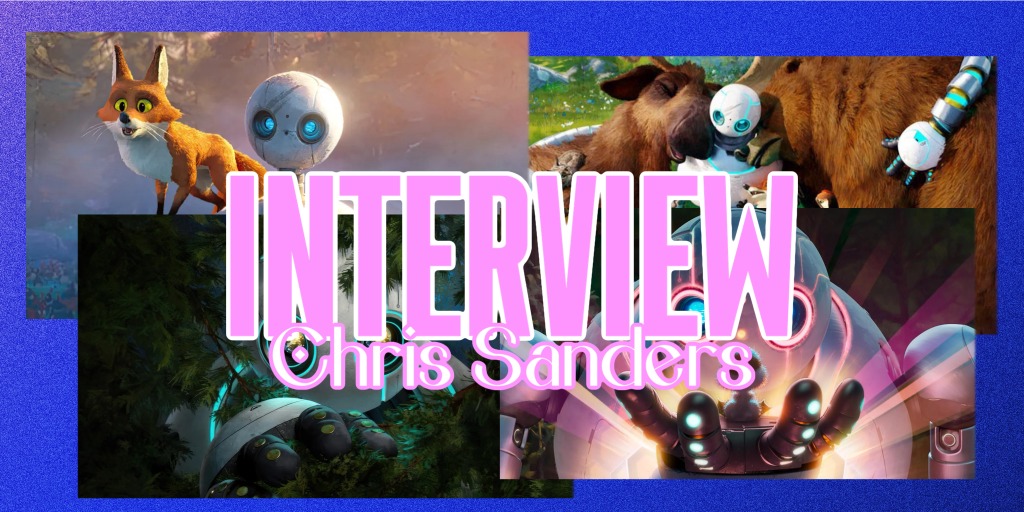
Celebrating its 30 years Dreamworks marks its long tenure with the emotional entry of The Wild Robot. Adapted from Peter Brown’s beloved Novel, the film follows Rozzum Unit 7134 (voiced by Lupita Nyong’o), who gets stranded in the middle of a forest filled with animals that take a strong disgust with her arrival. Facing their rejection, Roz is tasked to care for a young gosling named Brightbill (Kit Connor).
Offscreen Central had the opportunity to talk to director and writer Chriss Sanders about the film’s focus on its emotional impact and adaptation challenges with the need to streamline the story as well as key themes of kindness as a survival skill and the necessity to defy programming to grow, and how the film’s painterly style, inspired by Bambi and Miyazaki, enhances its immersive, human-like portrayal of animals and robots.
Jillian Chilingerian: Hey, It’s so nice to meet you.
Chris Sanders: Nice to meet you.
Jillian Chilingerian: This was one of my favorite films of last year, I’m obsessed with every aspect of it so when I heard I had the chance to interview you, I just got excited.
Chris Sanders: Swell. Well, thank you. Thank you for going to see it.
Jillian Chilingerian: I even have my little Roz figurine that they gave us during the original release.
Chris Sanders: One of the animators made this, he pretty much used wooden spheres and things, he liked spheres and dolls, but he threw it together, and it’s so cute.
Jillian Chilingerian: I love that. I love her design, and I think about her all the time. One thing that I love about this film is that I think it appeals to so many people. I went with 20 of my coworkers the day it came out, and I looked over everyone’s crying. During the holiday season, I put on a movie for my family who are not big animation people, and from the first frame, they’re locked in. They’re like, what is this story? Who is this robot? What was the task of trying to make something that appeals to so many people of all different ages? There’s so much that we learn from this movie.
Chris Sanders: First and foremost, I think that getting the core, the character, and the tone of Peter’s book up on the screen was like job one, and that means I will describe a book as a boat. A book can hold a lot because you can digest it at your own pace. I think of it as almost like a container chip, and that’s a wonderful thing, but a film is an airplane. It has to be sleek, it has to be lightweight. It only has a certain amount of time to make its trip so you’ve got to throw some things overboard, the first trick was to to pare down the characters and focus on the ones that I felt were critical in in getting this core story between Roz and her child up on screen. So characters I cut back on were three bears in the story, and I turned them into one. It was about clearing out space because I needed room for the narrative to feel like it was unspooling at its own pace. I didn’t want to feel rushed, even though we had a schedule to keep. I didn’t want it to ever feel like that to the audience so that was the most critical thing. We focused on two things, mainly there are load-bearing pillars, narratively inside the story and the first one was one that Peter Brown revealed in our very first phone conversation, he said that while he was writing the book, the guiding principle that was on his mind was the idea that kindness could be a survival skill. That was never memorialized verbatim in the book, so I wrote that down off-screen because we were doing a Zoom, and I determined that it would be on screen. Indeed, at one point, Fink says that exact quote that Peter told me the other pillar would be the idea that you may have to exceed your programming at some point to grow as a character, you may have to change the way you were taught to do things. This is one of the big things in the story that was our North Star. Back when I was at Cal Arts at college, I took a story writing class, and as dumb as it sounds, I asked the teacher, what is a story? Because I wrote these little narratives that were half a page long, or two pages long, just nonsense so I said, What is the story exactly? He said, Oh, that’s easy a story is changing, and a character that changes through a journey or changes the world around them, or both. That made so much sense to me so in this story, it is all about how Roz is required to go off script to accomplish something. Here’s where the weird relatability comes in, I found the characters in the story incredibly compelling. I don’t think a character must be relatable, but there are so many oddly relatable things in the story, certainly, a parent dealing with a child for the first time is incredibly relatable to both the parent and the child, who’s maybe in the theater, right? So it was relatable and unusually complex, because the more I and the story crew worked on the story, the more things lit up, very subtle, nuanced things that were all very emotional. One of the things that was surprising to me after we began to test screen the movie, you know exactly where the emotional beats are going to hopefully hook the audience, but in this one, they were all over the place, things that were like just a part of a narrative hooking two pieces of the story up would have a real effect on somebody. That was one of the wonderful gifts and unusual features of this particular movie, was how many poignant things were hiding throughout, if you will.
Jillian Chilingerian: I’m always someone that I’ll read a book before the movie and I wonder what type of stuff you want to pull out of that to emphasize a theme that might be in the book, but it’s not as explicit, and I love that you say kindness is a survival tactic. Watching this movie and seeing that, it just meant so much to me. We’re in a state of nihilism, where we want to look at the worst in the world, kindness is that guiding light. We get to see Roz teaching everyone in the forest and how that changes them. It also goes into this idea of how people can be able to evolve and change, and, like, move as things are meant to to survive. And I think it’s just like this really beautiful thing of how people can change, and it’s not too late. I wanted to talk about something that you touched upon, which we’re watching a robot but for some reason, it feels like we’re watching humanity play out with the life cycle. There are these things that are very heavy of what happens with death, and if you don’t get those things to survive with the urgency or when Brightbill goes off in the migration sequence, and you think about like, Oh, I didn’t tell my mom I love you or goodbye, or my relationship with my mom in of what she had to go through and wearing herself down. I want to talk also about that aspect of really presenting humanity through things that we don’t see as you know, human?
Chris Sanders: Yeah, absolutely, I’m so excited to talk about this. I think robots in particular are unusually good at telling human stories, but it was my wife, Jess that said, Well, you know, I think it’s because there’s so many things that aren’t there. With a robot, you have removed visual cues that may distract you, you remove age for the most part, you remove gender, and you remove regionality. They get down to the core issues with a robot. I think that may be why they’re so effective animals as well for the very same reason, you’ve removed all these things that for some reason you have an issue with top hats, a character with a top hat like you don’t like that. That stuff is missing so you get, you get to the core issue so quickly and I would describe it as there’s a purity to it, and there’s a purity to the movement. There’s a purity to the characters that is unusual. For me, there was a poignant moment and it was one of those things we were talking about. It’s not a big, giant thing. It’s not like Mount Everest inside the story. It’s a very small thing, but there’s a moment where Fink says, “When you grow up without something, you spend a lot of time thinking about it” and it’s something that was noted a few times that some people, felt like Fink was going out of character when he told this bedtime story. I was very insistent that he wasn’t, he was simply revealing a different level of himself because he’s a very guarded character. My mom, while she was pregnant with my sister, my younger sister, Dorothy, was diagnosed with cancer, and she chose not to get treatment. She deferred treatment and prioritized my sister, and that could have had something to do with the fact that she didn’t live very much longer after that. I didn’t have a mom for the most part in my life, and it’s something that I think about a lot and so that line for Fink made sense and so, like, that’s one of those things that some people might bounce past that. For me, I get caught on that because it meant a lot to me that he said that,
Jillian Chilingerian: I love that you say that because that one stays with me too, there’s so many moments of dialog that like you say, you can’t just move over it, it invokes a feeling. I always envision this film through the lens of nature versus nurture, and I love that, we get to see a robot and a little gosling, how they interact with one another, what they take from one another, and what that looks like when he is out within his community but learns from her.
Chris Sanders: Yeah, yeah. It just was the perfect little setup, one of the things we had to do when we were designing Roz as a character, and Lupita took the lead in deciphering, understanding, and creating the architecture of Roz’s thinking because Roz has to have some gaps. The character won’t work and the story won’t work if she knows everything. Of course, she’s such a giant supercomputer that it doesn’t make sense that she is missing things, but we have to make a decision that Universal Dynamics did not put some information in there so raising a gosling is just not there because we had to force her into a situation where, even though she’s obligated to stay on on track programming wise, she had to make a decision either fail in this mission or begin to improvise, which is a big no-no for these robots to do that. It was just such a beautiful setup that was in Peter’s book that to prioritize his life, she’s going to go off script, and that’s why she grows as a character so that the idea of defying your programming as a necessity sometimes, but it’s always, I think, going to be a moment of growth was just a beautiful mechanism that was built into the story, and simple, but eloquent and powerful.
Jillian Chilingerian: We see that too with how the music grows with her as she’s continuing to defy what she’s been programmed with, at first she sounds very artificial, and then Lupita, the most amazing voice performance, grows into it. I have to ask about, like, this world that you and these animators created, you’re engulfed into a whole new reality when you walk away, you want to go back, the scale of the trees when she first walks up or my favorite scene during the migration sequence, where she is on the cliff, watching Brightbill and her eyes. The scale of that cliff she’s on, you understand the weight of this world that is untouched by humans it’s such an appreciation of nature. Everywhere you go, we get to see the life cycle. We get to see different seasons and feel them.
Chris Sanders: I’m glad you are talking about this so the environment was a daunting one. All these different things are linked to the success of the resonance of the place itself. So first and foremost, it had to be the opposite of where Roz was supposed to be. So that was, in a way, I wouldn’t say it was simple, but it was clear. Roz was supposed to be in a place where things were level and she would integrate, and everything made sense. She was a cog in a giant, beautiful machine, but she’s in a place where she doesn’t fit at all. It was important that it be chaotic, and that the ground always be uneven. Nothing is convenient for her. It’s open to the weather where she was supposed to be in a place that was protected and under a dome, for example. It was clear which way we had to go with that, but then getting the place to feel the right way was why we went and pursued this painterly look. Bambi is the gold standard for a forest that is so beguiling, and immersive, you fall into it, and again, you don’t want to leave you feel at home there, even though it’s a wild place, we wanted all those things as well. I would cite Miyazaki forests, very same thing so we were aspiring to these Tyrus Wong and Miyazaki, as far as the stylistic and the vibe that we were going to. I also felt it was critical because of the nature of the story animals and a robot. If it was done in a more traditional CG style, I think, would have skewed young and I wanted this to be a film that an adult could go to by themselves, watch by themselves, and feel like, oh my gosh, this was 100% for me. It’s always going to be easily accessible to kids. They’re going to want to see this kind of movie and this kind of characters and stuff so pursuing that painterly style became really critical. We were very, very fortunate that DreamWorks had come to a point where they had broken away from that CG style that we were obligated to technologically get paint strokes onto the screen, but we pushed it even further, going much softer, much more abstract, impressionistic, I should say. That was another piece of the puzzle so not just like the literal design of the place, but the way it was made, a human being painted every frame in this film, the only thing that looks traditional CG is Roz. At the very beginning, brush strokes abound, even in the water, the otters, the effects, the bubbles, everything is a brush stroke, but Roz is traditional CG because we deliberately wanted her to feel like she didn’t belong. We have 30 versions of her that we switch out almost immediately so the idea is that as she’s damaged on the outside, she’s growing stronger on the inside, and by the time Vantra and Universal Dynamics show up to retrieve her, we wanted her look to be shocking. We want Vantra to reel at what has become of this robot that, first and foremost, shouldn’t be operational at all, and yet it is. I wrote down a whole report, nobody’s ever seen it, but I have a whole report by Universal Dynamics as to what I think is going on. It’s written after the fact because every piece of evidence was pretty much destroyed. Vantra is destroyed, and the retrieval ship doesn’t make so the whole thing is very worrisome. One of the things I liked best as well, is when they come to get Roz, she has this line “That’s a big ship, just for me” and Vantra says, “You’re a big deal”. Well, she is, because I would imagine, again, I look at this as a real product Rozs are probably a trillion-dollar industry, and the idea that one of them went this badly off script would cause huge problems for people who are inviting them into their businesses and their homes and their schools. They would be worried so safety would be a very high priority for them. I love looking at this thing from that angle and of course, this, you know, this degraded version of Roz. I don’t know if you noticed it, but one of the things that we designed for Roz is that her lights indicate two things. They pulse with her speech patterns, but they predominantly display a green, yellow, or red, whether her power level, where her power level is, but they also go red when she’s in distress. So when Thorn the bear strikes her, she immediately goes bright red and begins to run. She is in panic mode, if you watch very closely at the end, when Vantra comes to retrieve her and she is green, but the moment she drifts outside of Roz’s point of view, she goes bright red because she’s frightened of Roz and she’s distressed by what’s going on, but she’s she knows she has to keep Roz calm so when she goes back into Roz’s viewpoint, she goes back to green. It’s just one of those subtle things that we designed that I was so proud of.
Jillian Chilingerian: I need to go watch it again so I can see that. Thank you so much for this time I’ve grown up watching your movies and to have a new one of this through the line of found family and belonging and otherness and seeing how that’s evolved in your work. This is a gift of a movie.
Chris Sanders: Well, thank you so much. It’s been a pleasure to talk about it with you.
The Wild Robot is currently streaming on Peacock.
You can find our review of the film here.
 offscreencentral.com
Leave a comment