
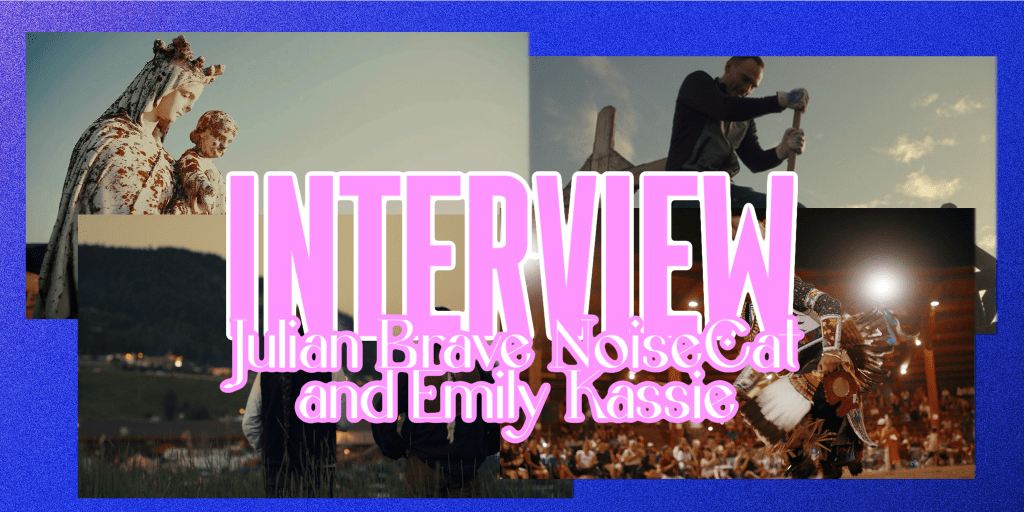
Sugarcane follows the investigation into abuse and missing children at an Indian residential school in British Columbia, Canada. In doing so, this ignites reckonings (and ultimately healing) throughout the nearby Sugarcane Reserve. Since its premiere at the Sundance Film Festival in January 2024, the documentary has received widespread acclaim. It won Best Documentary at the National Board of Review and is nominated for Best Documentary Feature Film at the 97th Academy Awards. We had the immense honor of sitting down with the film’s directors, Julian Brave NoiseCat (Tsq’escenemc) and Emily Kassie, to discuss the film’s importance in today’s political climate, and why it is resonating with all who watch it.
Sarah Abraham: First of all, thank you so much for taking the time to speak with me. I really appreciate it. Personally, this film meant a lot to my mother and I. I have an older half sister, and she’s part of the Diné (Navajo) nation, as is her father, and his parents were boarding school survivors. My mom even lived in Ganado, Arizona on the Navajo reservation with my sister and her father in the 70s and 80s. So, it meant a lot for her to see this film, and for myself and my sister as well.
Emily Kassie: Wow!
Julian Brave NoiseCat: Oh, that’s really cool. Thank you so much for sharing that.
Sarah Abraham: I feel like most marginalized communities have some form of trauma, but with Indigenous people, it does seem very specific and hard to articulate. So, how did you even go about making this film and tackling that trauma, knowing the heaviness of this topic?
Julian Brave NoiseCat: I think, obviously, this is a film, ultimately, about a cultural genocide that was erased and hidden and remains unknown by far too many people in North America. Em and I, while we are in the field, there were so many ways that we wanted to tell this story that were part of that, but that were part of the ways that people live. You still had to document the atrocities and the wrongdoing and the pain that had exacted on an entire people. Yet, I think that ultimately that piece of it, which we were drawn to over and over again in the field of the beauty of Native life, of a people who love their families, who spend tons of times with their relatives, who are really proud of their culture and are trying to bring back the languages that were nearly killed off by these schools. That ultimately is the story that is, in a way, greater than the story of the residential schools, because it’s the story of how the residential schools failed to annihilate a way of life, and how a people have survived and are now coming back in a very significant way.
The film is also, you know, part of the broader story. We brought this film to the White House, in part because the first ever Native American Cabinet secretary, Deb Haaland, she was leading a federal inquiry into Native American boarding schools. She’s also a close friend of mine. So, that the film is equal parts, I would say, a story of genocide and of survival and beauty. And, of course, the esthetic and artistic qualities of the film, which portray the Native life as a beautiful way of life are also an implicit and direct refutation of the mission of the residential schools, which said that Native people were backwards and dirty and that our way of life needed to die. Our film, like so much other Native arts, says exactly the opposite.
Emily Kassie: I think for me, I grew up in a community of Holocaust survivors and their descendants, and that was kind of my framing of the world. So, I was trying to, you know, coming from a small group of people who were attempted to be eliminated by a government force, that was a story that was really central to my world view. I had a lot of questions about that, and I spent a lot of time looking all over the world to understand why we do this to one another, you know, going to places like Afghanistan and Niger and looking at human rights abuses, and the genocide in Rwanda. Yet, I had never done anything on my own country. I’d never looked in my own backyard and knew next to nothing about the very genocide that happened in the place that I grew up. The last year of the residential schools was in 1997, my first year of kindergarten. There were 139 of these schools in Canada and up to 417 in the United States, and yet, so many of us knew nothing about them, and that’s because Native people, for as long as this country has existed, has actively tried to erase them, actively tried to erase their languages and culture and eliminate them as a people and quell them as a threat. Native stories rarely get to be the issue of the day, they rarely get the platform.
I think for me, this was an incredible opportunity to be immersed in this, as Julian says, this really beautiful world, and create a visual language that honored it, that was intimate and deep and told cinematically in a way that was worthy of the big screen, as these characters and stories are. I think both of us believe that it’s their time. It’s the time for this story. It’s the time for the uncovering of these horrific truths. You know, as we move towards a more authoritarian political reality here in the United States and elsewhere in the world, we need not look further than Indigenous communities to understand the roots of that authoritarianism. You know, Native people lived under an incredibly repressive regime, forced to live on tiny tracks of land and often needed passes to leave the reservation and lost the right to parent their own children or practice their own language and culture. So, I can’t think of a more salient moment for this film. You know, also in this moment where children are being separated again at the border, this is a story of child separation, and if we want to understand how we got here, we have to grapple with how we started.
Sarah Abraham: I couldn’t agree more and thank you both for sharing those answers. A lot of what you were saying are conversations that I’ve had with my mom throughout my life, because that’s who she is. I’m very lucky, and my sister’s lucky that she raised her to be a proud Native American. You mentioned Deb Haaland and her impact with the previous Presidential Administration. One of the ending credits of the film, it mentioned that the last boarding school closed in 1997 which was the year I was born. Then in October 2024, President Biden formally apologized for the atrocities of the boarding schools and their still present impact on the Native communities here in the United States. It’s always bothered me why people, both in the United States and Canada, are still so hesitant to even acknowledge that Native Americans are still here, but also everything that they’ve been through. So, I really loved how, even in the film and what you said Julian, that the boarding schools failed because they are still here, and it is their time to reclaim what is theirs and to tell their stories. So, it’s very beautiful that this film is happening right now, and just, it’s a lot for me, but I’m sure it must feel kind of therapeutic at the same time for you. Were there any hesitations at all in making this film? Like, were there any fears of pushbacks, or, if you don’t mind sharing, how did you overcome any internal conflicts when coming about this?
Julian Brave NoiseCat: I think that Em and I come from really similar but different backgrounds. We sat next to each other at our first reporting job, so we both have a journalistic background. But, Em is a visual storyteller. She’s been a multimedia investigative journalist for a decade now, and she’s made documentaries since she was 13 years old. So, documentary and film are really her art forms, long before it became one of mine. My background is more as a writer, I have a book coming out in October. That was always my lifelong dream, was to write books. And then, Em came along and gave me the opportunity to direct a film and expand my artistic practice and storytelling into a new form, and I’m incredibly grateful for that. I think in that way, us having different skill sets and also coming from different backgrounds, to the story, like Em is Canadian but not Native. She entered kindergarten the same year that the last residential school closed. I’m Native, and this was part of my family story, but was also something that we didn’t talk about for slightly different reasons. I think that the combination of perspectives and skills made us very complimentary collaborators in lots of ways. I also think that having somebody who is from the community and has worked on telling stories like this for a long time now lent us sort of the insider kind of perspective that created a lot of cultural literacy and there’s tons of easter eggs in there. There’s like levels of understanding that you can see in this film if you’re Native and if you’re from this world.
At the same time, I think that being ale to tell this story in a way that was legible and moving to outsiders was really essential. Stories need to be, especially in this day and age, they need to transcend differences. They need to be universal. I think that our collaboration made it possible to tell the story that was at once from inside the community and also universal. Anyone who has a father, anyone who has family trauma, you know, anyone who has dealt with questions of generational pain and the burden of history, like those are things that so many different people who are not Native also think about it. So, I think that way, it was a really generative collaboration. Also, we became, kind of, we have kind of a sibling dynamic in sort of the best way. It means that we were not afraid to disagree sometimes. I think that’s also, to be completely honest with you, I think that’s really important to making anything like this. Of course, you have to be passionate. You have to be all in to make a work like this, to tell a story like this, and it’s just completely unlikely that with anyone like that, that you’ll agree 100% of the time. Em and I agree a huge proportion of the time, but we also sometimes disagree, and I think that we are really good at working out those disagreements and ultimately figuring out what the best approach is for our shared vision and our shared film and project. We have stuck to it because we also think that this thing is really special. We felt that from the very, very beginning, and I think that has also helped us persevere through. It’s really hard to make an independent documentary in this day and age, especially one about a subject like this. To be completely honest, as you were saying, really like right now, it’s a little bit hard to have a film out there about a genocide that happened right here, and to feel as though that story is being overlooked.
Emily Kassie: The collaboration was like an incredible learning and growth opportunity for us both. One of my favorite things about the collaboration was just how much I learned from Julian. We spent just so many nights talking about ideas and how we were seeing things, what we had experienced that day in the field, and then being able to take on some of his ideas and embody them in the way that I was shooting was like this very cool and expansive thing, because it made me better, and I was able to help him learn this art form as well. We were both kind of pushing and pulling, but we were moving in the same direction together, and have had this, from the very beginning, a very shared vision of what this could be. I think we feel really proud that together we were able to achieve that and create something that means a lot to a whole lot of people, and to create art together. Art, particularly in film, is a collaborative art form, and that was really special. So, you asked about whether there were fears. I think for me, I knew Julian had this story, and I wondered if it was going to be a story that he would want to tell, and how hard it might be to shoulder that burden should he decide to tell it. When he did, it was like an extraordinary act of courage to go there with his family story at about a year into actually making the film together, and to continue to carry the responsibility through the rollout of the film too. He’s representing the voice of so many survivors and their descendants. So, the making of the film, and then there’s carrying the film into the world. I think he’s just done that in such a beautiful way. I feel very, very proud to be alongside him for this ride.
Sarah Abraham: That’s really sweet. You mentioned this a few sentences ago, and I’m going to use this as a segue into a question I have about the camera. I really enjoyed how, I think it was Julian that mentioned this. The film, it’s hard to digest what you’re seeing but the film really flows, kind of like a narrative or fictional film. It’s very easy to follow. The camera moves beautifully, the editing is sharp, and I really appreciated how the camera, when you’re listening to people tell their testimonies, it just focuses on their face, and then you can see them processing everything. Was that intentional to have that? For me, I took it as Native people are finally getting to tell their stories, after being ignored for so long.
Emily Kassie: Yeah, that’s exactly right. for so long in this art, in Hollywood, Natives have been portrayed at the end of a barrel of a gun by cowboys, and similarly, in documentary, you know, the first documentary was Nanook of the North, which portrayed the Inuit people as this kind of primitive people, who were unable to interact properly with technology and modernity. I think that our film needed to be a refutation of that. The way to do that was to live alongside our characters and to let them speak for themselves, not to extract information, but rather, to be in community with them, to live alongside them, and to form real relationships and build trust over time. The intimacy of the camera has to be earned. There’s another possibility, other than that imperialistic lens of the camera on Native people, which is to tell people that they matter and that they have agency, and to hold the space around them so that they actually feel empowered to live presently in this very difficult moment for an audience. That was very clear for us from the beginning. It’s why we shot the film as a verité film, and that the closeness that you feel and how close the camera is, that is about earned trust and respect over a long period of time.
Julian Brave NoiseCat: I think that the risk in telling a story like this in a sort of traditional documentary way, is sit down talking head interviews and with archival footage would be to reinforce that this is a past story. That this is, you know, that these are people of the past, which is so often how Native people get portrayed. Of course, we set out to tell a story in a verité style about how the consequences of the residential school live on today, that the ledger of a place like St. Joseph’s Mission runs long and remains open. So, the way that we went about telling the film was in service of what we were trying to say about this, which is that, this is a very present cultural genocide that is still very much alive, and at the same time, these are people who are very much still alive. I think that the way we went about it, to add to everything Em said was in service of telling that kind of story.
Sarah Abraham: It’s definitely refreshing seeing, I’d say maybe the past two years, of the slow build up of a wide range of roles and opportunities that Natives have within film and television to be able to share their stories. Whether it’s in fiction or a documentary like this, baby steps, but, any steps are more than the past. My last question, in what way do you think or hope those that watch Sugarcane can be assisted in their own healing, with their own family generational trauma, or with anything that they’re going through?
Julian Brave NoiseCat: I think that the story of the film is one of intergenerational trauma and healing. You see that in multiple character stories, and probably most prominently in my father’s story and my story. While my dad is the only known survivor of the incinerator at St. Joseph’s Mission, our story is also representative of the story of an entire people, an entire continent’s worth of Indigenous peoples who survived those institutions. I think that we’ve had the incredible honor to bring this film on the road to over a dozen Indigenous communities across Canada and the United States and time and time again, people really identify with that story and see themselves in it, and they come out and watch the film. Elderly survivors with their kids and grandkids come out and have conversations sometimes for the very first time about what they endured at the residential or boarding school that they were sent to, and how that has impacted their lives, their children’s lives, their grandchildren’s lives, and how through especially their own culture and ceremonies, they are trying to heal and to bring back what was taken.
Emily Kassie: I think that, again, like we’re so proud and we had these goals for the film that were nothing short of rewriting history and correcting the record, to spur dialog within Indigenous communities, to help them heal, and to bring the film to the highest levels of government, and we’ve been so lucky to be able to do all of those things. I think one more kind of broader thing that the film has done is, you know, there was a very basic level, a lack of knowing. I think it’s been really profound and moving to see non-Indigenous art audiences engage with the story for the first time, to really take in and understand what happened here, what their own history is, and to find resonance with it in their own lives. Julian was saying this, but everyone can relate to stories of familial strife and having conflict with your parents and trying to make sense of family secrets and reconciling your own place in them. Those are universal themes that have brought so many people all over the world into the world of Sugarcane. That has been an incredible thing to see the power of cinema really move people and change their perspectives, because they don’t just know it in their heads, they know it in their hearts. That is, of course, a testament to the incredible courage of our participants to be so vulnerable and present on screen with us. We hope that the Oscar nomination gives this story more of a platform. I think we both feel that Indigenous stories are never the story of the day, and it’s about time that they are. We’re so thrilled that Sugarcane is a part of that.
Sarah Abraham: It truly is one of the better documentaries that I’ve seen in recent years. I would be remiss if I didn’t mention again this film meant a lot to my mom…and now I’m getting emotional.
Julian Brave NoiseCat: Thank you so much. There’s nothing wrong with emotion!
Emily Kassie: I love the emotion, so I’m here for it. It means a lot that this meant something to you and your family, like, that’s the biggest thing for us. That means more than anything that it moves you and starts you in that way, like, that means everything to us.
Sarah Abraham: This really was a beautiful film. I appreciate it and thank you so much for taking the time to talk with me today. I wish best of luck to both you.
Julian Brave NoiseCat: Thank you so much. Thank you. That means so much.
Emily Kassie: Thank you so much.
Sugarcane is now streaming on Disney+ and Hulu, and distributed by National Geographic.
 offscreencentral.com
Leave a comment