
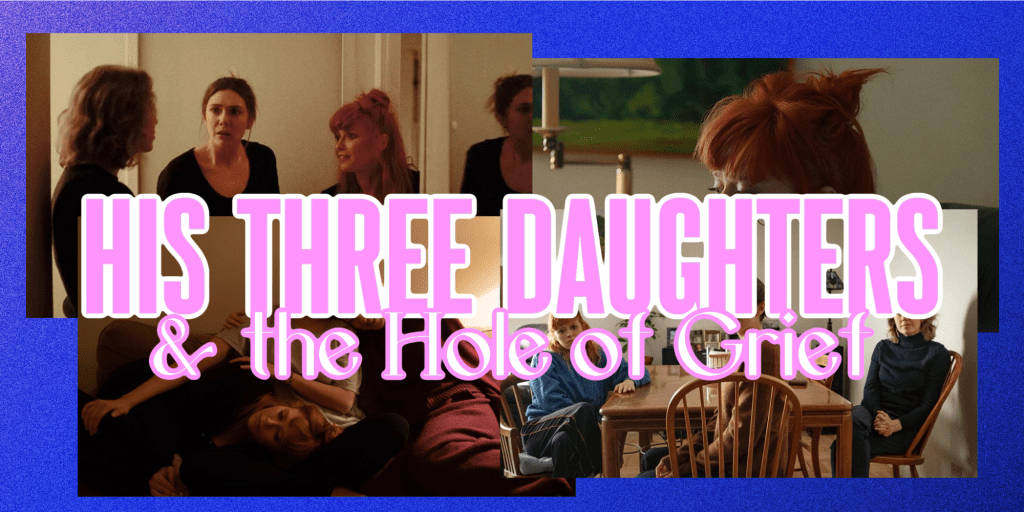
Grief is somehow an incredibly universal and supremely singular experience. Philosophers, psychologists, poets, and people in between have all tried to capture what grief is; contextualize the indescribable. And yet, with his latest film “His Three Daughters,” Azazel Jacobs is able to vocalize the vast differences and utterly personal experience of grief between three sisters.
Under the same roof for the first time in years, sisters Rachel (Natasha Lyonne), Katie (Carrie Coon), and Christina (Elizabeth Olsen) sit beside as their father Vincent (Jay O. Sanders) dies while on home hospice in his New York apartment. The three daughters’ coping mechanisms are immediately present. Katie, measured, slightly aloof, looks to control the situation. Despite living nearby and sporadically coming over to her father’s apartment, she immediately steamrolls everyone and finds faults everywhere. The audience first meets her when she complains about her father not having a Do Not Resuscitate (DNR) signed before he declined to his current state. Most of her ire toward imperfection is lobbed at Rachel, who has lived with their father for some time. Rachel smokes pot in the house, keeps only apples in the house, and spends her most of her days watching sports games she has active bets on. Rachel clearly uses marijuana to cope with the stress around her. But aiming to stay out of the eye of the storm, she does everything she can to stay out of Katie’s path.
Rachel has been a caretaker for Vincent for an unknown amount of time. As Vincent’s nonbiological daughter, Rachel takes to isolating herself from the others. Witnessing her father’s decline for so long, she cannot bring herself to see him in his final days. Yet, even as she secludes herself in her own home, Katie and Christina try including her in their process of grief. While Katie and Rachel are at odds, Christina frequently plays the peace keeper. Finding solace in herself, Christina copes by staying positive. On the phone with her husband who remains on the other side of the country, she will remark that she expects to be home soon. She never directly states that it is due to her father’s imminent passing, but you can tell from her side of the conversation, her husband does. She bats away concern and notes that she is fine. Her time spent watching over her father includes moments of her singing songs to him. Even as Katie makes note that Rachel has not watched over their father as they have, Christina finds empathy toward Rachel, noting it must be different for her. As Katie nitpicks everything Rachel does, Christina aims to find commonality between the three. She even takes the time to check in with Rachel, much to Rachel’s confusion.
Yet, in spite of their best efforts to power through this moment in their lives, the tensions of a stressful and devastating situation begin to crack the facades of the sisters. It is Katie, so tightly wound, that begins to crack first. She begins unravelling after her father has an episode which he rebounds from. Sinking into a bottle of wine, her resentments toward Rachel and her inability to control what is happening around her, Katie starts to come apart at the seams. She believes Rachel’s care has been inadequate despite learning Rachel keeps apples in the home as that was the only thing Vincent would eat. Even as she attempts to apologize to Rachel, Katie’s words are laced with indignation. Meanwhile, Rachel, who has always felt like an outsider, plans to make a clean break from Christina and Katie. After Katie and Christina’s mother died, Vincent was remarried to Rachel’s mother. Rachel’s mother then passed, leaving Vincent to raise Rachel. Though they shared no blood relation, Rachel and Vincent were exceedingly close. Rachel, however, was never close with Katie or Christina. And with the death of their father happening before their eyes, she just wants to be done with everything: her father’s suffering, her sisters’ presence. But it is when Katie’s wine-fueled interaction with her that sets Rachel over the edge. Especially after days of being told how inadequate her care was, the policing of how she exists in her own home. As the pair ensue in a screaming match, Christina gets between them. With her back to Rachel, Christina attempts to break up her sisters in their verbal attacks of each other, until she can no longer take it. Screaming at both of them, Christina folds to the pressures of being surrounded by her family and their grief.
Christina has always been forced to carry others’ grief. While Rachel and Katie are unable to confront their feelings over the imminent loss of their father, Christina has witnessed this before. As a little girl, her own mother passed. And as a young teenager, she watched her father be widowed for a second time. The way in which she copes certainly stems from her need to find the strength within herself to withstand the storm as no one was there for her. Now as an adult, you get glimpses to how she balanced herself. Whether it is following the Grateful Dead or practicing yoga, Christinas has learned to ground herself. Unlike her sisters, she has strived to be a better, grounded person than what she experienced in her youth. Over the phone, you hear how giving as she is as a parent. So, being back in her childhood home, there is a pull from her sisters to revert to their original dynamics. As Christina attempts to break apart Katie and Rachel, it all becomes too much. Screaming at the pair, both are shocked to see that level of emotion from Christina.
Following this outburst, Christina creates space to sit with her sisters. She apologizes for what she said and how she said, once again doing the emotional intelligence work for her family. But, this moment is a wake up call for Katie, who has always assumed that there are no tensions between her and Christina. Katie begins to recognize that her domineering nature was wielded at Christina as well. Rachel eventually joins her sisters for them to talk. It is the first time likely in their lives that the three have begun to have an honest conversation about their relationships. Rachel sees this moment as the end of her relationships with all of them: their father, Katie, Christina, their families. Yet, it is Christina who notes that part of her return is to facilitate a deeper relationship with Rachel, which takes Rachel by surprise. It is this moment of stillness that you begin to recognize that the heightened emotions, their behavior all stems from their grief. Rachel clearly is devastated by their father’s death. Never knowing her biological father, Rachel felt deep love for Vincent, who, without any obligation, chose her and loved her. And so, it is not just her sisters she is avoiding, but the inevitable loss of Vincent. Her sisters returning to the apartment they were raised in signals that impending tragedy and rather than confront it, she hides away. Meanwhile, Katie desires control. But there is no control with death. To her sisters, she sometimes mocks what Angel (Rudy Galvan), the hospice social worker, says to them. It is evident she does so as a means of deflecting from her reality. Angel coming to the home is a reminder of the outcome of her visit. Her father will die. Even her fixation on getting a DNR signed signals her desire to have control in a moment of her life which has her careening toward the reality of morality.
Christina, on the other hand, outside of her single outburst, is the calm in the storm. Though she might not tap into her deepest emotions, she does seem to really aim to process them. As a peacemaker, she is not only trying to keep the peace externally but within herself as well. Christina’s journey with grief is one of the most complex. With Rachel and Katie, the way their grief on their sleeves even if it manifests in other ways. Unlike her sisters, Christina internalizes much of her grief. And when she allows herself to externalize her grief, she manages to recognize what was happening, take into account how her actions may have harmed others, and taking accountability. This conversation between the sisters also reveals that Katie and Rachel view Christina and her life as perfect. It is evident that the thorniness Katie and Rachel share as shields are visible to themselves and others. Christina, however, handles her own initial reactions on her own. It was what makes her displays of grief so compelling. She has struggles, she has imperfections, she has huge and sometimes painful emotions. But she chooses to internalize her process of wading through that murkiness of grief to ensure that others are not responsible for her feelings. This revelation provides insights to her sisters, Rachel more so than Katie.
After this conversation, and as their father further declines, there is a scene where Christina decides to sit down, taking a rare moment for herself. Katie asks if Christina would like to join her, not recognizing that her sister’s stillness is a guard for her inner turmoil. But, it is Rachel, stumbling upon Christina that begins to recognize the stir of emotions behind the stoicism. Rachel is someone who struggles with naming and confronting her own emotions, so witnessing that in Christina, she makes a small gesture by handing her a beverage as a way of caring and seeing Christina.
The final act of the film culminates all of the pain and dread for the three sisters. That act begins in the evening. Katie, extending an olive branch, asks Rachel for help in writing their father’s obituary. Katie’s first draft is a chronological overview of their father’s life. Rachel then begins listing all of the quirks and interests their father had. They both remark that at the end of the day, all they did was write lists about their father, but question if they’ve truly captured him. Christina, however, notes that their father’s philosophy on death was quite different. Living on her own with their twice widowed father, Christina saw bereavement firsthand the endless well of grief. Sharing their father’s wisdom, Christina says, “The only way to communicate how death truly feels is through absence. Everything else is fantasy.” It is shortly after this moment that the sisters brings their father, who is having a moment of clarity and burst of energy, to his favorite recliner in the living room. Jacobs gives us a moment where Vincent monologues about his life and his final moments. Vincent vocalizes the humanness, in all its messy splendor, in his daughters. But much like how Christina mentioned before, all of this is fantasy. Instead of imparting final wisdom to his beloved children, Vincent takes his final breaths in his chair surrounded by his daughters.
After the death of their father, the chair which held his final moments is empty, being the physical representation of his absence. We watch the three sisters take turns sitting in their father’s chair, feeling the weight and reality of his death. Christina goes first, breathing through the storm of her loss. Katie follows, not only releasing that through a deep sigh but through vocalizing her new reality. Last is Rachel. Though her time in Vincent’s chair is brief, it is her first step in facing her grief. It is a powerful moment where the hard work begins. The grief the audience has witnessed throughout the film has been interrupted by Vincent’s presence. Though he is not seen on screen until the final act of the film, and though Vincent has been in and out of consciousness, he is still present. The events of the days leading up to his death are the grief before the grief. And when he has finally died, his true absence is felt. There is no one to sit with. No one to run away from. No one looked up to machines in the other room. No one to cut up apples for. No one to mediate. No father to love or be loved by. Just a hole where all of that remaining love begins to sting with pain. So much remains left unsaid and in the wake of this tremendous loss, three sisters, wildly different in their processing of grief and trauma find commonality. Their experiences are vastly dissimilar, but they are now able recognize the same absence in each other.
His Three Daughters is currently streaming on Netflix.
You can find our review of the film here.

 offscreencentral.com
Leave a comment