
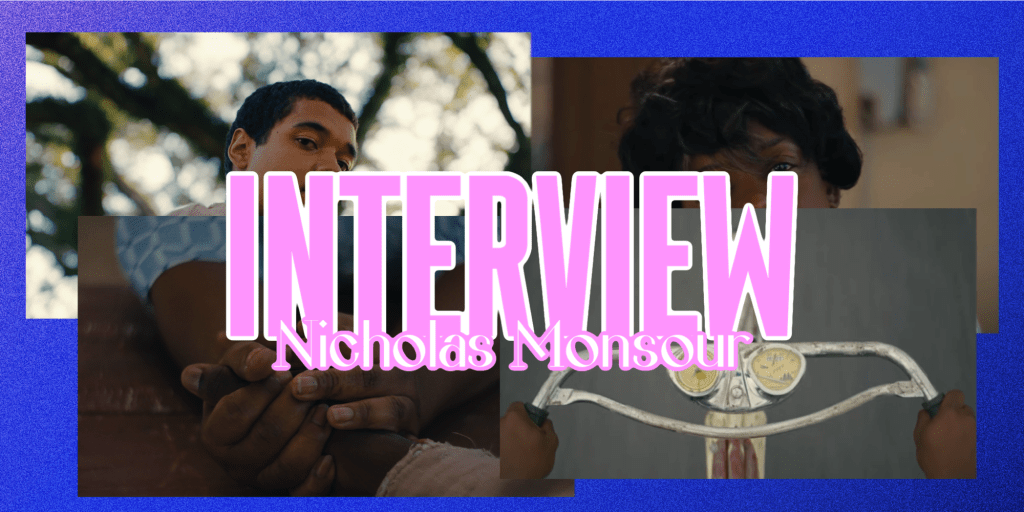
Adapted from Colson Whitehead’s Pulitzer Prize-winning novel, RaMell Ross’s Nickel Boys reinvents what it means to film first person POV for film in a sorrowful impactful tale of two young Black men. Offscreen Central had the opportunity to talk to editor Nicholas Monsour about his initial conversations with RaMell, the script’s ability to communicate the film’s intentions, and the role of music in conveying characters’ internal lives.
Jillian Chilingerian: Hi, so nice to meet you.
Nicholas Monsour: Nice to meet you.
Jillian Chilingerian: I was completely taken aback by this film visually and sonically. There’s so much that stuck with me since seeing it.
Nicholas Monsour: Thanks so much. That’s great to hear.
Jillian Chilingerian: What were the initial conversations you had on the project, as an editor you get to do so much on this from past to present to multiple POVs to found footage to montages.
Nicholas Monsour: A lot of the time it’d be RaMell, Joslyn Barnes and I looking at it with different searchlights for how we’re picturing it, and where we could see there being areas of particular focus, or reading the script. RaMell and Jocelyn did an incredible job of communicating how the film would feel. It didn’t describe every choice that was going to happen, and they had a lot of creative freedom during the shoot and the edit, but it communicated the intentions behind a lot of it. Not every script tries to do that, and not every script does succeed when they do try to do that. RaMell is a theoretician as well as a practicing artist, and he has a theoretical language and framework for all of this stuff. The conversations were about starting on the same page with the language around Jomo and him talking about sentient POV, for instance, rather than just POV. This was something different and these shots where we feel like a character’s focusing or noticing a particular detail, and it breaks from maybe super literal point of view, but you understand it as a more subjective anyway, there are all these terms that they had for different techniques they were trying that then we would carry into the edit and would evolve further. Understanding how much the character of what’s happening in the world around Elwood, and his engagement and interest in it is carried into this real visual and sonic aspect. You learn how sensitive he is visually and sonically to things, and I think that tells you a lot about him as a person. The last thing I’ll say about the first steps is that there’s a lot of trust gained when working with a new director. A lot of talking about art and theory and film so we love and things like that, to sort of get to that level of, okay, I can talk about this in an unfiltered way, and I don’t have to try and translate everything.
Jillian Chilingerian: It seems the type of film that everyone needs to be on the same page and have the same vision for it to all work and come together. What I love about this film is it not only tries to capture the human perspective, but it is the human perspective. Whether that’s lingering moments of how the gaze isn’t direct eye contact or conversations we see between core relationships. For Elwood, for your role as an editor, how was that of like working with the different people you’re collaborating with to make sure that that message is communicated?
Nicholas Monsour: I mean a few things. One is that while we all have to be on the same page, we’re all writing that page together for as specific and clear a vision as RaMell has, part of the vision is the process that allows for collaboration. I had to gain RaMell’s trust with how much credit we give to a film audience. It’s something we both feel a lot when watching films we love and films we don’t love, which is just that there’s an amazing visual literacy. One thing to keep in mind during this edit was really to have faith in what we’re feeling and what we’re sensitive to, there will be an analogous feeling and sensitivity in an audience, and we don’t have some secret information we have to impart to them, and I think a lot of that involves sort of not worrying so much, or not elevating story, story above everything else. The story was embedded in how they filmed it, in the performances those actors internalized those characters and stories to a degree that meant the narrative looks a lot of the time at unspoken details of what’s being observed that may be a bit abstract on one level, but on a very clear emotional level are communicating a lot about the trajectories these characters go on and the setting they’re in. It was taking a step back, taking a breath, and approaching the material with an openness to letting it lead us, and that included the archival material for which there is potentially infinite, near infinite amount to research and keep researching and finding new things. Those are some of my favorite moments of the film and certainly, we’re the most interesting to use your whole brain and body to edit, because we weren’t just looking in a documentarian sense for specific information. We were looking for things that are hard to put into words because it’s a primarily visual and sonic medium. I also worked with researchers to amass this stuff and find things and have remote guides for how even to approach it. That was a learning curve of getting up to speed with, okay, I’m not looking to construct a literal aid in the archival material, I’m looking for a sequence of images that continue to add and change the meaning of the film, and a lot of that was guided also by the immense input from the composers to give us this other huge framing to what the emotional scope of the film could be or was in certain scenes. Cutting to that music was crucial. I don’t think there’s any world where we could have used different music not by Scott and Alex, to make the film, because it was a huge part of the conversation from the beginning.
Jillian Chilingerian: That scene that you talk about specifically, multiple moments downloaded in my brain. I like how you mentioned that with the music, because we’re watching these, these visuals of the archives and it almost feels like, like your brain is downloading along with the music, as he’s cycling through these moments of trauma without it having to be spoken of, Oh, this is this thing. The brain is putting the pieces together with the music.
Nicholas Monsour:There’s a lot of things that we say all the time in filmmaking, but I think people get nervous about actually following through on and from reading the script without seeing Elwood’s face for large parts of the film, or Turner’s face when we’re in his POV. We all know music does this thing of taking us into the internal lives of the characters, but being willing to go that super specific into a unique person’s experience, and not just put on Well, this is the music you would expect here, and not blend it that together, but to really go there and follow that through, I think, is sort of fearless and amazing, even though it’s something we all kind of talk about and know.
Jillian Chilingerian: We have two very distinct POVs. I love the scene when they’re in the lunchroom, and we can see teir faces, and then you’re like, Whoa as we replay that moment to see it from the perspective of Turner. Another is when the boys jump, and then we see the perspective of Turner, who sees them as men, but Elwood sees them as boys. I feel like those moments emphasize the different worldviews that they have even though they’re in the same space. How was it to track those different perspectives with them having these internalized feelings?
Nicholas Monsour: That’s great to hear because there were multiple strategies of how to go from one POV to the other that they captured and set up, worked with the actors, worked with the crew, and captured, but we had options of how to do it. I think working with a caliber of filmmakers that knew that once you’re in the edit, you can’t 100% predict how that’s gonna work, and that’s good. You should find it in the edit partially so we the scene where we first go to Turner’s POV, actually, you know that was one of the things that we had to discover how to do. They had provided in the footage, multiple ways to do it, but it depended on a number of things. I’m glad it got your attention because that’s where we ended up being, like, you can’t hide this. There were versions where we may be feathered in, and it was a little bit more gentle transition to noticing that we’re in a different point of view. It had to feel like a bit of a jolt and yet also you had to sense that there was a logic for why we were doing it the way we were. That included jumping forward to our first time jump in this footage that incredible footage that RaMell captured of this time-lapse box cart. You don’t have a literal narrative framework to understand what you’re looking at yet, but you know that what’s happening in this moment where we switch points of view has something to do with that journey that you later understand the context for. The idea to repeat the scene twice came during the edit, and it was something that I had a hunch would work, but it didn’t fully work until we had everything up to that point working correctly, including getting an added scene of Elwood in the photo booth, where you’ve seen his face in a photograph. I think it just took that one more nudge of having seen his face, having seen an archival document, so that then when we go jump time to this other capture of this fast motion, time jump, and then we switch POV, you’ve already understood that there is an internal logic to this film that we are following, and you trust these gestures in a way that I think in other versions of the edit, you hadn’t quite gained the audience’s trust to go with those things yet.
Jillian Chilingerian: I love that there are these little moments of us to tune into, and then we come back to them to figure out. It’s one of those films where it gives a lot to the audience and the trust to piece things together. Even when they’re on the bikes, and there’s the reveal of older Elwood, it took me a moment to be like, I think this is happening, but am I putting together a fantasy in my head or something, it was like those little things that are not outright explaining it and just forces you as the audience to think about it.
Nicholas Monsour: That’s great to hear. Yeah. I mean, I find it very inspiring and empowering watching it because it’s the genius of the novel too. What the novel does textually is you follow this older character digging into this past, but it’s largely done through transcriptions and things he’s reading. I don’t know many filmmakers who could have a mastery of visual art and archival imagery and the history of photography, who could take on, how do you do that in a visual medium? I love that, as you see Elwood in the future, researching and digging into this stuff, we too are digging into it and learning about it and on this same kind of investigatory path. I feel like you just want to keep doing it when the movie is over, you’re like, I want to know what happened. I want to know what’s out there.
Jillian Chilingerian: Those are my favorite types of movies when I’m impassioned to go and continue the research.
Nicholas Monsour: That story is still unfolding, they’re still finding stuff at the Dozier Academy. They’re people are still seeking some kind of justice there. So that’s, yeah, amazing.
Jillian Chilingerian: Thank you much for this time with your in-depth answers, because it’s one of those films you watch and you are so emotionally invested, and every sense is taken over. It is so lived in and so textured so I was sitting having both of those thoughts, of the stories unraveling, but I’m also like, how did we put this together?
Nicholas Monsour: That’s awesome. I mean, keep talking about it. Not every project you are on makes you so happy and inspired.
Nickel Boys is playing in select theaters in Los Angeles and New York.
The film will expand in January.
 offscreencentral.com
Leave a comment