
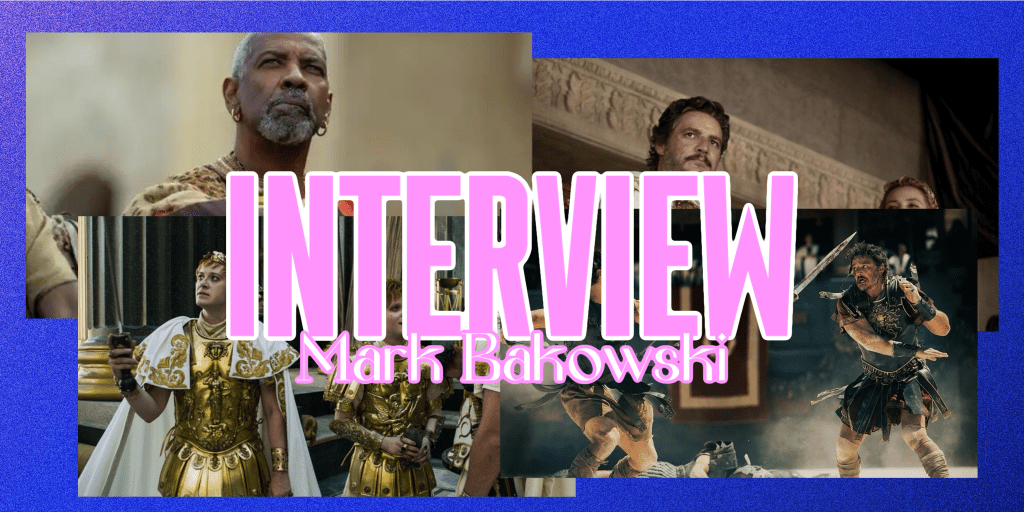
Twenty-four years later the arena is welcoming audiences back for Gladiator II. The visionary himself Ridley Scott has assembled quite a team of frequent collaborators to continue his version of Ancient Rome on a more bloody and brutal scale than ever before. With a scale more epic than the first, Offscreen Central had the opportunity to chat with Visual Effects Supervisor Mark Bakowski about the practical and visual effects challenges such as filming the rhino scene, the water effects in the naval battle shot “dry for wet”, and the final battle scene involving two armies.
Mark Bakowski: Very nice to meet you.
Jillian Chilingerian: You too. I’m excited to talk about the film, it’s become one of my favorites of the year. I just think it’s such an impressive feat and spectacle.
Mark Bakowski: Cool. Sounds good.
Jillian Chilingerian: This film definitely up the stakes from the first being more brutal and nihilistic and also bloody. The obstacles that poor Paul Mescal has to go through in the arena with the rhino and the monkeys, and even how water is captured in the film when you have to do it digitally.
Mark Bakowski: So you kind of start with a script, you look at it, it’s got lots of things in it. Not all of them get to be in the final version, you get various incarnations and you go, ‘how are we going to do that?’ Then you very quickly get into if we do it that way, how much money is it going to cost. Then every department’s doing that. They’re all kind of working it out, getting together, bouncing off each other, go, okay, so if the rhino is going to be at one point, it’s like, for example, the idea was the rhino would be a horse rather than the mechanical rig. How’s that going to affect you in visual effects? Well, in visual effects, that’s going to affect us, because the horse’s head is high so that’s going to be lots of paintworks, to restore. We’re all debating it, and everyone’s budget starts to come together, and the creative comes together, and you look at it, and you go, geez, that’s a lot of money at the end of it. Then there’s some rationalization and Ridley comes in. Out of that comes a shooting plan with some script changes. Then you’re onto the practicals there, you’re there on the day, this didn’t work, that didn’t work, whatever so then you’re responding to that kind of thing. When you’re dealing with rebuilding that way it’s an evolving thing the whole time. You have to react and, and, and, and go with it basically.
Jillian Chilingerian: The battle sequences and the action sequences of what is initially filmed and then when you come in are adding the different things into it. The monkeys were crazy, how is this mapped out?
Mark Bakowski: So the monkeys, that was in the script. I was going on to Ridley about the movie The Revenant, where he fights the bear. I was going on, you got to rehearse this, you got to work in a a plan. Ridley is not so much into that. He’s more into, like, on the day, I’m going to work it out so it’s a different vibe kind of thing. We just reacted to him, we said, Okay, well, Ridley, we’ll do what we want to do and then we’d say can we just do an extra pass where we maybe take out the stunt man who’s there playing the baboon for physical contact. The problem is the stuntmen are quite big, physically, quite big, and they don’t move as fast as baboons. So it does give the actors something to react to, physically and visually, but it also gives us a real headache in terms of making things work. So we’ll do multiple possible shoots, one version where they’re all there, then we’ll do another version where we remove all the extraneous ones so that only the ones who are physically in contact with the actors are there because it’s quite hard to fake the muscle tension and all that business. Then we’ll go, Okay, now, can we even remove those and just pretend you’re resting? It is just different things to build up what we need to do, to recreate it at the end. Often we’ll end up taking parts of one shot and putting them in the background of another shot and it’s quite a jigsaw puzzle to go, oh, we need someone to die in the background of this shot. We’ve got a shot over here of someone being attacked by a monkey let’s cut them out of there, put them into there, flop it round, and they want to the whole thing is quite puzzled. It is a puzzle to put together.
Jillian Chilingerian: I wouldn’t even think about the muscle definition and the little things to complete them all together.
Mark Bakowski: This is the actors. That’s where I was looking at Paul Mescal and you need to do everything you can to help them sell, I think, is the thing. They’re brilliant actors, but if you can give them something to interact with, I think that’s going to be easier for them.
Jillian Chilingerian: For the water, because I know they put the water in the actual thing, and then there was also no water. What was the process of figuring that out for the naval sequences plus the sharks?
Mark Bakowski: It was on the same Colosseum set that we shot a lot of the stuff on but there’s no real water there. So we call that dry for wet. They can see the CG water later on and there is an advantage in shooting in the dry which means cameras can move around far more quickly. Resets are more quick. It’s just that shooting day happens a lot faster on the dry wherever you are because imagine trying to shoot on the water. It’s just difficult. That said we did have a plan to shoot large sections of it in the water because it kind of makes sense. If you’ve got real water, might as well use the real water, right? There was a big water tank there, and so we planned to do that. But then along came the actor’s strike and we had a week to do something. So everybody was like, we’re doing that. We’re doing that battle and the tank wasn’t ready, so we shot it all on the dry. That forced our hands a little bit to go, Okay, we’re going to CG water for a lot more than we planned, because you don’t want to intercut too much the two, because with the best in the world, they’re never going to quite feel the same. Then after that, it’s getting lots of information so you make sure you scan the boats, the exact shape of the boat and know how fast it’s going. What the camera and lights are doing, put it into the computer, making it sound like that, artists do it with great care and attention. Physically correct doesn’t look as cool as we thought it should, now, that’s cheating so it looks prettier. It’s that kind of creative process all the way through. Of course, the water should be more translucent. I want to do like a swimming pool, less like a murky canal. Okay, we’ll make it more translucent. That means you can see the bottom and the sharks more clearly. Is it too much, or too little?
Jillian Chilingerian: There are so many different variations that water could be.
Mark Bakowski: There’s a whole myriad of ways you could have done it, in terms of, literally how murky and how green it is.
Jillian Chilingerian: The beginning sequence again, we’re with the water, we have the ships, and from what I remember in the behind the scenes that they showed, like, kind of expanding out what that front looked like.
Mark Bakowski: That was always the plan. That was shot in the place in Morocco. It’s where Ridley shot the Kingdom of Heaven, the movie. It was a set that played for Jerusalem and there’s a standing set already with towers and whatever walls and things we extended that. Obviously it’s the deserts there’s no water whatsoever there. Neil Corbould, who was the Special Effects Supervisor, had this great plan that we’d have two of these large boats, and they’d be driving around on wheels, on big movers that they used to think carry bits of airplanes and big things around the place. These boats would be driving around in the desert so it was always the plan we’d be putting in the water. There were complications in terms of when these things are driving around, they kick up dust, and when the dust kicks up, you can’t justify dust in the middle of an ocean. It does bring problems, but it also brings a great deal of flexibility for shooting, as I said before, and I think for us, certainly, with a big expanse of water like that even if we had gone to the ocean and shot it in the water, the boats wouldn’t have gone fast enough. We’d have to replace it anyway, and while you’re there so it’s better to at least go and shoot against the set piece of that you’ve got and go, Okay, people can be on those walls that can pretend to shoot arrows. The arrows are CG, basically, but at least there could be someone there kind of miming the arrows. There’s all soldiers everywhere and it gives you something physical to shoot and hang on to. For us having something real in the camera to work from which Ridley is just amazing at doing is brilliant, because that’s a reference for how the light would work, how the physics, how the camera is, it’s just a reference for everything that you can expand and build on.
Jillian Chilingerian: That goes into my next question because I love how so much of this feels real and practical. I was curious about like, those parts where you step in to paint in a bigger scope, because obviously, this is a humongous movie, so like working a lot with those practical things that he has given through being on location and having all texture and stuff, and how that impacts, like when you are coming in.
Mark Bakowski: We hang on to all that with great love. You know, he’ll do things as he’ll set things on fire to make large smoke clouds and give texture. He’ll use dust, he will have Neil splashing water onto people, and although sometimes you do have to rub bits and pieces out because it doesn’t necessarily work a lot of the time, it works well, and you get something in camera which is fantastic, or you work around it kind of thing. So we embrace all those things like that the rhino was a mechanical thing that someone’s with wheels, but it still has a loop. It moves up and down like that. So when the person sitting on top of it is there. They’re not just driving around, like on a moped or whatever. You get the physical gate, which is important, you get the feeling of them moving up and down. It’s, again, like the actors fighting the baboons, you’ve got to sell the physicality. All the sets, all the explosions, all those things add to the believability for everyone who’s shooting it and gives us the best starting point to build out from kind of thing.
Jillian Chilingerian: I love seeing that perfect balance of, the things that are there and how you can incorporate that, and where you can add in.
Mark Bakowski: It’s old school in the best way filmmaking, to my mind, it’s classic filmmaking, as opposed to just shooting it all on a green screen, or whatever. This to me is far more satisfying.
Jillian Chilingerian: I want to ask in the end with the sky behind Lucius.
Mark Bakowski: Ridley wanted this mystical vibe, it’s not meant to be realistic. I think it’s the equivalent of in the first movie when he’s wandering around through the field, it’s that moment. That surprisingly, went quite quickly. Sometimes we got hung up on things, but we worked out what Ridley wanted. It worked with the sound cue. We were always playing with it, listening to the sound, making sure it felt so it was never meant to be realistic. It was always meant to be stylized, but just the right level of stylized was the idea kind of thing.
Jillian Chilingerian: The first one was so cutting edge and now we have the sequel. How have you seen from advancement of technology helping?
Mark Bakowski: I think the volume of things you can do, I think was 10 times as many visual effects shots, roughly, in this as the first one, is that you do greater volumes of things. There’s an assumption that you always find a way. I mean, I don’t think we could do anything like a certain point you might go, it’s going to be expensive. Ridley goes do it anyway and you’re all right, fine, sort of thing. So you can always find a way to do everything. I suppose it’s just a question of time and money, but these days, those things you can brute force, and you can force them through kind of thing, like the naval thing, all of that, like in theory, we used to have blue screens. Ridley has 12 cameras, maybe 14, sometimes pointing in every different direction, all seeing each other, literally pointing at each other. There’s a tiny little blue screen in one corner that no one’s ever looking at. In the end, we find a way to get it done because it means he gets to shoot the way he wants to shoot, which is what gives you the result and the energy of the scene. So you make it work for him, you know, you make it work every time, kind of thing.
Jillian Chilingerian: Was there anything that you came across on this challenging project?
Mark Bakowski: I’m seeing it all the time, all the way through, it’s not, kind of not surprise for me. So I’ve seen it in pieces lots of times, and then so on. But I guess seeing it with the final grade and the final sounds, that’s, that’s pretty damn cool. It does everything, elevates everything just improves massively so that’s a lovely surprise. I loved seeing the opening titles as well. Also seeing the final two armies coming together, was a big challenge for us and that was kind of down to the wire a little bit as well.
It was shot in Malta and those armies in the original plan weren’t supposed to be there at the very end. They’re supposed to be there when he gets out of the river. From that point onwards, they’re there but you never see that whole arrival sequence, that never happens. We had to put the armies into all those shots, which was pretty damn hard. There was a whole bunch of pickups done in the UK so there was maybe a quarter of the sequence we shot in the UK intercutting Malta with the UK. There are these soldiers just walking through this grassland that doesn’t look anything like Malta. So that was a real effort to meld the two environments together. A, make England look like Malta, and B, put soldiers into the background of the Malta shots, and they’re all shot different times of smoke in the background of some there’s no smoke in the other ones at different times of the day. So it was quite a puzzle to make it come together, but fingers crossed, it sells that they’re there the whole time. Well,
Jillian Chilingerian: I would have never noticed that.
Mark Bakowski: That is filmmaking in general these days is often everything’s shot on different days in general. Nothing really is that consistent, but it’s the extent to which you push it sometimes. I’m glad you didn’t notice, which is good,
Jillian Chilingerian: Well, thank you so much for discussing all this with me. I am blown away by the scale and just the intimacy of the storytelling.
Mark Bakowski: It’s really great to talk to you.
Jillian Chilingerian: Thank you.
Gladiator II is available to watch in theaters
You can read our review of the film here.
 offscreencentral.com
Leave a comment