
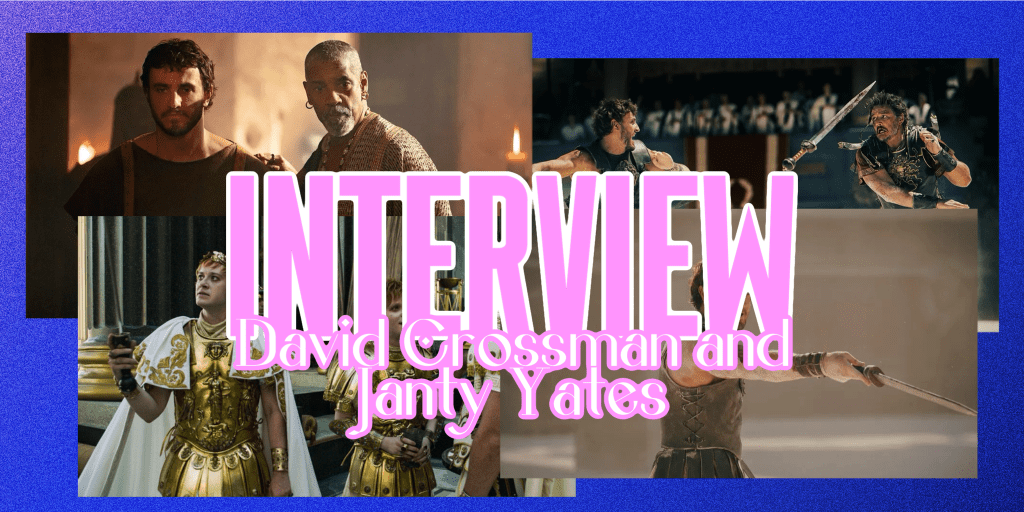
Twenty Four years later the arena is welcoming audiences back for Gladiator II. The visionary himself Ridley Scott has assembled quite a team of frequent collaborators to continue his version of Ancient Rome on a more bloody and brutal scale than ever before. With a scale more epic than the first, Offscreen Central had the opportunity to chat with costume designers David Crossman and Janty Yates about the wealth gap between Numidia and Rome, with Numidia depicted in simpler clothing and Rome in opulent armor, the evolution of characters’ costumes as they ascend or fall to power, and the challenges of mass-producing costumes for large scenes.
Jillian Chilingerian: I’m excited to talk about the film. I was blown away by the costumes so I can’t wait to dive into it with both of you.
David Crossman: Thank you
Janty Yates: Thank you
Jillian Chilingerian: First, I want to start with the timeline of the film. It’s not that too long from the first and the second and it speaks to how much can change in eight years. I think we see this in every society, and specifically with the Roman Empire, we see this rise of wealth and opulence. For both of you, how do the costumes really speak to that?
David Crossman: My only wealth gap in the film, really is between Numidia and Rome. In the beginning, it’s supposed to be Numidia, a much poorer country, and you’ve got the horrible might of Rome coming at them, and all this kind of armor, and which is all money, essentially, at that time, armor is just lots of money against poor old Numidia and their bits of skin and the odd helmet and stuff. So that’s, that’s my biggest depiction.
Janty Yates: Our peasants this time around were fairly beige, but we did have a lot more middle and upper class this time around, and they were quite visible in the Colosseum. It’s really in the Colosseum crowd and the streets of Rome that you do see the working class, they’re quite prevalent, but there was quite a bit of that in Gladiator, in so far as the bread was thrown, and it was feeding the people. It was patronizing, all of that. So I think we kept our crowd fairly similar to the original Gladiator. There was just more opulence this time around, I think.
Jillian Chilingerian: It’s so interesting to see where things are the same, and then things might have changed a little bit between the two films. I love that, like, so many of the characters transform through what they’re wearing with Macrinus and the robes. It’s the way that they utilize the clothing within who these characters are without having them having to speak. How was it to map out each look as we introduced new characters into the mix?
Janty Yates: Well, I can talk about Macrinus very briefly. We did have an arc for him, whereby, when he’s in the suburbs, he wears darker, less ornate outfits, and less jewelry. When we came to the close-up of him, he looked so powerful and awe-inspiring, I’m going, Oh, you, you know you haven’t, you haven’t read the assignment. You know you’re supposed to be sort of ambitious, but not so he’s so wonderful throughout. His costume is really by the by, because it’s all in his face, but the costume, I think, helps, and he works the costume so well. So we went to an arc in so far as he arrives in Rome, and he’s wearing layer-on layer. He’s wearing some animal skin, he’s wearing bigger jewelry. He’s wearing more rings and a lot more gold. A lot of designers wear very simple but elegant costumes or clothing because they know it’s the finest fabrics in they know it’s the gold. So we could use a slightly simpler look for him towards the last two outfits that he wears, but he just worked his costume. He worked it all the time. He’d play with his rings. He’d twiddle his wrap, he was marvelous, absolutely marvelous.
Jillian Chilingerian: It’s interesting to see when the characters become more comfortable in the situations of how they peel back and give them their true selves, and then how that’s depicted and what they’re wearing.
David Crossman: Pedro is always powerful or you always want to project power with him, because he’s the general. He’s got his different armors, and he’s got his white parade armor, and then he’s got his softer when it when he’s just in tunic but it still has the embroidery of a general or something that we created to be the embroidery of a general, whereas Lucius starts with more folksy hand woven Numidia. That’s just meant to be speaking to the more basic forms of armor when you have nothing. So what you do is make the armor from pieces of skin, or, you know, bits of leather. The Greeks used to make it from linen and just hard on the fabric, you know, because they because the whole thing of metal and steel and iron is just so expensive, so it’s in short supply. So that’s what we’re that’s what we’re trying to do with Lucius there. As he progresses into Rome, obviously he gets his gladiatorial cuirass, which becomes his thing, until until we get to the third act.
Jillian Chilingerian: We see how the Empire is expanding, and you get to see all these different cultures and people like come in, and what does that influence on where they’re from, and what resources they came with, and how that’s depicted in their clothing and what they have near them?
David Crossman: Yeah, well, the good thing with Rome, you can always argue the silks come in across from Asia. There are places that things can travel to, to Rome, there’s all this influence. I suppose it’s the same in Numidia at the beginning because it’s kind of coastal Africa, so it’s a place where lots of people would have stopped and put port and where all those influences and cultures would mix eventually,
Jillian Chilingerian: For the emperors, their looks.
Janty Yates: They’re just so mad.
Jillian Chilingerian: Yes, they’re so crazy because they’re almost like the same person, but like, they’re so different. With the hairstyle or what type of materials or colors they wear with where they are at in their power compared to everyone else.
Janty Yates: Ridley’s jumping-off point was Sid Vicious and Johnny Rotten. So punk. Hence the red hair, the white makeup, the possible gold tooth, etc. So it was quite easy to create because we had some wonderful fabrics, all very vintage, beautiful, embroidered, beautiful, encrusted. And so we were just draping. The boys were completely in shock, going, Really, what is this? What that? And now you want me to wear this, which is lovely. It was lovely to do so many outfits for them as well.
Jillian Chilingerian: There’s so much edge into what we would think with historical of how you can bring in some contemporary and infuse that into archetypes with people.
Jillian Chilingerian: When we think of costumes, we always forget, it’s everyone, and so there’s a pretty large scale of people that you have to represent everyone that is in the empire with large sequences. What was that process like, of, constructing those scenes just to make sure that everyone was uniformed, or, like, looked, you know, like they were all together?
David Crossman: I think it’s just a, it’s a race against time from the moment that you start, and then you’re, trying to work out the things that you’re going to replicate. You have around three months or so from the point of being green-lit and being allowed to spend money, then you’ve got to prototype things, then you’ve got to go into mass production, then you’ve got to get it all to Morocco. That’s where we’re going to start shooting. There’s nothing there so everything has to come there from all over the place. The industry was very busy at the time, so lots of people didn’t want to make 500 sets of Roman soldiers. So we had to go further afield. It”s all those challenges, what I was saying before was, you just hope that it doesn’t get lost in just trying to get those big numbers done, so we were, we were just making these big clumps of things in England, Budapest, New Zealand, and then just trying to get it there on time.
Janty Yates: We had to ship it in, then break it down, then fit it, pre-fit it, and then hopefully we’d be all right for filming. I mean, it was all just the skin of your teeth. It just never knew. Luckily, it all worked out.
David Crossman: Even when we got to the water, people were flying in with suitcases full of arms for Gladiators, or helmets from. It was a daily thing, it calmed down. Eventually, we got to about three-quarters of the way through the film, then we had everything, but you were still. We were just chasing ourselves until that point. Luckily, all the actors were easier, they were all made in-house, so you can just be on top of those all the time, whereas with everything else, you’re relying on people who don’t always care as much as you do about whether it gets there or not so it’s, all those pressures.
Janty Yates: We were quite lucky in the civilian world, because in the Gladiator One, we were dressing 3000 every day, or not every day of the shoot, but big chunks of it, and this time we had probably the maximum 700.
Jillian Chilingerian: For Pedro’s look, there is in fact the softness, when we first meet him and he is attacking these people. Once he is toned down a little bit in his clothing, it’s kind of like it gives him a vulnerability.
David Crossman: I suppose it’s just to me, it was more about him being more relaxed and not always as formal in armor. I suppose in a way, rather than him being more sympathetic because I knew in the script that he was going to eventually. The first armor was trying to do a very powerful set of leather stroke metallic armor, which would look striking with his Medusa head and exaggerated serpents on it. Then it was to be this kind of figure arriving in Rome in this triumph of white armor, the victor returns from Numidia. It was more of a he’s at home now. He’s going to wear an embroidered cloak and an embroidered tunic. We did have another thing that we never saw which we didn’t use, which was an even more homely version of Pedro before he’s back into his armor. I think Ridley wanted him to wear his tunic only for his finale, and then, we all had a discussion. Then he was back in his armor, which was a nice thing.
Jillian Chilingerian: Thank you both so much for diving into the processes, and for the costuming, because it’s everything looks so stunning, and is interesting to see the different arcs of like with Paul from coming from nothing to being the gladiator.
Janty Yates: Well, thank you for all your very good questions.
David Crossman: Thanks, Jillian
Gladiator II is available to watch in theaters
You can read our review of the film here.



 offscreencentral.com
Leave a comment