

Anyone headed into a Robert Eggers film knows to expect period accuracy and extremely detailed design. Production Designer Craig Lathrop has worked on all of the feature films from Eggers and beautifully speaks the same creative language. Lathrop had heard from Eggers about his plans to reimagine Nosferatu early on their partnership and was fully ready to jump into the world of Count Orlok. Offscreen Central had the opportunity to speak with Lathrop ahead of the film’s upcoming Christmas Day release and discuss building over sixty sets for Nosferatu, the research required, and even the popcorn bucket of his design!
Kenzie Vanunu: Congratulations on the film! I’ve seen it twice and it’s just absolutely a masterwork.
Craig Lathrop: I’m so happy to hear that. I I’m excited. I haven’t seen it with an audience yet. That’s fabulous. I can’t wait to see it with an audience because there’s no surprises for me, right?
Kenzie Vanunu: There are just so many scenes where just visually you’re taken aback. I think people are so on the edge of their seat for Count Orlok’s reveal and there are so many other moments that are just take your breath away and it’s so exciting no one’s suspecting them.
Craig Lathrop: And he does reveal his whole self to them at one point.
Kenzie Vanunu: Yeah! Very much.
Craig Lathrop: I love that scene, personally.
Kenzie Vanunu: It’s amazing. You’ve worked with Robert Eggers on his entire feature filmography, which is amazing. I love a partnership like that and seeing the same creative language spoken between the team and the director.
Craig Lathrop: I feel blessed, believe me.
Kenzie Vanunu: As a viewer, I feel blessed. It’s amazing to watch. I know this film has been a big dream for him for quite some time. At what point did he approach you and say this is actually the next?
Craig Lathrop: Oh, it’s been going on for a long time, so after The Witch, he mentioned it to me. He didn’t send me a script, but he mentioned it to me, that he was wanting to do a remake of Nosferatu, and that he had been thinking about it for a while. And then before we did The Lighthouse, he sent me a script and I actually started breaking it down and started working on it, but it fell apart. And then we quickly changed gears. So, we turned quickly and did The Lighthouse, which actually I think was really good for us because then we did The Lighthouse and then we did The Northman. And by the time we got to doing Nosferatu, we had sort of grown together, everything was much more solid. We understood from The Northman doing a larger [scale] film was about and how it pertained to doing a larger Robert Eggers film. I thought it was good timing, but where did it start? It started way back then. And even though I didn’t really know all of the script, I started dreaming of Orlok back then. And I’m so happy he’s been able to unleash Orlok to all the rest of y’all’s dreams. And it’s not just me.
Kenzie Vanunu: Me too. Me too.
Craig Lathrop: But that’s when I first started thinking about it. I remember I was going on vacation, and I actually brought ‘Wuthering Heights’ with me to read.
Kenzie Vanunu: Oh my gosh. When I was watching it, I was trying to think of all the other things that are not the typical inspiration people are assuming for this film, and that was definitely one of them.
Craig Lathrop: Yeah, it’s a great, it’s one of my favorite books, so it’s good.
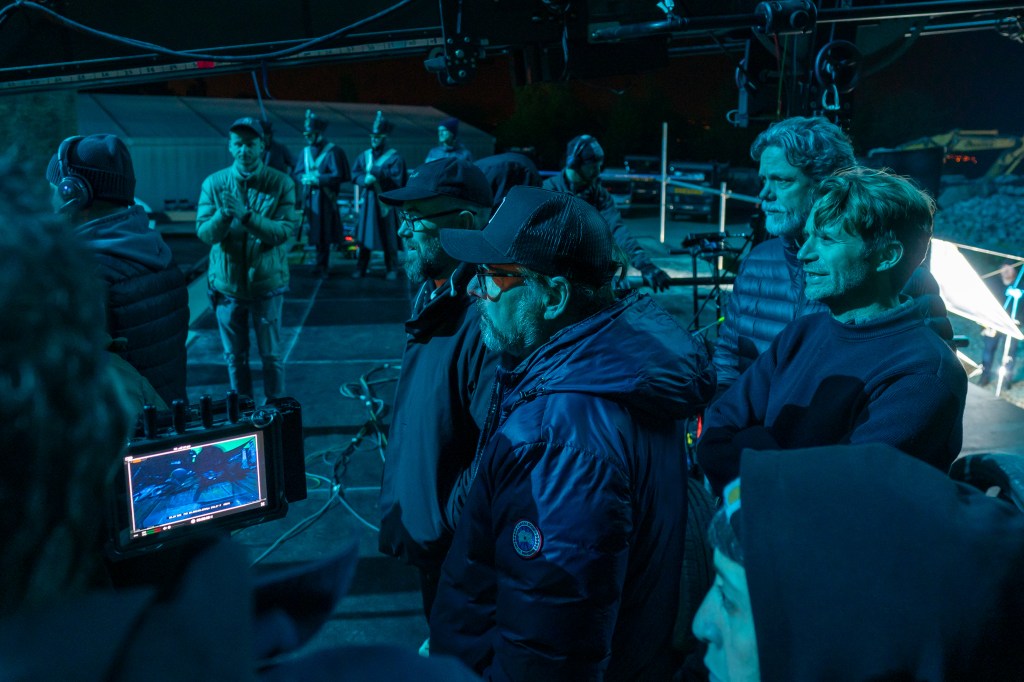
and director of photography Jarin Blaschke on the set of their film, NOSFERATU, a
Focus Features release.
Credit: Aidan Monaghan / © 2024 FOCUS FEATURES LLC
Kenzie Vanunu: I know he’s a big research guy, how much research on the time period did he come to you with and where did you start yours? Did he bring you any specific inspirations from items from real life in the time period or other films or art?
Craig Lathrop: Oh, he does a ton of research on his own. I start doing a bunch of research and usually, when he comes to me with these reams of research, most of it I have, if I’m lucky. Some of it I’m not going to have, and some of the stuff I’ll have that he won’t have, but he does a lot of research. But I do try to do a bit of my own research as well. My research also goes a little bit deeper into the weeds, specifically of the architecture and the style from the period in that form, which is not to say he doesn’t look at that, but he does so much more. He does so much amazing research, as you probably noticed in some of the other films, not so much this one. The dialogue and the dialects are appropriate for the period and the time. That’s all next level. The truth is you already know as a base level, he wants it to be as authentic as we can make it, as period correct as we can make it. That’s the base level. That’s where you start as opposed to it being plastered on top of.
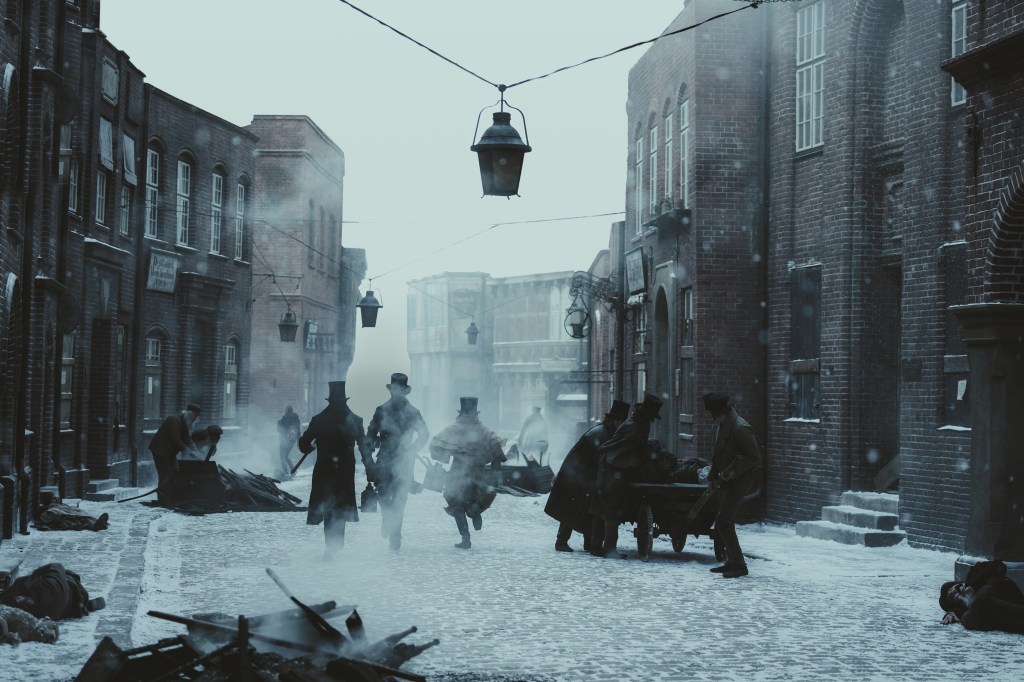
Credit: Aidan Monaghan / © 2024 FOCUS FEATURES LLC
Craig Lathrop: So, then you start thinking about the characters in that relationship, which is normal anyway, but it’s a different emphasis. In the emotional beats of the film are all coming out through this, how do we do that through this period accuracy, as you’re trying to put it all together. It does become a base level though. And it’s great for me too, because even when I’m having a prop master is doing a prop, he comes to me and says it’s really cool. He knows that my first question is going to be, “where’s the research for this? Let me see.” Because if it’s not directly out of my research, and he wants to show me something new, then I want to see the research. Because I know Rob’s going to ask me as well. I do look for some cool things, obviously. Some things that tell us something new about the character. But it is always period correct.
Kenzie Vanunu: I love that. Actually, one of my favorite parts of the story of Nosferatu and Count Orlok are all the different chapters, like Ellen and Thomas and their up and coming starter home contrasted with the wealthy Hardings and then the village outside of Count Orlok’s castle, there are so many segments to the story with such variations of design and character development. It’s really interesting. How did you approach all of those different kinds of sets? They’re all so beautiful.
Craig Lathrop: First off, thank you very much for saying it, most kind. How did I approach it? It’s the same way for each one. It’s not really dramatic difference in terms of the approach. Yes, we’re going to figure out what is correct for the period and all of that. And then also what is cool and what has the emotional beats, but they’re both right. It’s not one without another. Yeah. For the streets of Wisborg, for instance, I dug a lot for the architecture and I got that out of actually, the only places I could find it, was there were some German museums and libraries that had some of it. But I also looked at Samuel Prout, who’s an artist from the period. And he did a lot of sketches in Germany. So that was like the nuts and bolts of the streets.
But then it’s, the It’s the same thing when you go to do like the Romanian village, you’re just looking for what we can see. And actually Rob and I went and looked at some open air museums in Romania that had buildings that they’d pulled and rebuilt in one spot so you could see what buildings looked like that were quite old. We pulled all of that out, looked at a lot of castles, none of them quite fit what we wanted, so we ended up building it.
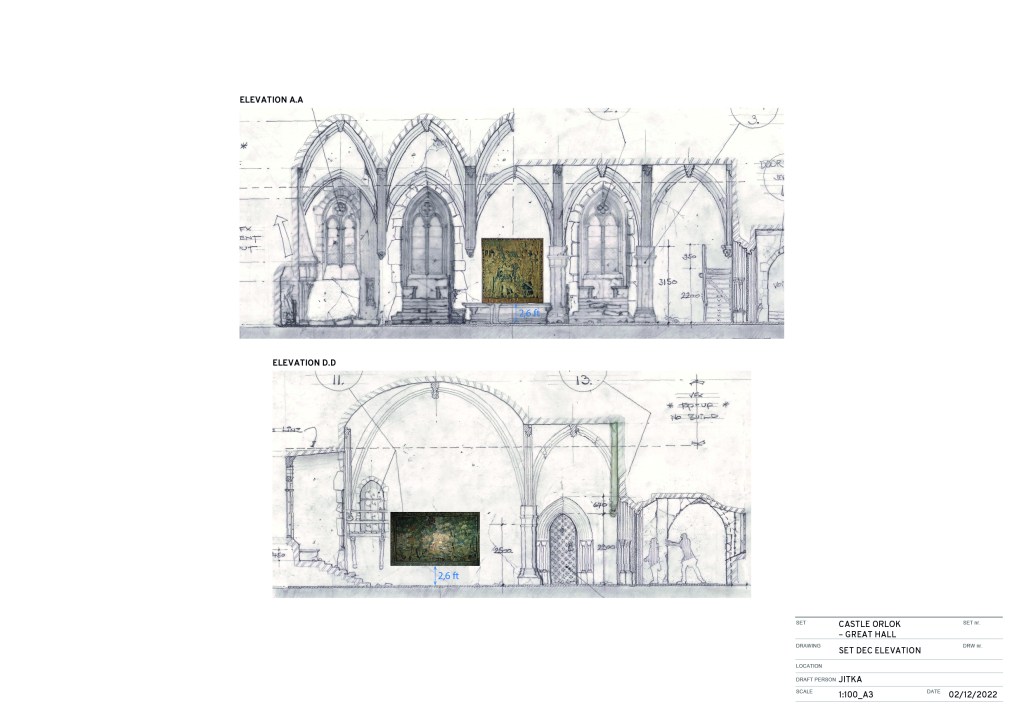
Credit: Craig Lathrop / © 2024 FOCUS FEATURES LLC
Kenzie Vanunu: That was my next question, actually. Count Orlok’s castle is just so iconic to everyone with so many variations of this story. I love the scene when Thomas first goes to the castle because you get to really get the lay of the land as he’s entering. Can you just talk about creating the exterior and the interior? Because it’s so detailed.
Craig Lathrop: So, we built a little bit of the bridge because we couldn’t get the carriage to the exterior. We had to do that composite, but the exterior is actually Corvin Castle in Romania. And that was an inspiration for a lot of the castle itself. And then the only other spot that we built some pieces in, but we didn’t build the whole thing, was the courtyard when [Thomas] Hutter first comes down, he’s looking for the crypt, that courtyard was Pernštejn Castle in the Czech Republic. But everything else we built, including all the interiors. And the one, I think that what you’re getting at, is there’s a scene that has quite a tricky camera move where they come up the spiral staircase.
Kenzie Vanunu: Yes!
Craig Lathrop: Yeah, so that that was fun. We opened up the floor of the stage we were on in Barrandov Studios and I built the staircase into the basement, so that they could come up and do that all in what appears to be one shot and we can have Orlok disappear as they’re coming around the spiral. And then he just literally ran off the other side. He’s there. But hopefully it appears magical.
Kenzie Vanunu: It definitely does.
Craig Lathrop: It was all just done on camera. It was just a very carefully worked out camera move with Jarin [Blaschke], myself, and obviously Rob, in terms of what we needed, the angles that we needed, how I build the set. I originally had, this may be too much information, but I originally had staircase going in the opposite direction because that’s normally the way they go. But this would allow us to have a better angle going into the Great Hall.
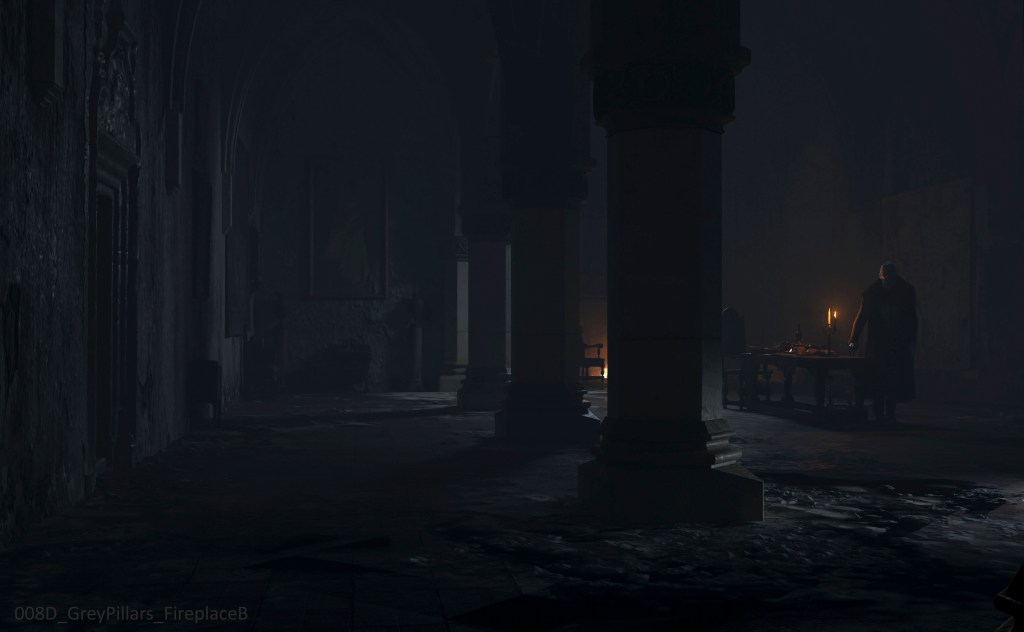
Credit: Craig Lathrop / © 2024 FOCUS FEATURES LLC
Kenzie Vanunu: It did feel like a descent, the way that he it’s angled in the way that you are rising up with him and then him just vanishing. It literally felt as if you descending into something. It was really cool.
Craig Lathrop: Oh, very good. Very good.
Kenzie Vanunu: Yeah, when I spoke to Linda, the costume designer, about his boots in that shot. This is the entrance we all love so much. It’s so interesting. So it was a great build on that staircase and all the partnership with creating that to have the movement be so magical.
Craig Lathrop: Oh, cool. I’m glad you liked it. I just did another interview and somebody asked me about this, so it’s on my mind. Did you notice that the head moves in the fireplace?
Kenzie Vanunu: Yeah! So, the first time I saw it I was like taken aback by it and then the second time, I knew that it was coming so I watched it to try to see how it did that.
Craig Lathrop: We did that live! We did that as an animatronic, it’s not visual effects.
Kenzie Vanunu: Oh, wow! That is so incredible. No wonder it feels so real.
Kenzie Vanunu: My favorite part about vampire stories is that they have just lived such long lives and they’ve acquired all these things because they have just had all these different variation of identities. Can you talk about just all the little trinkets and items he has?
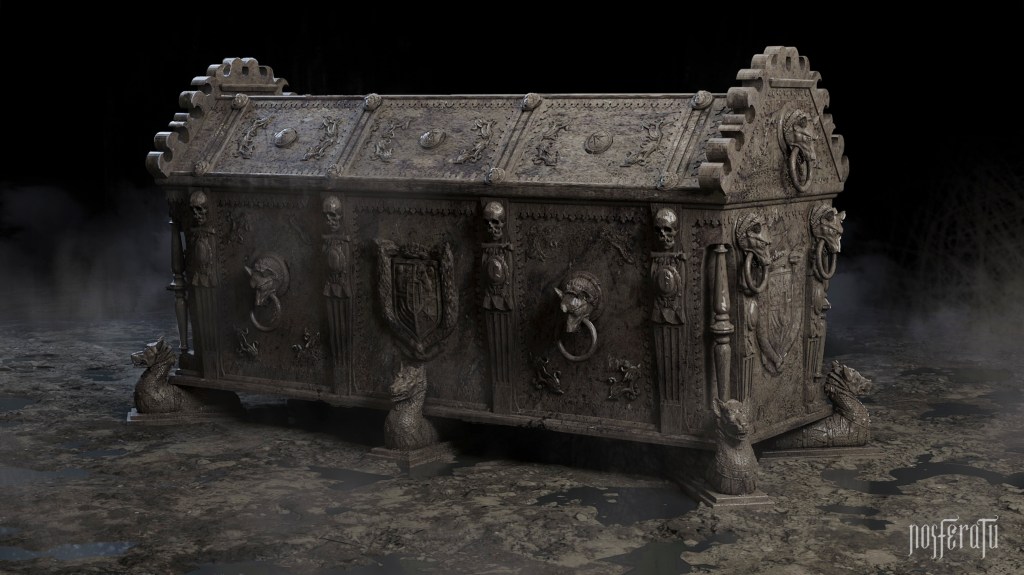
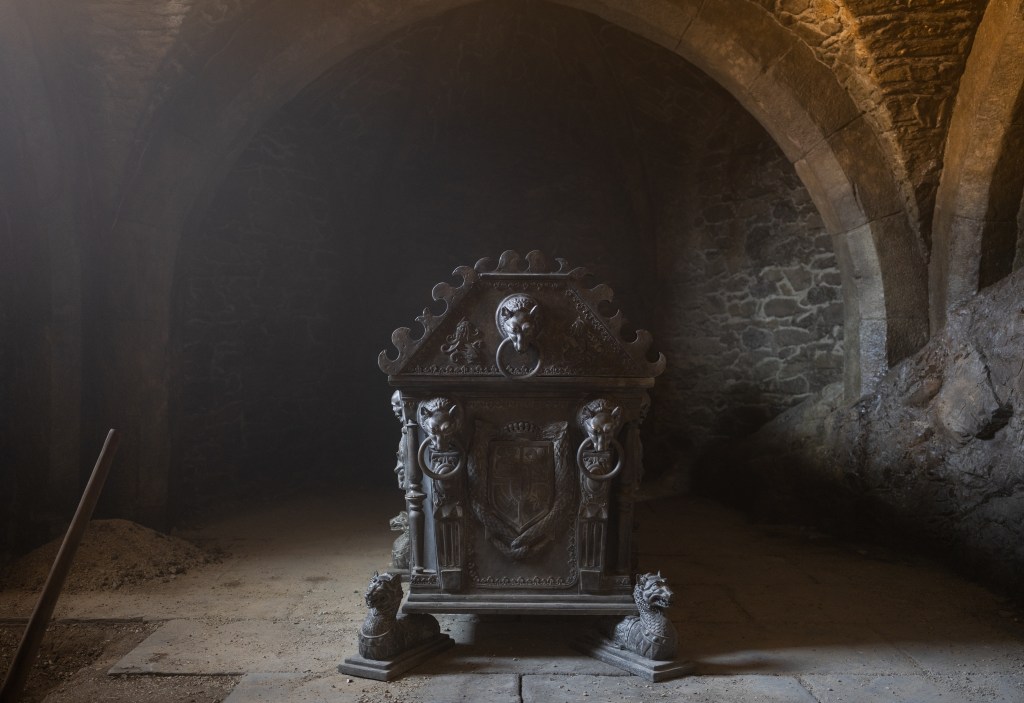
Craig Lathrop: First off, I’m glad you mentioned that because, in our mind, and it’s talked about in the script, Orlok has lived a very long life as you would imagine a vampire would, and he stopped coming out of his sarcophagus and he was just in there for a hundred years or so. When he comes out, we wanted the place to feel decayed, not just because it would have been in disrepair and falling apart, but also it suits Orlok and who he is. He’s dead, he’s reanimated and fallen apart himself. So you wanted it to feel the same. The big items would be the sarcophagus, which we designed loosely based on a sarcophagus I found from the 1500s that was actually Polish.
Credit: Craig Lathrop / © 2024 FOCUS FEATURES LLC
Craig Lathrop: And the carriage, which is a little bit dark, so you can’t see all the detail, but there was a lot of detail in that. And that was based on from the early 1600’s, like 1602, I wanna say. It was a gift from Elizabeth the First to the Tsar of Russia. And I based ours loosely on that, obviously, I changed it a little bit. So, we built those two things.
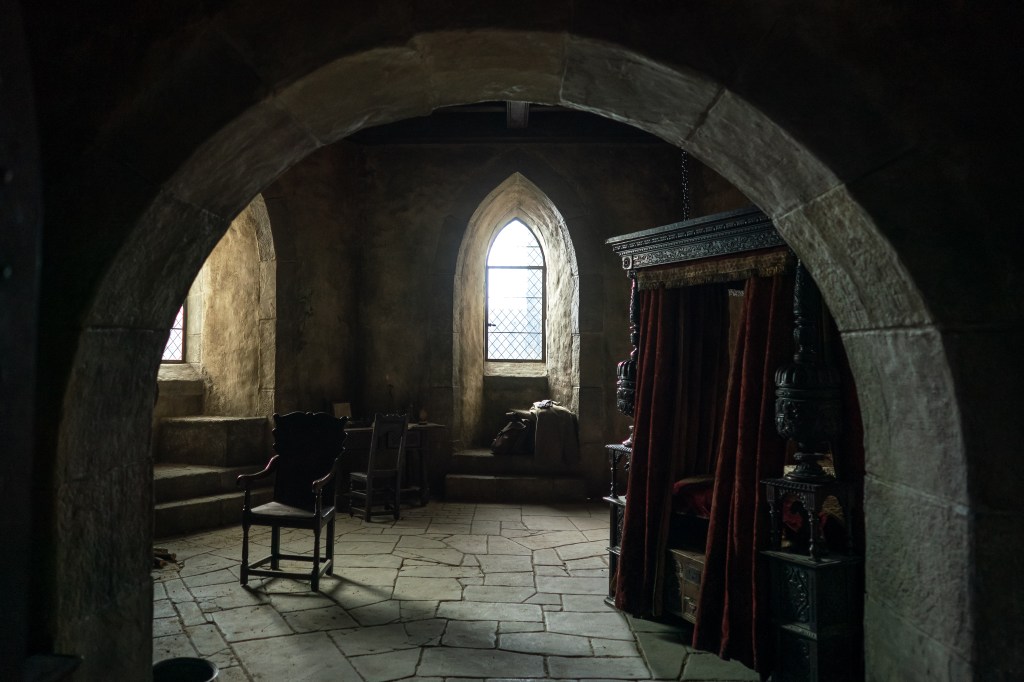
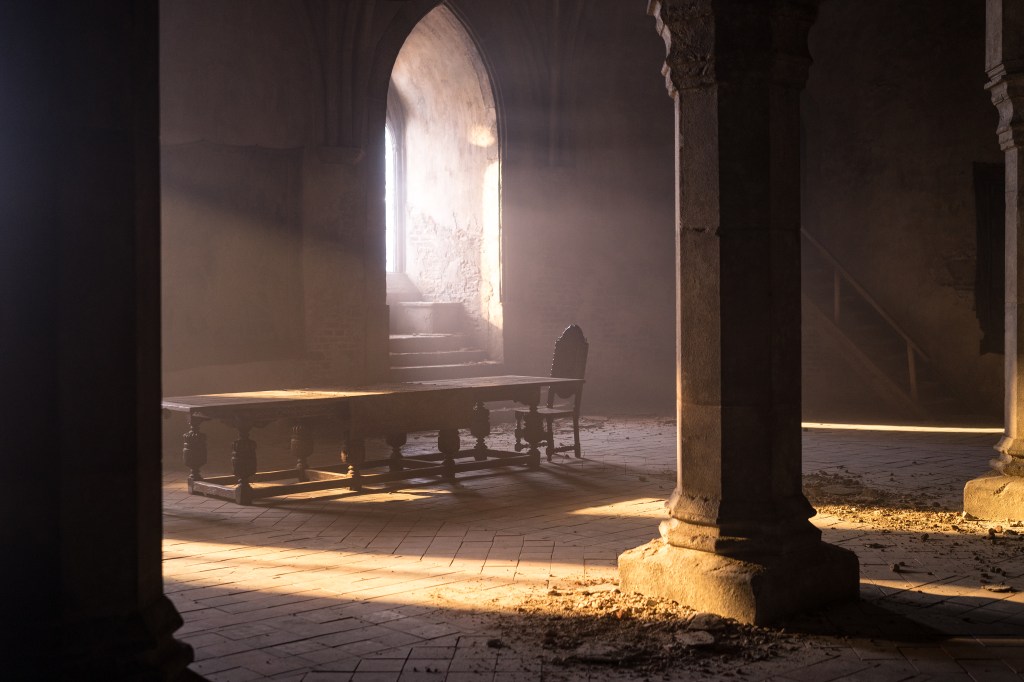
And then the rest of the details, it’s actually almost a lack of some of the stuff. It’s not as much stuff. You’ve noticed probably that there was that giant table in the middle of the room, but there’s not a lot of other furniture. He lives there alone and he doesn’t eat. So he doesn’t need a lot of things. Although, there are a lot of details once you get into the tower chamber where Hutter sleeps. The bed itself we rented from London. There was some parts that I wasn’t really happy with so that we made those.
Credit: Aidan Monaghan / © 2024 FOCUS FEATURES LLC
Craig Lathrop: And we made all the curtains and all the bedding and all the kind of stuff that you would expect. And what other details are in there? There’s some more details on the fireplace. I don’t know if you even see the ceiling. The ceiling is a coffered ceiling with There’s a lot of painting on it, but it was dark. Then, there’s the crypt. We built the crypt, of course. And so there are other coffins in there, but this is the main sarcophagus.
Credit: Aidan Monaghan / © 2024 FOCUS FEATURES LLC
Kenzie Vanunu: And now so many people get to see it at so many theaters. They have it set up, which is so cool!
Craig Lathrop: I can’t wait to see the popcorn. Have you heard this?
Kenzie Vanunu: Yeah! Somebody sent me a picture that they started to get them. They’re like, ‘we can’t sell them yet.’ I guess it’s metal.
Craig Lathrop: I have to see. I have to get one myself.
Kenzie Vanunu: Someone needs to send you one.
Craig Lathrop: I know. ’cause that’s my sarcophagus. They’re doing some sort of event at the Masonic Lodge with the real one and the real carriage
Kenzie Vanunu: That is incredible. I love this new wave of incorporating all these like real things from the film into the marketing so people can go see it. It’s really it like really helps immerse people.
Craig Lathrop: I think so. It doesn’t help for people in Des Moines. Certainly in the larger hubs, it will give you a chance. I’m obviously a film nerd. I love this stuff. So whenever I go to a theater and I see somebody’s costume or I see some prop, I’m always thrilled to see it. It’s always fun.
Credit: Aidan Monaghan / © 2024 FOCUS FEATURES LLC
Kenzie Vanunu: I remember reading a lot of interviews about The Lighthouse that you had to think about the designs being captured in the black and the white. So in this one, so much of it is obviously set at night, but the cinematography is so beautiful. You can actually see everything, all the details. You can just feel the texture of all the woods and like all the bedding. Like you can really see it all. It’s so wonderful. Did you have to change any specifications knowing it was going to be this nighttime setting for most of the scenes?
Craig Lathrop: No, there was the day and the night. Just dealing with the palette. Funnily enough, though, because first with The Lighthouse, even though it was in black and white, that’s when Jarin first did this filter that he developed or figured out. He actually got it from a medical filter. That’s very specific wavelengths. It’s very blue and it turns things red and darkness and all those things I talked about before when you’re changing it to black and white. But, so I was used to it. And then we did The Northman, which we use something similar. So, I had an understanding of how the color palette would shift under that light that now as he’s perfecting it for Nosferatu. I think I just I got it. Which is the beauty of working together with a group of people over and over. You know where he’s trying to go with it.
Kenzie Vanunu: It’s truly the most beautiful nighttime shots I’ve seen in a movie in so long. It’s just so magical and ethereal; you really feel like you’re under the moon. It’s so amazing.
Craig Lathrop: It’s pretty good, I gotta say.
Kenzie Vanunu: I love that you can still see everything, even under the darkness. You can really see the texture just all the within their bedrooms. Especially, there’s scenes where Ellen goes to another room for comfort and it’s just so beautiful that you can still see all the personal details.
Craig Lathrop: Oh good. And they’re pretty bold. We had to make all those wallpapers for instance. I tried to choose ones that were a little bit tamer but still had the had that Biedermeier look of the period, because I really was hoping to transport you to the time and place that we were at, right? I wanted to make sure that you felt that you were there, that you were part of this world.
Kenzie Vanunu: You definitely did. All of your work, especially with Robert Eggers, you guys always are transporting us to exactly the story you’re telling and the time period it’s in. It’s such an honor to every time I’ve watched your collaborations. It’s really magical the way y’all are able to transport us back in time.
Craig Lathrop: Oh good, that’s the main idea. Not just any time, but to this specific time with these specific characters, but yeah.
Kenzie Vanunu: Thank you so much for talking with me. I am so excited for more people to see the film and see your beautiful work and hopefully get their own sarcophagus at their theater.
Craig Lathrop: Oh, I can’t wait! It’s an odd thing to get popcorn out of. Thank you, Kenzie.
Nosferatu opens in theaters on December 25, 2024, including in IMAX and Dolby.
You can read our review of the film here.

 offscreencentral.com
Leave a comment