
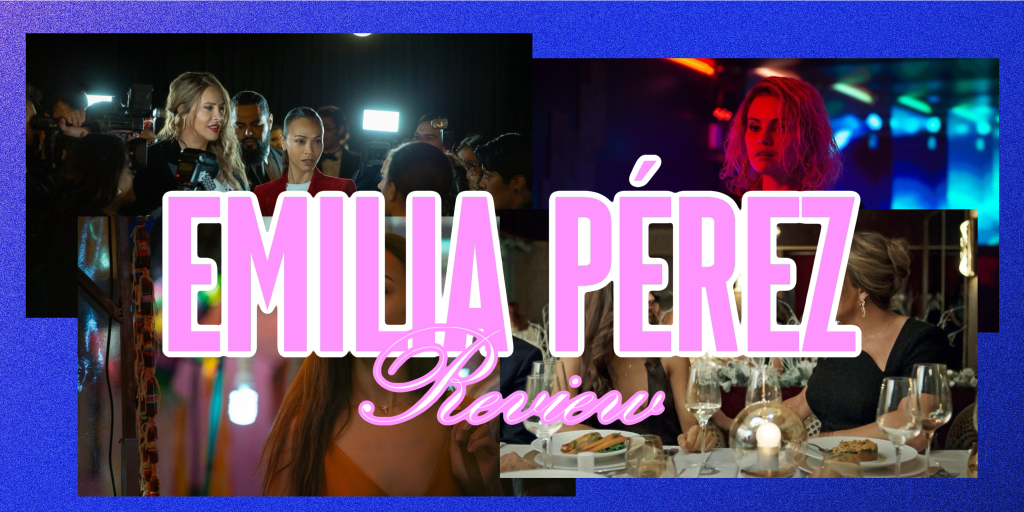
Emilia Pérez serves as a truly original yet polarizing story from Jacques Audiard. The creative visual storytelling in the musical numbers, impeccable production design, along with spectacular performances from Karla Sofía Gascón and Zoe Saldaña help elevate the inconsistent script and almost jarring premise to a undoubtedly unique film experience.
Disclaimer: The subject matters of this film and their respective executions are not without controversy, specifically from the transgender and Mexican communities. While it is impossible to please every single audience member, with this film, it is crucial that we hear their feedback. Without their voices, Hollywood will never become as welcoming as it claims to aspire to be.
The current state of cinema often results in divided reactions from audiences. With films ranging from live-action adaptations of animated classics to what many deem as unnecessary sequels being announced, there has been an increase in demand for “original stories.” Well, for any viewer that is searching for a film that is only original, but for better and for worse, goes against every established and expected sense of normalcy in what a film is and can be, they should look no further than Emilia Pérez, written and directed by Jacques Audiard.
Emilia Pérez‘s plot already differentiates the film from others that gain widespread attention in Hollywood. Set in Mexico, an undervalued lawyer named Rita (a far-too-often underrated Zoe Saldaña) is recruited by a feared cartel kingpin named Juan “Manitas” Del Monte (Karla Sofía Gascón) to help fake her own death in order to live authentically as her true self; a woman. Manitas offers Rita an amount she cannot refuse, and sends her around the world to search for the best doctors to perform her sex reassignment surgeries. Once the procedure is set in Tel Aviv, Manitas relocates her wife Jessi (Selena Gomez) and their children to Switzerland under the false notion of protection. After a multitude of painful but successful surgeries, Maintas begins her new life as Emilia Pérez, the woman she has always wanted to be. Four years pass and Rita is reintroduced to her former employer, now as Emilia. Desperate to see her children, Emilia has Rita bring Jessi and her children back to Mexico, hiding under the false pretense of being a distant relative of Manitas. It is here that Emilia finds new passion and purpose, and comes to terms with the actions of her past, all of which pose a threat to her new life.
Anyone familiar with Audiard’s previous works knows how ambitious of a filmmaker he is, and this is absolutely no exception. In fact, it may be overly ambitious to its own fault. Emilia Pérez marks the first time the 72-year old Audiard has worked with a cast of majority women and the first of his films to be largely in Spanish. When developing the story, Audiard originally wrote it to be a four-act opera libretto and based the titular character, “Emilia Pérez” off of a chapter from the novel “Écoute” by Boris Razon.
With a pre-production and development spanning multiple years, the film was changed from a libretto to a musical, yet maintaining the cadences found in opera arias but with melodies and lyrics that wouldn’t touch a traditional movie musical with a ten-foot pole. While this allows the film to have an undeniably distinct style, it is undoubtedly different in a way many audiences are not resonating with. Some – keyword, some – numbers are exciting to watch and really elevate the crowded plot along, while simultaneously showcasing the talent of its leading ladies, the creativity of the production design, and direction by Audiard.
For example, the opening number, “El alegato” follows Rita in a crowded street market and allows us to see how devoted of an attorney she is for a boss that refuses to give her the credit she deserves. The choreography and creative liberties with the camera movement is intentionally rough, almost mirroring something you would see on a stage. The action happening on camera along with Saldaña’s incredible dramatic performance allow the viewer to be drawn into a film experience they likely have never encountered before. Perhaps just as impressive as Saldaña’s acting in this number is the production design of this market, to which was remarkably shot entirely on a soundstage. Production designer and art decorator Emmanuelle Duplay and Virginie Montel go above and beyond to give this film a color palette and interior setting that truly matches the fever dream of a story it has.
One of the film’s positive attributes is that the sincerity and genuine passion of the cast and crew is felt throughout the film. The previously mentioned Zoe Saldaña is consistently phenomenal not just in the musical numbers, but in the dramatic and quieter moments. Saldaña, being Afro-Latina of Dominican and Puerto Rican ancestry, has been outspoken about never being given a chance to play a Spanish speaking part due to colorism within the Latin American community as well as Hollywood’s expectations of how a Latina is supposed to appear physically. It is a shame that a performer of her talent that has acted in some of the highest grossing films of all time (Avatar and Avengers: End Game to name a few) very rarely gets opportunities such as this to showcase the wide range of her abilities. Rita is arguably a co-lead along with Emilia, and Saldaña is given plenty to work with from the script and musical numbers. If any director or viewer was doubting her dramatic chops – whether that comes from a preconceived bias they have of performers from genre films is up to them to work through – this performance should be the one to finally put the nail in the coffin.
Selena Gomez has had a successful and deservedly acclaimed run in comedy television for over a decade along with releasing, pun not intended, popular pop-music records. Unfortunately, she’s not as continuously prosperous here. The character of Jessi is the one that suffers the most from the inconsistent writing and development, and Gomez not having strong enough dramatic chops to give her some charisma unfortunately assists her to slip into the background. That doesn’t mean she is devoid of moments worthy of recognition. Jessi’s musical number “Mi Camino” is perhaps one of the better songs on the soundtrack and allows Gomez to showcase her musical and acting abilities that she is comfortable in. Contrarily, the other underwritten supporting character, Epifanía, is played by Adriana Paz who is heartbreakingly memorable in her little amount of screentime. A successful actress and dancer in Mexico, Paz shows up nearly an hour and a half into the film and makes her presence known as perhaps the most underappreciated yet equally as important performer of the film.
The real standout and breakout star of Emilia Pérez is the leading lady playing the titular character herself, Spanish actress Karla Sofía Gascón. It is always an incredible experience watching a performance where you know a star is hopefully being made, and Gascón is undoubtedly a star. Gascón insisted to Audiard that she play Emilia before her transition because she was confident in her talent as an actress and wanted to fully experience the character. In doing so, she beautifully displays both the outside ferocity but internal gentleness and suffering that makes her all the more compelling to watch. Gascón is truly a revelation in this.
Emilia Pérez as a film is not without faults. Its pacing drags at times, the script is inconsistent, and the premise is so far out of there it can be almost too much to watch. However, the originality of it can seem like a breath of fresh air for those desiring new stories from Hollywood. One can easily appreciate the boldness to take such risks. This creativity along with impeccable performances from Gascón and Saldaña and captivating production and costume designs, for better or for worse, there truly is nothing like Emilia Pérez.
Grade: B-
Oscars Prospects:
Likely: Best Picture, Best Director, Best Lead Actress (Karla Sofía Gascón), Best Supporting Actress (Zoe Saldaña), Best Adapted Screenplay, Best International Feature (France), Best Original Score, Best Original Song, Best Sound, Best Film Editing
Should be Considered: Best Costume Design, Best Production Design
Where to Watch: Streaming on Netflix

Sarah Abraham
she/her @sarsaraaaaah
Lives in Orlando with her mom & dog. Clarinetist that loves movies, EDM, yoga, hot girl walks, and tzatziki.
Favorite Actor(s): Omar Sharif, Danielle Deadwyler, Hiam Abbass, and Daniel Day-Lewis
Sign: stereotypical Taurus




 offscreencentral.com
Leave a comment