
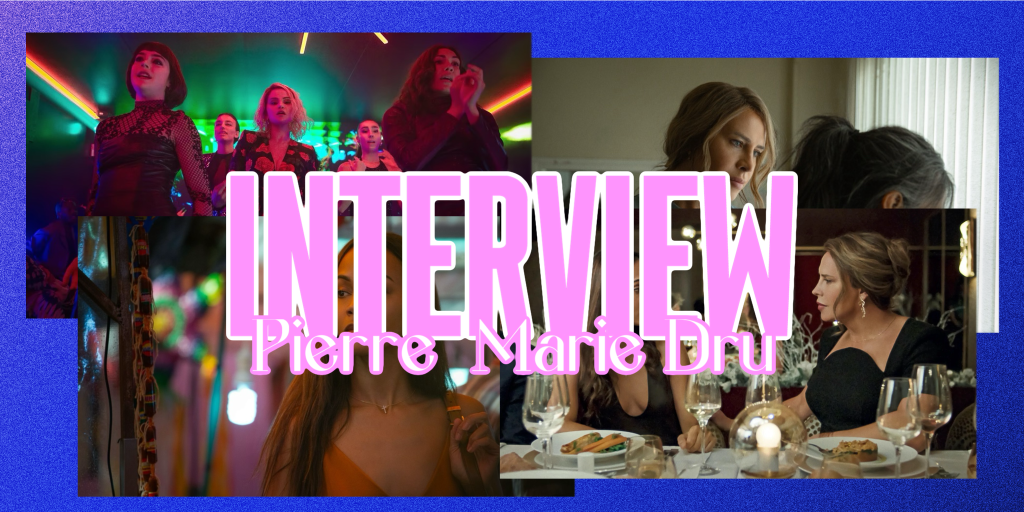
Emilia Pérez has been described as unlike any other film you’ve ever seen, let alone unlike any other musical you’ve ever seen. The music within the dazzling musical transports you deep into the story Jacques Audiard is telling. Offscreen Central had the amazing opportunity to speak with Music Supervisor Pierre-Marie Dru about the original songs in the film, composing the varied soundtrack, and more!
Sarah Abraham: Hi, Pierre-Marie! How are you?
Pierre-Marie Dru: I am in Berlin actually working on a new project.
Sarah Abraham: Oh wonderful. I can speak a little French. I studied for eight years in high school and university. Plus, I have a coworker that is from Paris so I get to practice frequently. I go back and forth between French and English.
Pierre-Marie Dru: Oh wow! It is nice to practice, yes. I will do my best in English.
Sarah Abraham: No worries! Thank you for taking the time to speak with me. Can you tell me about yourself and your career and what led you to Emilia Pérez?
Pierre-Marie Dru: I created my own company called Pigalle Production 20 years ago. Before that, I studied architecture and music at the same time. I was young, traveled a lot, and I spent time in Spain in the footsteps of my grandmother. So, I’ve learned flamenco and different kinds of music there. I had an emotional shock watching a Pedro Almodóvar movie called Todo sobre mi madre. There was an African song from Ismaël Lô called “Tajabone.” I was very moved by this and started thinking this could be a job. I previously didn’t know being a music supervisor or executive music producer could be a job. I got called to work on an African film called Ouaga Saga which was my first music job in film. It was all by chance. I decided to create my own company after that, and 20 years now, I’m working as a music producer and publisher.. For the past 10 years, I’ve been working as a music supervisor. I have worked on different movies that went to the United States, like I Lost My Body, an animated movie that went to the Oscars and it had an amazing soundtrack. Later on, I worked on Annette, which is also a musical film with Marion Cotillard and Adam Driver. It helped me a lot to reach this film, Emilia Pérez, because we are a part of this team.
Sarah Abraham: What was the name of your production company again?
Pierre-Marie Dru: Pigalle Production. Pigalle is a place in Paris where you have all the music shops if you want to buy a guitar or something. So, when I was younger, that was the place to be.
Sarah Abraham: That’s beautiful! I’m a classically trained clarinetist and the brand I use is called Buffet Crampon and it’s headquartered in France. They are well known for their instruments.
Pierre-Marie Dru: That’s true.
Sarah Abraham: What was the process of even assembling the team to work on the soundtrack for this film? Because…it’s a very unique film, different from any I have seen.
Pierre-Marie Dru: That’s a good question and a very long story. It took almost five years working on this movie. I started working closely with the film director, Jacques Audiard and the composers Clément Ducol and Camille. I knew Clément before because we worked on Annette. At first, Emilia was not a movie, it was an opera. So we started creating the songs with Jacques with that in mind. We worked with Jacques to help with casting and, in fact, I was the one who found Karla Sofía Gascón and I pitched her to Jacques. Me, Clément, and Camille were involved in all of the stages, even up until Jacques told us that it would be a movie. After that, we needed a team, and they ended up all being musicians in Paris casted by Camille, Clément, and I. I also had a Mexican team with a friend of mine, Annette Fradera, who did an amazing job with the Mexican choir. It was from France to Mexico, over 200 Zoom calls with Annette and we managed to produce a musical like this. Since we were shooting in France, we did a lot of things with the French team, with an accent coach, vocal coach, music editor, sound engineers, etc. Most of the team was French, but we had this very special team in Mexico to help us every single day.
Sarah Abraham: The film does have a very operatic feel to it and I’ve never seen that incorporated into a movie musical before, let alone with the subject matter this one has. You mentioned the vocal and dialect coaches. I imagine those were very critical given the specific setting of the songs and the timbre required to convey the emotions needed. Also, Zoe Saldaña, Selena Gomez, Adriana Paz, and Karla all come from different regions and they speak very differently in their normal vernacular. Can you talk about how you found the right vocal coaches?
Pierre-Marie Dru: It was different for all of them. We started with Karla and she was living in Spain but she has worked in Mexico too. She met all of my team there with Annette and a vocal coach, an amazing guy named Juan Pablo Villa. The wonderful team in Mexico worked like two or three weeks with Karla Sofía because she’s not a professional singer. It was obvious to Jacques that she was “Emilia Pérez.” But, the film was a musical. So we had this incredible team in Mexico that could work with and help her, also in Madrid. She also spent a lot of time in Paris training with Camille, Clément, and Lucile Chriqui and Carolina Santana, two amazing vocal coaches, finding a good tune, trying to have her own feeling on the songs. She wanted to deliver everything for this role. For example, she’s the one who said to Jacques, “I will play ‘Manitas’.” She wanted to play “Manitas” in addition to playing “Emilia.” Karla is just amazing.
It was very different for Zoe because she would have her own accent. Jacques worked it into the film that her character would be from the Caribbean so there was no problem with that. She worked on the accent with a member of Annette’s team in Mexico, Ortos Soyuz. When she was in Paris, she worked a lot with that team as well as working on the dancing with choreographer Damien Jalet. Zoe knew how to sing but she worked a lot with the coaches too, because she’s so professional. The main thing was to be ready to record that playback before the shooting because Jacques specifically wanted that.
You were mentioning the lyrics, those were very important to us and we needed them to be perfect. We are all French, so we had lots of people to help us with Spanish. Selena arrived in the middle of shooting. We came in and Clément and Camille wrote her song, “Mi Camino,” a week before she had to shoot. Jacques wanted a more personal song for her character and so that’s how the song came about. One week after that, we recorded it with Selena in Paris and she worked a lot with the coaches there as well.
Sarah Abraham: “Mi Camino” was one of the highlights on the soundtrack for me. I think the sound of the song is different, but so is the entire film so it fits perfectly! Can you describe what the playback was like before shooting? Was it different for each number as well?
Pierre-Marie Dru: Yes, because, in fact, this was the first musical for Jacques. It was very important to have very nice playback, so Jacques told us that we would be doing playback during shooting. But, the minute we started shooting he changed his mind. We start with this first sequence, an amazing sequence in the market with the song called “El alegato,” and we started doing the rehearsals with all the extras and the background singers. It was such a big show and Jacques wanted that everyday. We started recording everybody during the shooting. There were no rules for Karla and she wanted everything in her ears, the voices and the playback, the clicks, everything. Zoe usually only wanted the music, or the music and the click, but never the voice. In the end, during post-production, we reworked the voices (ADR) or sometimes picked from the playbacks, but most of the time it was the voices from the shoot that we kept, so we could make the most of the cast’s performance and Jacques’ direction. It was an evolution in Jacques’ mind (at first, he thought he was only using playbacks) and it was always changing, but what always guided him was the emotions that the scenes had to deliver. He wanted the audience to feel it intensely. It was incredible to see how different every day was on set, and how there were no rules.
Sarah Abraham: I love hearing stories like this. Were there any specific equipment that you used like the microphones, or the software systems?
Pierre-Marie Dru: There is one very important guy on the team called Cyril Holtz, the re-recording mixer. He is great and he had previously worked with Jacques. We spent one or two years talking every Sunday about what should be the sound of the film. When Cryil started talking with me about that, he was talking about recording with some of his friends who, along with Cyril, had developed a technology for recording in Atmos and suggested we use it to record the orchestral parks. We recorded things separately. Strings, woodwinds, percussion, and brass all separate and during three days. In the end, you can feel in Cyril’s mix how sound and music are one and the same.
Sarah Abraham: I would be remiss if I didn’t mention how much I appreciated hearing live instruments in there. Especially in the song, “Las damas que pasan.”
Pierre-Marie Dru: That’s an amazing song.
Sarah Abraham: I loved it! Adriana and The Mexican Choir, so good. Can you talk about having The Mexican Choir weaving in and out of the score?
Pierre-Marie Dru: Very nice question. I love Adriana too. She is amazing and she’s a very great singer. What’s great about Clément is that he is a very good composer and a good conductor, a real maestro. He’s also an amazing orchestrator, it was crazy. We had a lot of different kinds of recordings with the pub band, orchestras, backing vocals, etc. “Las damas…” was actually not written by Camille, it was a famous french song called “Les passantes” by Georges Brassens. It’s very different as it’s only guitar and Georges. He’s a very old singer in France and the song is beautiful. One day, a Cuban orchestra arranged the song. So, we mixed the two ideas and then we got “Las damas…” We had many rehearsals with Annette and the entire team in Mexico. It was all done live at the end with some mixing into it. I am very happy for the Mexican team because they did an amazing job.
Sarah Abraham: I love that the Mexican team was very involved with working with the French one. Can we talk about the song “Deseo?” Karla is truly just such a once in a lifetime talent and she was incredible in this film. That number specifically…
Pierre-Marie Dru: Karla is great and she sings very well for not being a singer. It was a hard song for her to sing, we changed it a few times but it was a nice song to have in the film. Karla was great the entire time and very persistent on performing the song herself. When you know her story, she’s just fantastic as an actress and as a singer. She has a song in the film called “El encuentro” where Maintas is meeting Rita (Zoe Saldańa) for the first time and the song has this weird rhythm to it, almost like she’s talking. It was like she was telling a story. Jacques loved how Karla performed the song and how every take was different. He thought Karla was just playing this role so amazingly.
Sarah Abraham: I love that. What was probably your personal favorite highlight of doing the music for this film? Do you have a favorite memory?
Pierre-Marie Dru: Oh, yeah! I have, say, two or three because there are so many. The first one was the first day of shooting because we waited three or four years. The first day was the number, “El alegato,” the song Zoe sings in the market. We had Zoe dancing and singing and all the extra dancers with her. We were talking about “Las Damas…” earlier, that was another great memory. Working with the Mexican team was very moving. It was also the last one we did.
Sarah Abraham: How was it working on a largely Spanish language film that was focused on women?
Pierre-Marie Dru: It was great. My grandmother was Spanish and I was very close with her. She was living in France but she was Spanish. I told you I grew up watching Pedro Almodóvar films and I love the music of Camille as well. So those two things joining together was like diving into my roots.
Sarah Abraham: That’s really beautiful! Thank you for sharing that and taking the time to talk with me today. I really appreciate it.
Pierre-Marie Dru: Of course! Thank you.
Emilia Pérez is currently streaming on Netflix and available in select theaters.
You can read our review of the film here.

 offscreencentral.com
Leave a comment