
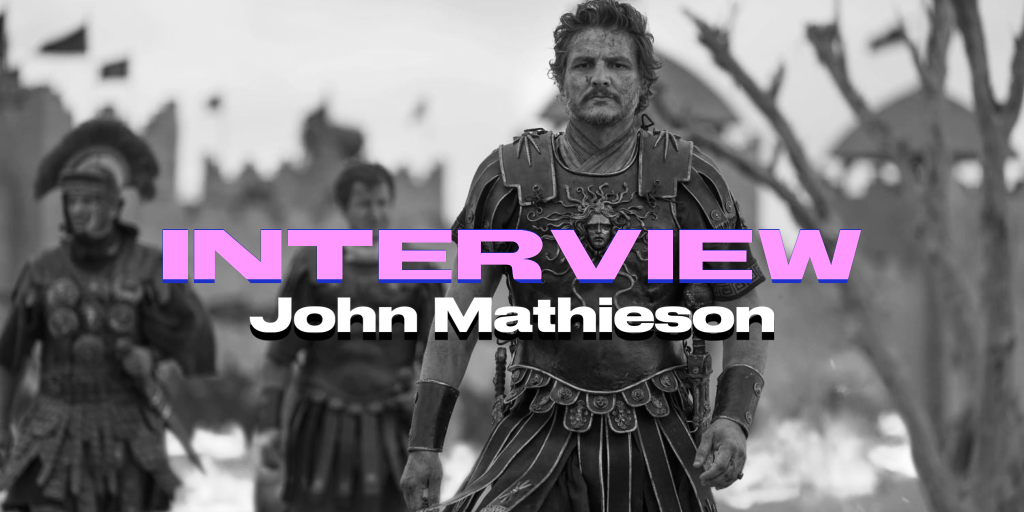
Twenty Four years later the arena is welcoming audiences back for Gladiator II. The visionary himself Ridley Scott has assembled quite a team of frequent collaborators to continue his version of Ancient Rome on a more bloody and brutal scale than ever before. Offscreen Central was lucky enough to talk to Cinematographer John Mathieson on the film’s continuation of the story’s themes of corruption and decadence, transitioning from film to digital, and the importance of lighting in conveying secrecy and character motivations.
Jillian Chilingerian: Hi, nice to meet you.
John Mathieson: Hi, I’m John. Nice to meet you.
Jillian Chilingerian: It’s been quite sometime between the films, and I love that we see how Rome has progressed in this period of it being a little bit more brutal, a little bit more nihilistic, seeing power corrupt a lot of the institutions. How do you dive into those themes with returning to this world?
John Mathieson: Yes, things have moved on, but you remember Rome lasted almost 1000 years which hasn’t been that long. The Colosseum ran for 300 years until Constantine came along and said, Yeah, shouldn’t do this then he moved to anyway. So I think it’s quite a short period, really things very much as we left them. We went to the same places. I suppose, deep down, I thought, I’ve never been away, you know. I think in the story, yeah, you can see it’s gone sour and it’s gone decadent Vegas, calm, immoral, corrupt, beyond, yeah, there’s no, there’s no sense of us and the Romans and the Senate. The script felt like what we were doing was going back. It was a strange place to revisit.
The actual shooting of it was the same of course, the sets are slightly different. The visual effects have moved forward an enormous amount so that was far more dominant this time. For me, the cameras were digital rather than film. That’s a difference, but not big. It’s easier for Ridley, because he likes lots of cameras, so you can see them all at once.
Jillian Chilingerian: I love that it felt like walking back into something familiar. It is a continuation of the story, and we get to see so much of the manipulation of these people, and just how you feel towards them change over time.
John Mathieson: At least Lucius survives this one. Last time we got rid of everyone, there wasn’t much chance of how we’re going to make it, how are you going to follow that up? Because it was always in the question and then there was this silence, people stopped talking about making another Gladiator. After Napoleon, suddenly it was there and I went to Ridley’s office, and they were talking about doing a sea battle in the middle of the Sahara. So I thought, well, this sounds as though it’s going to be amusing or challenging.
Jillian Chilingerian: From your perspective how do you honor what happened in the first film into this and make it where it does feel like its own, but it’s still connected?
John Mathieson: It came up quickly and I had about six weeks of prep. We didn’t talk about how to make it different. We like the identity of the first one with building the same sets and as you said, it just continued. You’re shooting on two different formats so I find digital can be a bit boring in the daylight, if you’re in a studio, you can do things in the daylight, and there are a couple of scenes in it, where it gets where it gets overcast, and Ridley’s looking at me, and I’ll say, I can’t do anything. We worked on what we could to give it contrast and, that was the main thing, trying to give it contrast and color.
Digital cameras, if you push them hard and where they don’t want to be, then they start doing interesting things. You don’t want them to clip to burn out, but they do in one scene right at the end trying to stretch that image, make it not too flat, and make it contrast the colorful, deep shadows, and hot Mediterranean sun. So that was different for me, because I’m not on film, and film is a bit easier on that front. But the advantages of digital for Ridley, and he likes digital outweighed all those things. Lensing action and film language is faster now it’s slightly quicker than it was, and so maybe that’s picked up a bit, smooth with that. Ridley’s always ahead of his game.
Jillian Chilingerian: With this theme of manipulation and political moves that people are There are a lot of moments underground in the dark, how was it to construct those scenes?
John Mathieson:The Senate was corrupt, then it was dissolved, but then you got the underground plotters, the old senators, of course, the mole in there, Tim McHenry’s character. Underground at night, secretive, because Lucilla, she’s seen as the last royal Roman, even though you’re talking about the Senate and democracy. She’s an emperor’s daughter who had very different ideas of how to run the country and the Empire. When we’re going to set this scene in a catacomb somewhere in the ground with a couple of candles. Well, yeah, it’s got to look treacherous and wicked and secretive, but it’s where you set it. When Macrinus goes to meet Lucilla and tries to get some information, he’s very friendly self-deprecating, and humble. He’s a secret service man trying to work out what her angle is, how powerful she is, and that this character has appeared, that no one knows who he is.
Then his drinking friends, and I keep him in the shadows, always put a ping in his eye, like a real sharp ping. He’s speaking very loosely, but his eyes are piercing. So even though he’s very shadowed, you can see this. That was a last-minute thing when I was doing that scene because it’s very dark and stuff, I thought, I don’t want to put light on his face, but I want to feel that he’s in the shadows listening. Of course, he’s in the room, but he’s trying to work something out.
The Ravi character looks a bit of a hopeless sort of junkie, but then he’s got a connection to this man. He’s all covered in his greasy curls and very dark tattoos again, I tried to get into his eye when you trust him a bit more. So yeah, you play a bit with the eyes and with Connie. You know, she’s trying to break into her son, and she can’t do it, made sure that you got those nice Danish soft blue-green eyes. Even though there’s a lot of chaos going on, it’s very important to get the faces at the right time doing the right thing.
Jillian Chilingerian:They say so many things that they don’t mean, but when you get those moments to watch their behavior you start to see what they’re thinking.
John Mathieson: It’s about shots, not always about the dialog. It’s the looks of other people who are saying things that will tell you that’s not scripted, that’s not written down, that’s observing.
Jillian Chilingerian: Well, thank you so much for the time to dive into the cinematography.
John Mathieson: Thank you so much.
Gladiator II is available to watch in theaters
You can read our review of the film here.
 offscreencentral.com
Leave a comment