
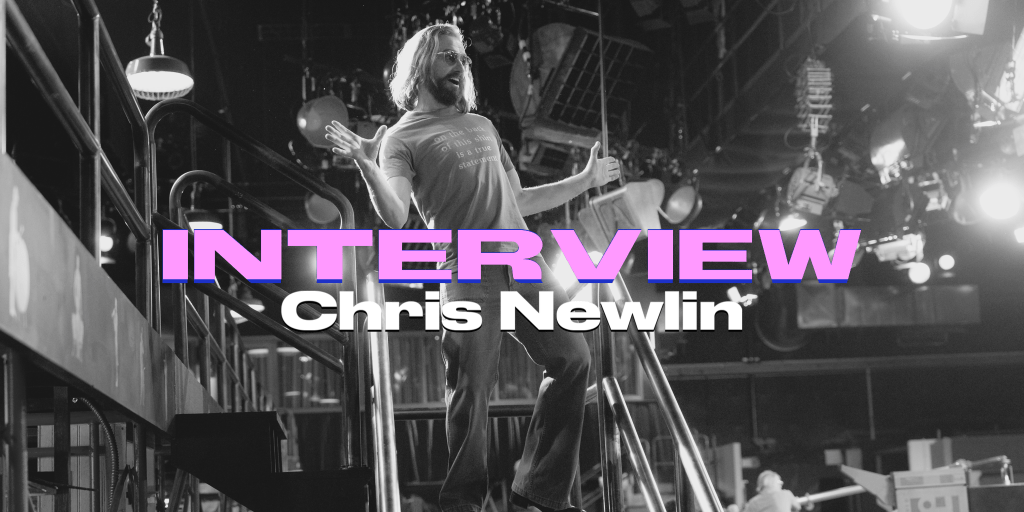
‘Saturday Night Live’ has entered their 50th season on air, a fantastic milestone for what seemed like a pipedream for the young comedians involved in its inception. And the first night they went live was just as crazy as you can imagine. Offscreen Central had the opportunity to talk to the music editor Chris Newlin and what it was like to not only capture that chaos leading up to night one, but also how he fell into the career he has now.
Jessa Hay: One of the first things that struck me about the film was how chaotic everything felt. There’s people running around, finishing script ideas, testing the equipment and so much more and that’s just the opening minutes. How difficult is it to make decisions on what sound or music should be heard, even if a little bit louder, than the rest of the background?
Chris Newlin: That’s a very astute observation. The first 20 minutes or so really launches you out of a rocket and you’re either along for the ride and all in or you’re screaming “get me off!” If you can stay on, I think it really pays off in the end, albeit alarming at first. There was a lot of conversation around this during early preview screenings with what we can do to help people settle in to the movie. Specifically, there was the oner shot where we were meeting all our characters for the first time is super chaotic. Originally I had cut a piece – this was one of the first scenes I got – and I cut something in from these New York sessions we had done before it went to shoot, but then we had this redirect when they recorded all the stuff live on set.
This is what Jason [Reitman] really wanted, and so I found a piece from that that worked really well but it was much more chaotic; much more syncopated percussion, it was a little more aggressive and it really moved forward. It had this güiro scrape in it and there’s really great Latin rhythms but it just added to chaos which Jason initially was like “This is great!” and then realized we need to allow people to settle in even though everything is chaotic around them. We wanted to figure out what would make this oner more fun for the audience. Then we had a lightbulb where we had this cut from the New York sessions with a more 70s groove that makes you want to bob your head and say “Okay this is a fun ride.” Jason hadn’t seen it so I recut it to the scene, we showed it to Jason and he immediately knew it was the thing. It was really rewarding to know that initial gut decisions aren’t always a bad thing.
That was a fun way of trying to help the frist 20 minutes or so where it’s still fun as well as being chaotic. Beyond the music, the sound team put a lot of thought and work into helping the chaos through all of this. Tom Ozanich, our dub mixer, did some really great things where dialog pans off, which isn’t something you normally do. Usually dialog’s right in the center because it keeps you really focused on the screen. With all of our characters running on and off screen and the camera whipping around it was a lot of fun to be able to have the dialog trail off to one side or another. Those were some really fun and creative choices that also helps you track who you’re supposed to be listening to.
Jessa Hay: What about composer Jon Batiste’s music did you find inspirational that you wanted to make sure was prominent in the film?
Chris Newlin: Listening to the score, you really feel that it’s a character in the film. He wrote these really interesting and original pieces and what Jon is so great at doing is mashing up genres. Jason talked about 70s funk and afrobeat and Fela Kuti so Jon would do versions of those ideas. He had great musicians and percussionists and use period accurate instruments, but then he’d put this classical thing on top. It’s just what he does so well, he’s just very exciting to watch what comes out when he sits at a piano or grabs any sort of percussion instrument. That’s kind of what he did on set; maintaining that spontaneity and improvisation is what he brings into what we ultimately cut into the picture while still being able to tell a story and be that character in the movie.
Jessa Hay: You’ve worked on a variety of projects ranging from John Wick 4, Blue Beetle, The Last of Us, and Chicago Med. Those range more in the action category of work. What skills from those previous works aided you with Saturday Night, which is more of a contemporary piece?
Chris Newlin: I’d argue that Saturday Night has some pretty intense action, as far as the driving and the pulse of it all. Obviously, totally different sensibilities and style of music and that presented a nice challenge and creative opportunity to just do something different. The process of how this came together really felt fresh and it was really exciting and meant a lot to me to be taking this amazing music that Jon recorded and try to appropriately make sure it sees its way through the film. Every project’s a little different and it’s nice when you’re not just doing one type of thing. I find myself fitting in best when it’s a more nontraditional score. That’s where I find myself the most comfortable, where we can push boundaries on something that’s a little different than what you’re expecting to hear, and I think Saturday Night abounds by that.
Jessa Hay: When it comes to being a music editor, you work with a bunch of different departments within the film production industry. What is the most difficult thing about being stretched between different departments and what do you love about it?
Chris Newlin: Part of this job, why I love it, is because there’s a lot of different things to manage. I think I thrive in the chaos of what this job can be. It never gets boring and every day you never know what’s going to come up and what challenges will present themselves. For me, working with the filmmakers – the director, the picture editor – and being as involved in that process as I can be and doing whatever I can to help tell the story. But then taking that and working with the sound team and how do we make sure the sound effects and music aren’t just colliding and getting into each other’s way. Those are the things that are always very collaborative and fun about this job.
Jessa Hay: Was there something you needed to do to help create that live setting of ‘Saturday Night Live’ the show that was difficult because the film is not live?
Chris Newlin: From my side, it was very much on the page. The screenplay that Jason and Gil [Kenan] wrote was fantastic. It just read so quick and read exactly how it ended up playing, so it’s a testament to their writing and to Jason’s planning and pre-production going into shooting this. He had it all mapped out and shot with stand-ins before they built the set so he could get everything sorted out. And the performances really captured the spirit and the vibe. Our job was to basically support that as best we could. It was so fun to see it come together, but you’re sitting there thinking this show may not happen. That’s the thing that’s beautiful about this film though because it still pulls that off that they might not make it to air.
Jessa Hay: Is there a dream composer you would like to work with in the future and why?
Chris Newlin: I come from a rock background, I’m a guitar player originally, so obviously like Trent [Reznor] and Atticus [Ross]. The Nine Inch Nails of it all is something I would love to do if the opportunity ever arose because I just think what those guys do is really interesting. There’s a lot of great composers out there and anyone’s that’s trying to do something different or interesting I’m always willing to be a part of that process.
Jessa Hay: Music editor is a unique job to get into. What is your background in music that led you to this career?
Chris Newlin: It is one of those things I think a lot of people realize that exists. Even if they do, they don’t really know what it is. I had done an internship at a music library that also had music production that wanted to hire me as a music editor. I had one more semester of college left and it was a nighttime gig and various circumstances led me to not taking that job where they would have trained me to be a music editor. I sat with their in-house music editor one day and it was a really tempting position to take, but with everything I thought “Let me put this on hold.”
Then ironically my roommate at the time had started working for some music editors that were building a small company and they just needed help with, at the time, importing CDs and iTunes and making copies of things for deliverables. I got to learn through them and it just happened naturally and from there I got a job working for a composer and doing some non-union projects with him until I got into the union and worked on some films with him. It’s also interesting looking back when I was a kid making movies with friends. A buddy of mine, who interestingly enough is a director now, he and I would make movies and it was very important for us to have music in our home movies. We would have a boombox with a CD or cassette tape in it and right when we would hit record (on the camera) we would hit play (on the boombox) right where we wanted the music to start. In high school I had two VCRs for editing projects for school and I could overdub audio and have needle drops happening. And I didn’t know what I was doing, so I guess somehow it’s always been in my DNA in that sense. It’s funny to look back and think I was sort of music editing before I knew what it was or what it could be. I feel really natural in this job.
Jessa Hay: What advice would you give to an aspiring musician who would love to work in film?
Chris Newlin: Know both your film history and your composers and scores. Find a composer who is looking for an assistant at any capacity and just get in there and do whatever you can. It’s a very very competitive business to get into. The union is doing this apprenticeship program, which is really great, because in the past you were trying to help get people into the union. I really enjoyed building community around music editors and pulling people into that, getting other people into this job. There is a lot of that ‘who do you know’ thing but if you can find somebody and kind of latch on if they’ll have you. And make yourself useful, know your place, and just listen and learn and observe. Watch for those opportunities where you can show what you’re made of and what you’ve got.
Saturday Night is available to watch on PVOD.
You can read our review of the film here.
 offscreencentral.com
Leave a comment