
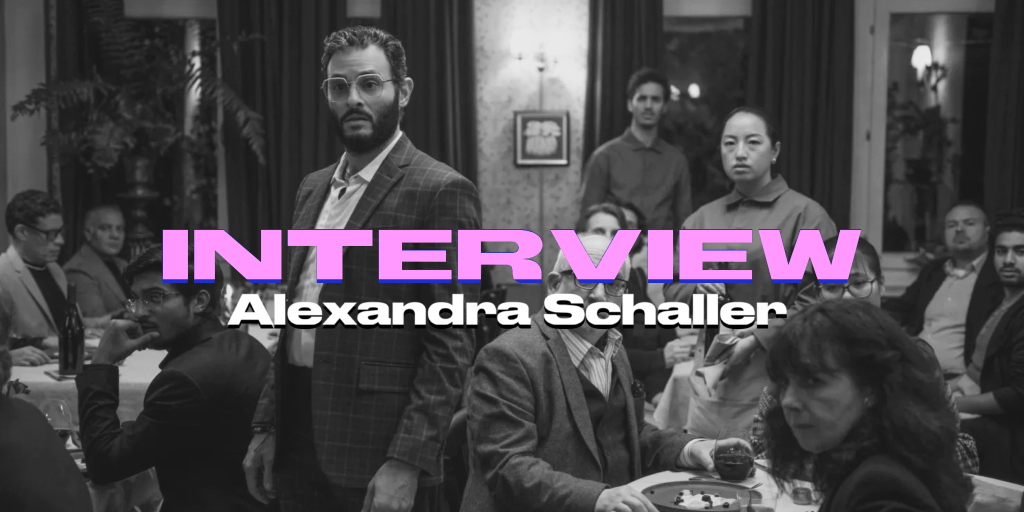
Alexandra Schaller, production designer for Amazon Prime’s House of Spoils, sat down with Offscreen Central to discuss the creative process behind the film’s impeccable design and visual aesthetic, emphasizing the role of food as an inspiration for her work, and how she created it for this film alongside food stylist Zoe Hegedus. She highlighted the use of color to make the food stand out, alongside a lush garden and a beautiful countryside mansion, and how this film differs from work on other projects, such as the film, After Yang. Alexandra also gave insight into the creative process on making the script come to life, including but not limited to utilizing real dirt to create a fear-inducing tunnel!
Sarah Abraham: Hi, nice to meet you! My name is Sarah Abraham and this is my first ever interview, so I’m very excited. Thank you so much for taking the time to speak with me.
Alexandra Schaller: Sure!
Sarah Abraham: House of Spoils was one of the first movies I watched for this spooky season, and I loved the design of it, the color palette, everything. I really appreciated the originality as well. So congratulations, mabrouk, for a wonderful looking film.
Alexandra Schaller: Thank you.
Sarah Abraham: Of course! I wanted to talk a little bit about where you took inspiration for some of these settings and how that correlated to the film’s focus on the food story.
Alexandra Schaller: Yeah! So you know, the food is obviously a very central part of the script from the very beginning, and the food goes through various transformations. You know, as “Chef” [Ariana DeBose] is emulating different people’s foods before she finds her own voice. I knew that the food would look different throughout the movie, and so I created a sort of color story for each of the beats of the menu. I knew that the environment should also look and feel really delicious, and so I wanted to design a world that was really green, lush, and immersive to make the audience feel super connected, as though they were almost in the estate. But, I always wanted the food to take center focus, and so we played a lot with calibrating color throughout the film to make the food really stand out.
Sarah Abraham: Incredible. The food with any restaurant film always captures my eye. It’s a very niche genre, but with this film, I was very intrigued by how distinct and original the food looked. It almost looked like you guys really did create individual dishes. It was great.
Alexandra Schaller: We did, yeah!
Sarah Abraham: Can you talk about that?
Alexandra Schaller: Yeah, I mean, I spent a lot of time watching Chef’s Table and, you know, researching fine dining restaurants and what the food would be. But, you know, this movie, while it’s a restaurant food movie, it’s not really about that. I mean, the food is sort of a vehicle for “Chef” to kind of tap into her own creativity, so we could really have fun with it; with the food stylist, who is a real artist. She works very closely together at making the menu, and she’s a chef too, in her own right, so she was also able to kind of bring the creativity and also the know-how of the cooking world. But, you know, the main thing about the food and about the story, is that, it’s food, but it’s also…”Chef’s” using greens from the garden and from the outside, and she’s using unconventional ingredients. So, I had a lot of fun planting those, you know, unconventional ingredients in the garden so that Ariana [DeBose] could eat them for real outside. I thought it’d be really interesting to see the full journey of the food, from the garden to the plate, so I played a lot with that. We also featured some of the food in some custom wallpapers that we designed. So, really, the world of the food and the garden and the presence of the witch is everywhere in the movie.
Sarah Abraham: I love a witch movie, and this, I love the aesthetic of this witch movie. You mentioning the garden is a great segue. I was curious about the garden that is adjacent to the house. It was gorgeous. It reminded me a little bit of Coraline, in the other world, which I adored. I love the colors. It made me want to frolic in it but also not at the same time, because I’m a little scared of supernatural stuff. It was really incredible seeing the before and afters of what that garden looked like. It looked like a patch of dirt before…
Alexandra Schaller: It was a patch of dirt! It was a patch of dirt, we were like, “This is the perfect place for it!”
Sarah Abraham: How exactly did you start, like, the process of creating that patch of dirt and then, not creating the dirt, but growing, evolving it into that beautiful garden? Like you, hand planted, all of this stuff?
Alexandra Schaller: We hand planted, absolutely everything. You know the movie is, I would say, less horror and more, kind of, supernatural. I wanted the movie to feel supernatural and folkloric and soft, because “Chef” goes through this journey of harnessing her own femininity, which on one hand, is, you know, kind of the softer side of things, but also a little raw and a little violent and difficult. So I wanted the garden, even though it’s a place of inspiration and also a struggle for “Chef,” I wanted the garden to feel really soft and lush and beautiful, so that the foods that she picks from, it could really stand out against that backdrop. And so I was doing a lot of research, and I found the Irish cottage garden. I love the way that the Irish cottage garden is always structured, but the way that the foliage is planted is a little bit more wild, and so I modeled it on that.
Sarah Abraham: It was beautiful. You mentioned the femininity aspect of what “Chef” is going through, because she does mention a lot of the misogyny and sexism that she endures being in the culinary world, and specifically talking with Barbie Ferreira’s character, “Lucia.” I really enjoyed that. It’s interesting that you made a connection between how the softer elements of the garden can be parallel with exploring what femininity means to someone in such a masculine career setting.
Alexandra Schaller: At the same time, it’s also power, right? Because, when she really taps into her creativity and inspiration, and is harnessing the ingredients for the garden. It’s really working with her, and so there’s a real power for her in the garden and in the ingredients and in her ability to find her voice. It was important to me to kind of play with that duality and the design of the movie.
Sarah Abraham: It was lovely. I did want to talk about the mansion, the old mansion. Looking at the befores and after everything, with the vines that were covered on it, it had an almost fairy tale, Pixie Hollow-esque setting to it. Where did you take inspiration for that to create sort of a dream space, but in a supernatural setting?
Alexandra Schaller: You know, the movie needed to be sort of first and foremost, grounded in reality. So, I started with research about real places upstate where this could plausibly be. We were shooting in Hungary, and the architecture in Hungary is nothing like the architecture in the United States, so it was a real challenge to find the estate, but we found something. Even though it was completely the wrong color, it had the right bones and could be transformed. This movie is supernatural, so we did want to elevate it a little bit. I thought to myself, “Oh, well, you know, giving it a little bit of a Hans Christian Anderson, Hansel and Gretel feeling, keeps sort of one foot in the door of realism, but also takes it to a kind of more magical place.”
Sarah Abraham: It’s a very interesting comparison, because I believe there is a witch in Hansel and Gretel, isn’t there? That’s interesting! The scenery of when Chef’s driving, it’s supposed to be upstate, but when she’s driving through the Hungarian countryside, it was absolutely gorgeous, and the house looked wonderful. Were there any specific paintings or eras that you drew, aside from Hansel and Gretel, to create the interior design of that house?
Alexandra Schaller: Yeah! Yeah, so when I first read the script, I thought it was just the most kind of wild, inspiring project. Like, my mind was full of ideas the second I read it, which is how I know that I’m connected to a story. I thought a lot about the Hieronymus Bosch painting, The Garden of Earthly Delights and that wasn’t from the script. That’s just what came to mind, because it’s a real feast, and the painting depicts the balance between, you know, good and evil and Paradise and Hell. So, I thought it was sort of an interesting source of inspiration and parallel for the design of the movie. You know, it’s also a triptych, so that each panel is completely different and telling a different story, but what I love about that painting too is that it’s very full, and there’s always somewhere for the eye to land and new details to pick up on. That’s what I wanted for the design of House of Spoils. Even if you don’t necessarily see the detail as an audience member, it’s full, full, full of detail for someone who is looking. There are lots of easter eggs throughout all of the design that reference some of the main parts of the movie. So, we have, you know, potato bugs and red peppers designed into the wallpaper in the bedroom, and we have etched gloss that has a Victorian era style pattern with the rabbit in it. All sorts of little tiny moments, all of the paintings, all of the artwork in the restaurant, which sort of evolve over time. If you notice, all the paintings contain greenery, or rotting foods, or foods with bugs in it. So, I used a lot of Middle Ages and Renaissance artwork as inspiration too, because I felt like the colors have a depth and the paintings have such a detail, that it felt like a good source of inspiration for me and a good reference.
Sarah Abraham: That’s incredible. I did notice a little bit when watching some of the wallpaper had animals on it. Which, by the way, that green wallpaper? Obsessed! I would love to have that in my own living room, it is gorgeous! You pretty much just helped transition into my next question. I was curious about how the specific little details included in the wallpaper, how that contributes to “Chef’s” psyche, and if those symbolize anything that relates to what she’s going through.
Alexandra Schaller: Well, I think so, because, you know, the movie takes place all in one location, right? And then, this estate, as we call it, is a source of inspiration and also conflict for “Chef,” and it feels like she can’t escape the power of the witch or the witch’s message. I wanted to put all the little details everywhere, so that it really feels like everywhere she looks, the signs are pointing towards her really paying attention to her environment and harnessing her surroundings.
Sarah Abraham: Speaking of, “can’t escape,” I was obsessed with that tunnel. I’m very claustrophobic –
Alexandra Schaller: Me, too!
Sarah Abraham: Girl! It was a little intense to watch, but also horrifying at the same time, because I kind of anticipated that she would get blocked in. When you read that in the script, what was going through your mind? Where do you even start with creating that? Did you work with the director and the screenwriter? Walk me through that because I would love to hear how that was made.
Alexandra Schaller: Yeah. I mean, I had a very close collaboration with the directors [Bridget Savage Cole and Danielle Krudy], who also wrote the movie, and the cinematographer [Eric Lin], because there were lots of conversations about how to shoot such a tiny space, and we wanted it to be really small. I have to say that Ariana was an absolute champ, because she got in there and crawled through that tiny space. I mean, she was amazing. But, when I first read the script, I really saw it as a birth canal, and so I wanted it to feel like that; you know, this tiny, little space that she crawls into and then comes out into the tomb and then up into the world. I wanted to feel closely connected to her rebirth as a character, so that’s kind of how we approached it. But we wanted, you know, the whole design of the movie is intentionally visceral, because I wanted to try to have the audience really tracking “Chef’s” journey and being there with her, since it’s such a point of view movie.
Sarah Abraham: That was incredible that you mentioned the birth canal imagery. Thinking back to it, it does give birth canal vibes, especially when she crawls out of it. The dirt that was in there, that was real dirt?
Alexandra Schaller: Real dirt, yeah, it was real dirt, and real roots coming down.
Sarah Abraham: The wine cellar, and then the, I believe it’s a root tunnel that leads into that. It was all the bricks and everything was beautiful. Were those also on a sound stage or individual sets?
Alexandra Schaller: So, the wine cellar was a location that we wanted to feel like it was under the main estate, because she goes down the stairs. It wasn’t a wine cellar, we turned it into that, and estate, because she goes down the stairs. It wasn’t a wine cellar, we turned it into that, and then we also built a false wall inside to allow chef to open the door, crawl through and then cut to the same hallway, we duplicated the hallway on the soundstage, which goes into the root cellar, which goes into the tunnel, and those are created on stage.
Sarah Abraham: That’s incredible, and you mentioned Ariana being a champ, because that whole set looked horrifying from my point of view.
Alexandra Schaller: Yeah, kind of it was. It was fun though! It’s fun to make a set like that. We also went to town with all of the little details that we put little messages in and stuff that, you know, that the camera never sees; we really, really made it very detailed. I found an amazing, ancient Italian illustration book that I put in with all of these kinds of images of weird plants, which were sort of old botanical illustrations that we put down there. It was a really fun project, you know? It wasn’t just like, “Oh yeah, let’s just make a gross, a gross basement.” It’s like, “Let’s make this witch’s lair with all of her concoctions and propagations and botanical research that she’s doing.”
Sarah Abraham: It definitely looked like you had fun. I mean, you mentioned the camera didn’t pick up all the details, but even the ones that it did pick up, the attention to detail was very noticeable and admirable, and I love it when I can notice that in the movie. I was a big fan of your work on After Yang (2021), and I was wondering, how different this was from that project as well.
Alexandra Schaller: Completely different. Completely different, and one of my favorite parts of the job is the fact that I get to inhabit these completely different worlds from project to project. It’s always different. You know, earlier this year, I was doing a 1920s logging movie, and so I learned all about vintage logging and all that, like the foundation of the railroad in the United States, and, you know, that was very interesting. But yeah, it’s such…my approach to design is always the same, even though the content is different. It’s always, you know, “How do I, how do we want the audience to feel,” based on the themes of the movie, the characters, so I always approach it that way, from a feelings perspective, because how we want the movie to feel often sort of helps shape how we want the movie to look.
Sarah Abraham: Yeah, that’s great. Thank you for answering that, and thank you for putting all that effort into both projects. I am excited to see that logging project whenever it comes, that’s very interesting.
Alexandra Schaller: I know, me too. I cannot wait to see it.
Sarah Abraham: Have you been doing your research with books or online?
Alexandra Schaller: It really depends, but yeah, a lot of books. I have so many logging books on my shelf right now. I also go to the library. I live in New York, and there’s an amazing picture collection at the New York Public Library that’s a great resource. Kind of all different kinds of places. I also use, like you can see in House of Spoils, I use a lot of art and painting as reference to, and so museums and just sort of inspiration is kind of everywhere. So, walking around and taking it all in.
Sarah Abraham: I did notice there were a lot of books and House of Spoils. I’m also a huge bookworm. I love my local library. I liked how, like the ancient house and the garden, the books in the film did also have a timeless feel to it, especially the color of the parchment paper, the way she’s writing. She’s actually handwriting stuff instead of typing, which I appreciated. Was that intentional, having the books? Even the ones that were just placed on the shelf in the which in the cellar, the layer down below, everything, seemed so timeless.
Alexandra Schaller: Yeah, it was very intentional, and in the root cellar, you might notice that the shelves are sort of bowing under the weight of the books. I wanted that to be sort of under the weight of, you know, all of this information and knowledge that she has to tap into.
Sarah Abraham: Books are great. I always appreciate when a book is used as a set decoration, especially when it has…there’s just something so appealing about handwritten stuff, and that color of the parchment in the book. I really love that.
Alexandra Schaller: Yeah, and there was so much. You know, we had illustrators drawing a lot, doing all of “Magnus’” [Béla Ficzere] sketches and writing in those notebooks. And, you know, we also worked really hard to clear the hero cooking reference books that “Chef” is consulting. Those are real books. It’s sort of, the hero cooking reference books, that Chef is consulting. Those are real books. It was a big book-heavy project, and it’s difficult in Hungary, because all the books there are in Hungarian, so we have to, sort of, recover, or kind of make our own insert pages for when she’s looking at the books.
Sarah Abraham: I loved the drawings in those books. I thought they were a nice touch of detail into the psyche of what a chef living there would go through. I’m very interested to know if any of your personal experiences, whether your culture or upbringing, influenced the design and the color palette of this film.
Alexandra Schaller: Mmm, that’s interesting! You know, my background is in fine art, and then I went to art school, and I studied design for performance. My background is in theater and immersive design, and so I feel like my experience doing immersive theater is something that I bring to all of the design of all of my film projects. I also grew up in a big city; I grew up in London. It’s very multicultural and so there’s always influence coming from all different kinds of places. So, I think that definitely factors into the design, because the world is a melting pot, and so, you know, like if you look at After Yang, because you brought it up, and if you look at House of Spoils, you know, it’s very cross cultural. Like, if you look at After Yang, all of the packaging has text in it in many different languages, because we’re living in a global society. If you look at House of Spoils, you know, it’s a fairy tale. It’s in English, but we have a lot of Hungarian, Eastern European influence on the design.
Sarah Abraham: That was something I was probably the most curious about, just because of the Hungarian setting, and just how influential different cultures, even if you’re not of that culture, just being surrounded by it can influence you, especially as an artist, and how you incorporate that in your work. So, that’s very interesting.
Alexandra Schaller: You know, we travel so much as production designers. Now, we rarely shoot in the place where the script is set, and, you know, so much of site specific and immersive design is about working with your environment as opposed to against it. So, for me, it’s interesting. It’s like, okay, we want to make it the US, and we should, and that should be believable, and that’s really important. But how can we harness what the place has to offer, instead of completely denying it? So, you know, where possible, I try to do that because I think it sort of allows the location and the environment to sing and speak for itself.
Sarah Abraham: Which set was probably the most fun to build that you had to work on for this?
Alexandra Schaller: Gosh, gosh. That’s..that’s a tough question, because everything in this movie, pretty much was created from scratch. You know, the kitchen was formerly a bedroom, and it was a bit of a mind bender to figure out, “Okay, well, how are we going to turn this into a professional looking kitchen with appliances that actually work?” But, I feel like I looked at the design of this movie really holistically, because it’s all in one place, and all the places have to feel a part. I really love this little room that didn’t make it fully into the final cut, but it’s the room where she discovers the witch’s photograph on the wall. I love the details in that room, and you can’t see the furniture because it’s covered in sheets in the scene, because they cut out the part where it was uncovered, but all of the furniture was so intricate; it was beautiful green velvets and carved wood. My favorite wallpaper is that one, because it looks like a green botanical motif. If you look really closely, the leaves are actually a green man or a devil.
Sarah Abraham: Oh, that’s sick. That’s so cool! Dang. I think a green, velvet furniture would actually fit that house really well.
Alexandra Schaller: Yeah, yeah! It looks, it looks so good! I have a good friend who’s a production designer, and she and I always joke about, you know, making an Instagram handle called, “Sets you never saw,” because there are so many sets, and details that, of course, inevitably get cut out of the final edit. So, we want to give the Production Designers an opportunity to post all of those sort of forgotten sets.
Sarah Abraham: You should, that’d be interesting! I think people would love to see that.
Alexandra Schaller: Yeah, yeah. So, watch this space! We’ll do it sort of at some point.
Sarah Abraham: Trademark it soon! Well, those were pretty much all my questions. Do you have any other secrets, anything that you wanted to share about the most interesting part? I know, “fun” and “interesting” can be subjective from person to person, and especially as an artist for each film. What was probably your biggest takeaway from working on this project?
Alexandra Schaller: Yeah! So that’s a good question. I mean, my biggest takeaway is that it really just reminded me about how much I love color and playing with color in a film, and how much color experience affects a viewer’s experience. You know, the color palette of the movie is pretty controlled. It’s very earthy. There are lots of greens. There are moments that, where there are colors that pop, like reds with the pepper and or like bright greens with some of the food. An interesting, little anecdote, is that there’s no blue in the movie unless it’s the mold or associated with the mold. I feel like even though it’s really subtle, it does create a kind of particular feeling, and we did that purposefully so that we really felt the power of the mold and the rotting over “Chef’s” creations.
Sarah Abraham: Now that you point that out, that makes a lot of sense, because the mold was very striking, and wow. I’m also wearing green, not planned, but…
Alexandra Schaller: Lovely! Yeah, I made a big mold color palette reference board that we stuck to. There’s one moment where the costume designer put a mold colored turquoise necklace on “Andreas aunt,” who has the shellfish allergy, and that was really deliberate, too, because then it’s sort of like the mold affecting other people.
Sarah Abraham: The food in this movie really did have, like, their own set. Was all of it edible? Like, was it real?
Alexandra Schaller: Yep, it was, it was all edible. And, you know, the credit for that really goes to the food stylist, Zoe [Hegedus]. Especially, because we had to make custom fruits and vegetables because there’s no way that Ariana could bite into a real pepper. I knew that I wanted the pepper to look a certain way. I wanted it to be bulbous, and so Zoe had to recreate an edible version based on my image references. That’s a real skill. There’s also a fruit that, at the end of the movie, when you cut it open, you can see the sort of witches motif with the seeds. That was a custom fruit that we made. I knew that I wanted it to look like a mangosteen on the outside, color wise, but on the inside, I wanted to look like a guava, for that kind of difference in color. And Zoe did an amazing job at creating an edible version of that so she [Ariana] can bite into it and cook with it.
Sarah Abraham: I said that last question was my last question…I’m a liar. Now I’m curious about the food, which you just answered. What was the food stylist’s name?
Alexandra Schaller: Her name was Zoe. Zoe Hegedus. She is Hungarian, and she’s wonderful. Really, she’s amazing.
Sarah Abraham: I want to definitely give her credit for when we type this up, just because the food, on one hand, some of it looked really morbid with the mold, but then some moments it looked very delicious. So that’s incredible work on that.
Alexandra Schaller: I know she did such a great job. The fun thing about color is that she’s [Chef] taking inspiration before she kind of finds her own voice as a chef. She’s emulating other people’s cooking, and so it was interesting to play with color there. It gets to a point where she’s emulating other people’s style, and she’s confused that the food just turns into a slushy mishmash, and it’s kind of like the way we talked about it. If you mix all of the paints together, you know, on the palette, and it kind of becomes no color, and then it comes out the other side when she finds the fruit and the pepper and can find her own voice. So Zoe and I worked really closely and had a lot of fun with that.
Sarah Abraham: Would you ever do another food film or project again?
Alexandra Schaller: Sure, yeah, definitely. I definitely would, especially if I could work with Zoe, I would, She has become a very good friend, and I would love to collaborate with her professionally, too, because she’s really talented.
Sarah Abraham: I’m really happy that you had a great experience. I’ve always been intrigued, specifically with women behind the camera and what makes film and television happen. So, I love hearing when they have good experiences working. That really was my last official question, I apologize for deceiving you earlier.
Alexandra Schaller: No, no, no! It’s kind of nice that the conversation flows!
Sarah Abraham: I like it too, and this was my first interview like this.
Alexandra Schaller: You did great!
Sarah Abraham: Oh, shukran, Thank you so much. I look forward to your next project. You were so lovely and kind, and thank you so much for talking to me. Congrats on the film, it was wonderful.
Alexandra Schaller: Thank you!
House of Spoils is now available to stream on Amazon Prime.


 offscreencentral.com
Leave a comment