
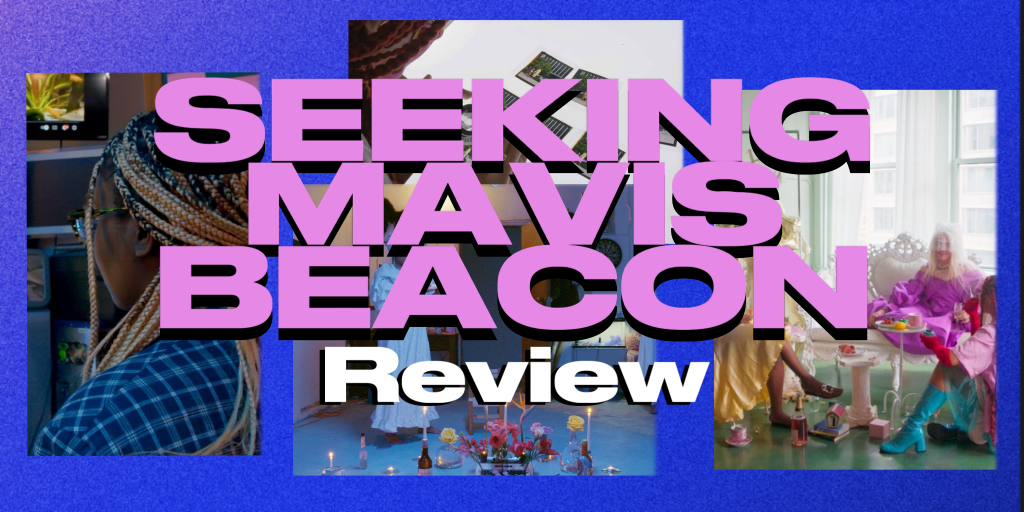
Seeking Mavis Beacon balances intuition versus obsession in a search for an internet icon in a Tumblr core documentary from visionary Jazmin Jones.
Mavis Beacon is best known for teaching multiple generations how to type in the 80s and 90s just as the internet was starting to boom, unknowing of its future where computer typing is a must-have on any resume. The elegant black woman in front of the screen with her acrylics welcomes users to their daily lessons. There was a poise to her that could be felt through the screen even with a pixelated body. But who was this woman and did she exist?
To the surprise of many, Mavis Beacon is not a real person but modeled after Haitian model Renee L’Esperance. Silicon Valley white men conceptualized her as a marketing idea to sell the game. Shortly after her Mavis Beacon fame, Renee took a step back from the spotlight never to be seen or heard from again. Jones and her collaborator Olivia McKayla Ross set off with the basics of the case laid out in a timeline as they set out the search for Mavis herself.
Seeking Mavis Beacon doesn’t lean on finding its missing icon as its entire story, it’s the journey of the search that makes the film work. Jones and Ross have their connection through growing up playing the game with memories of typing flooding their brain waves. Mavis meant a lot to people as the first program to prominently feature a Black woman on the cover which was so progressive at the time that some suppliers limited orders. It gave a literal beacon of hope that tech was opening up a spot for Black women to have equity in the game as she mentored the youth and elders through their typing troubles.
Outside of a search, the film raises the questions of who owns their likeness in the digital era and the truth of Mavis pioneering the footprint of Black women in tech. Though not one of the coders, it was her face that inspired so many people to take a risk on a typing game and invite her into their homes. She started a domino effect of so many young Black girls who picked up this game and now have found themself in the realm of the tech industry, a space that is primarily white and male. Jones and Ross expand on the conversation around technology by bringing in Black queer expertise in how the philosophy of technology expands outside the reach of strictly white men.
Like any case of a missing person, a hotline is the immediate first step that Ross and Jones set up to encourage people to share their memories of Mavis. One rare quality of the internet’s ability to connect us all is the sudden realization many people had that Mavis Beacon had once been in their lives, they don’t know when or how but they know those hands. Hearing the name brings back an immediate response of memories for people posing the question about how our memory can deceive us of what we remember. The very idea that Mavis was a real person with a large cultural footstep that even the film points fun at with multiple deep fakes of Mavis accepting awards and having worldwide acclaim that easily could be added to one’s memory as actually happening or remembering an event as such.
The documentary is one of the few films that accurately captures the digital age through its desktop documentary editing techniques to the finely curated office space our lead investigators inhabit that feels like a Pinterest board downloaded into a room. A perfect symbol of how the internet curates a person’s aesthetics, melding and mixing different forms of media until it tells the story of the person who created that vibe. Mirroring a video game start page, Jones pulls you into the screen shifting around the narrative as to how one might interact with a piece of technology free of its icy metallic exterior replaced by the kaleidoscope nature of Black queer women who have been at the forefront of internet culture.
Seeking Mavis Beacon opens up so many conversations within technology including the idea of perception. Users are so normalized to seeing photos online and injecting their perspective on how they think something occurred whether true or false. This is where the obsession creeps over intuition as these drives to solve a phenomenon push people to stop thinking with logic and instead what best fits their narrative. The online conspiracy searches have so many voices hopping in not to come from a place of intrigue and care but clout seeking. That is where Jones and Ross certainly differ in their approach by completing their due diligence in the search cracking through the screen into this is an actual person.
Where this film finds its challenges is the relationship between obsession and genuine intrigue. It is so easy for people to become addicted through the digital age whether with another person, thing, or object. Technology makes it easy to act on our urges to find out everything we could ever want about something and do with that information however we please. Jones and Ross are extremely determined to find Mavis from the point of view of being fans and wanting her to be able to reclaim her story for herself. There is a place of deep love in this search for them but as things get intense the search starts to feel like a borderlining obsession that if they crack this case it might heal a part of themselves. When Jones travels to Florida alone hoping to come face to face with Renee, there is a moment of pleading on the phone that the audience can emote with close to desperation but she can reel herself back in through self-awareness. Near the end of their journey which unfolds to reflect on their own identities, there are moments they begin to pull back and put into perspective that sometimes people don’t want to be found and silence is their commentary.
Seeking Mavis Beacon is in a league of its own led through the charm of Jazmin Jones and Olivia Mckayla Ross as they navigate online culture offline to find the face of technology that brought them comfort as well as reopen the conversation of who is allowed to have equity in technology.
Grade: A
Oscars Prospects:
Likely: None
Should be Considered: Best Documentary
Where to Watch: In Select Theaters

Jillian Chilingerian
she/her @JillianChili
Lives in LA. Loves Iced Americanos and slow burns.
Favorite Director: David Fincher
Sign: Leo


 offscreencentral.com
Leave a comment