
Fresh off its World Premiere at the Toronto International Film Festival, The Wild Robot has been lauded with raving reviews for Dreamwork’s 48th film. In honor of the animation studio’s 30th anniversary this year, the film has been hallmarked as a celebration of all Dreamworks has achieved in the last two decades while marking the start of a new era. Star Lupita Nyong’o, who voices Roz, director Chris Sanders, and composer Kris Bowers joined together for a press conference ahead of the film’s September 27th release to talk all things The Wild Robot.
The Wild Robot marks a return to directing an animated feature for Chris Sanders who previously did 2020’s live-action film, The Call of the Wild. Sanders said the animation experience is “more immediate” compared to live action as “Animation happens slowly over such a long period, and you’re there on the day, you’ve got to get everything, and it’s all about collaboration, particularly with the actors. So, yeah, there’s a lot more interaction, I think, in the best way possible”
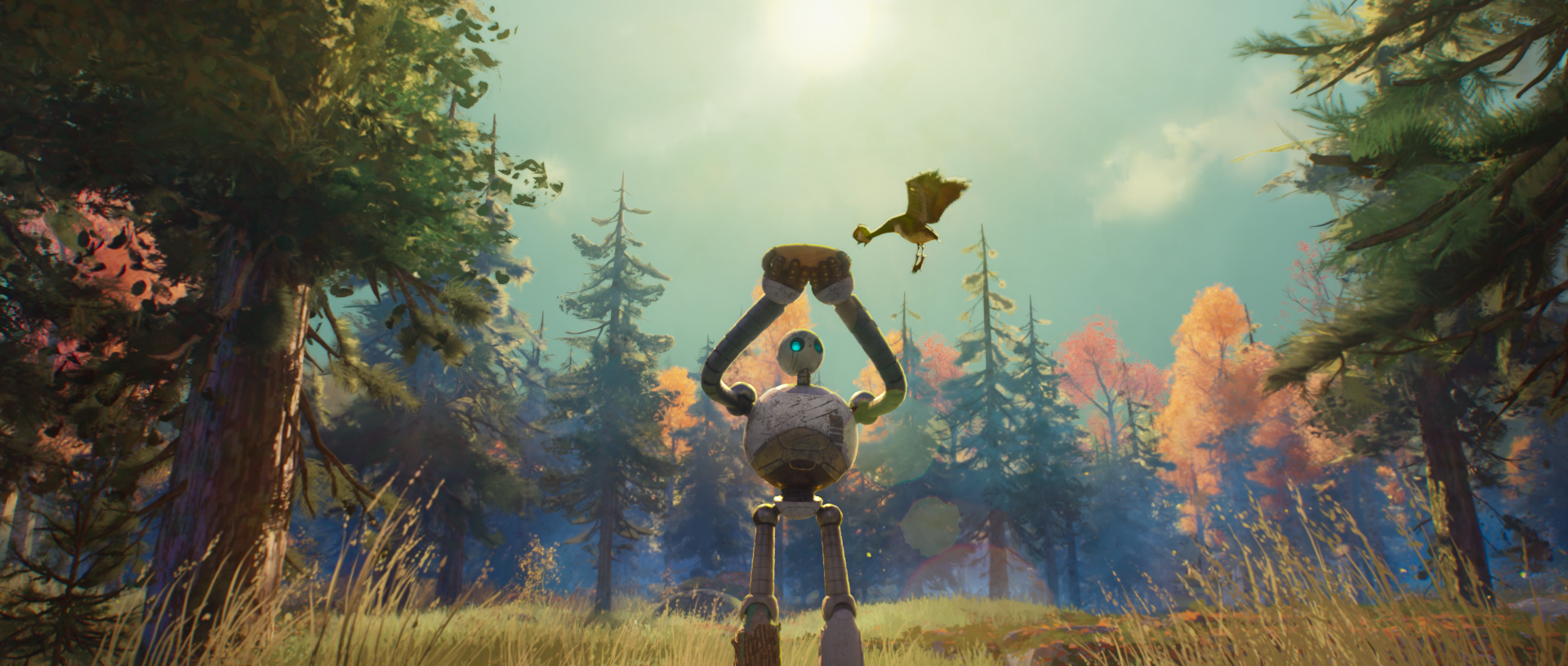
Lupita Nyong’o voices the titular wild robot Roz, where she is tasked with playing a very mechanical robot with only eyes to communicate her feelings as she enters this strange new world. To get the voice right Nyong’o worked with Sanders who chose her for the role because of the “warmth of my voice” and they knew that Roz was going to end up sounding like her, so they had to depict that evolution through her voice.
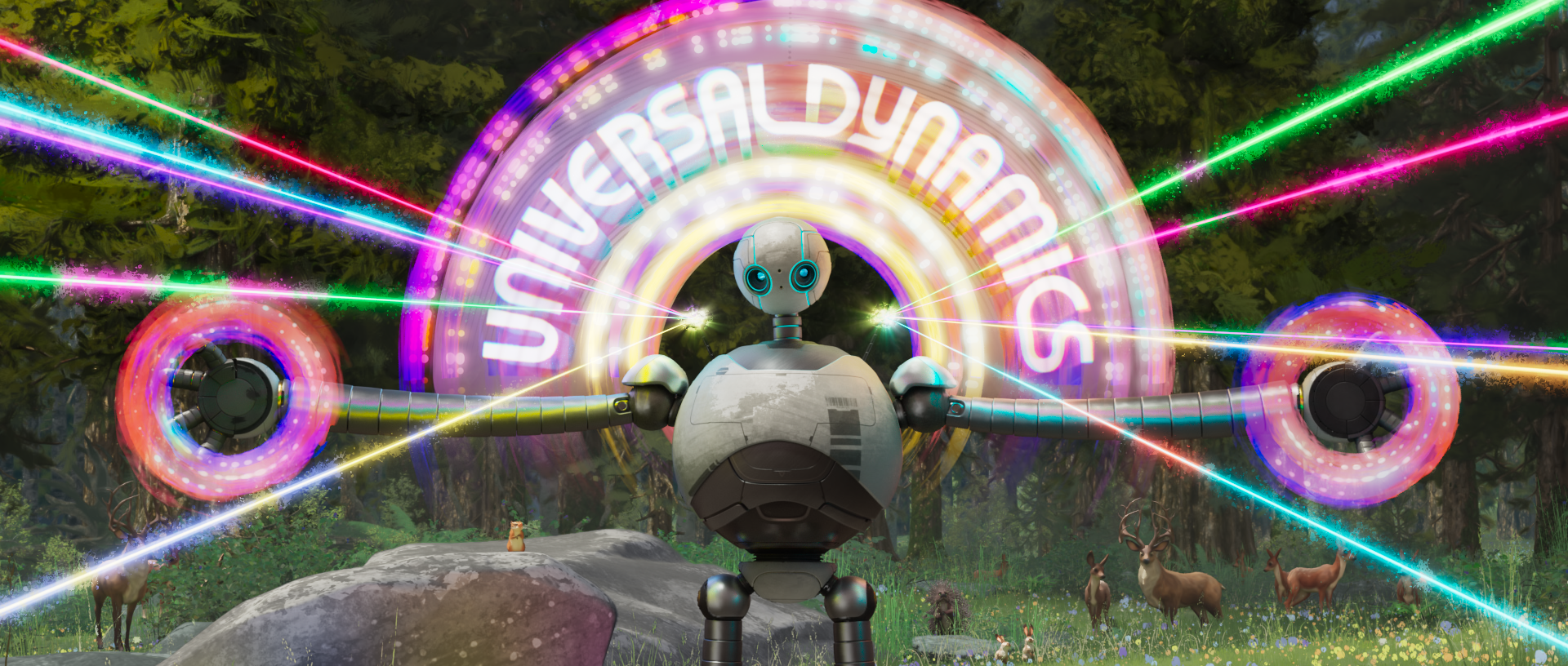
Nyong’o was inspired by the automated voices of Alexa, Siri, and the voices of Tiktok and Instagram. In looking at those she found an “optimistic brightness.” Of course, getting the voice right means there are trials and errors with many versions of Roz, but for Lupita that “was the beauty of doing it over two and a half years as the script develops so does the voice. In the end, Roz ends up with programmed optimism to start her off, and there are markers in the script of when and how Roz’s voice is evolving to show how she’s adapting to her new environment.
Like Chris Sanders, composer Kris Bowers has experimented with live-action and animation. For scoring this film, bowers drew inspiration from becoming a dad as the film started, and by the time it ended, he had a two-year-old. Across those two years, Bowers examined his relationship with his daughter and what it felt like to become a parent. Looking at how his wife felt similar to Roz’s learning how to become a parent and looking at his appreciation for his parents, his mother, and the sacrifice of his wife. He noted that “so much of the emotion in this story that’s so palpable and involuntary brings up these visceral emotions.”
Bringing in his experience of his family was important for one sequence in particular as he said “I think about is the migration sequence, and there’s a queue that we worked on for a long time, and my first pass at it, you know, was bright and happy, and Chris reminded me about the fact that this is this bittersweet moment where Ross is saying goodbye to Bright Bill, and they don’t know if they’re gonna see each other ever get and they’re not saying I love you, and they’re not saying those things, and what would that feel like.”
The main difference for him in live-action versus animation would be starting mainly with black and white pencil sketches and animation. There was reliance on Chris’s guidance as a director, to understand what he is scoring to look at the concept art and realize what this is going to look like in terms of color and imagery leading him to use his imagination. Bowers said, “If I have still images that I’m writing to, I’m imagining it in its fullest form so that I’m writing music that doesn’t feel like it’s it’s held back at all wonderful work.”

A lot of the beauty not only comes from the emotional messaging of remembering to say I love you but the painterly animation style that calls back to Miyazaki. To get Roz right Sanders wanted to make sure she was built “with a lot of articulation” as a humanoid because of the book, but “we also wanted her to be surprising and interesting.” This gave the animators opportunities to move her in interesting ways, which Sanders said “they exceeded in every turn.” Especially with her rig and how the island was meant to be uneven. Sanders said, “We don’t want these flat like these mysterious flat paths that were magically a great way for her so that she could make her way easily through everything.” They wanted to be sure that the audience understood this was not where she was supposed to be tapping into the engineered optimism that Lupita mentioned as she was walking through the forest.
In terms of what they hope audiences take away from this experience, Sanders said, “the idea that we’re at some point going to have to change our programming to accomplish something.” That idea was the core of Peter Brown’s book the film is adapted from that the filmmakers wanted to focus on in crafting the story. Lupita Nyong’o answered with kindness mainly in how kindness “can be considered a vulnerability and in this film, Roz’s journey shows how it is a force, and it’s a force to reckon with, without a doubt.”
Roz finds herself on a journey of being stranded on an island, for Sanders he “wanted to make sure that we built Roz with a lot of articulation. We knew that she had to be like a humanoid because of the book and the role that she played in the story, but we also wanted her to be surprising and interesting, and we wanted to give the animators opportunities to move her in interesting ways, which, by the way, they exceeded in every turn.”
Childhood played a role for all three when stepping into this world. Bowers said, “I just thought a lot about when I first realized the power of music to help tell a story, which was in early animation.” Working on the project for Bowers was not only an honor to “work on a project that utilized music in that way but also wants to pay homage to those great composers who were able to make us feel so many different things with just, you know, music on the aural side.”

Lupita leaned into Roz’s childlike quality as a sophisticated robot. Landing on the island she is brand new with fresh eyes and naiveté on what life on a wild island can be like. She thought of the innocence of children through interacting with children as to her “they say the darndest things.” One example she brought up was “We asked this child, what would you how would you look out for other people? And she said, with a telescope, right? And like an adult, you just don’t think that way.” There is a literal way of looking through the world for Roz because she is brand new and keeping that innocence.
The Wild Robot opens in US theaters on September 27.
 offscreencentral.com
Leave a comment