
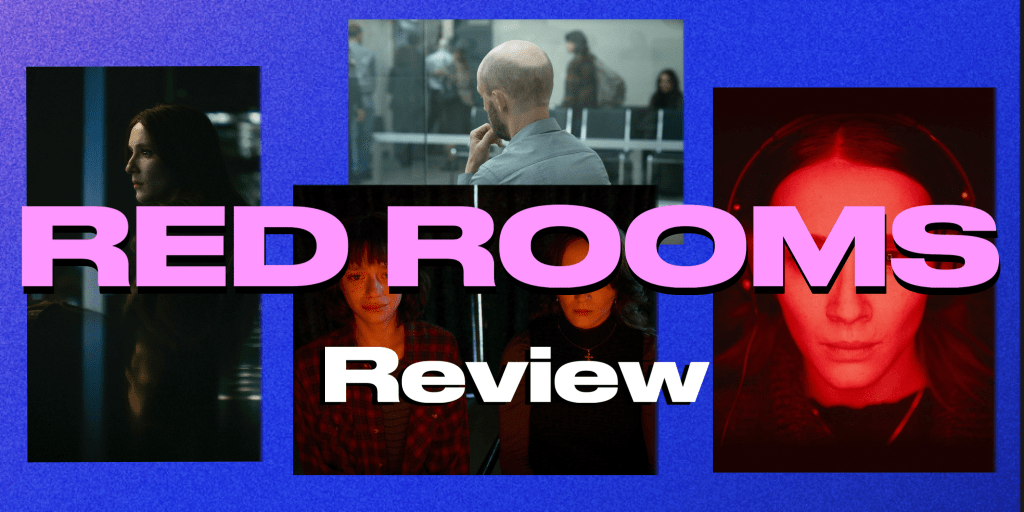
Like members of a jury, the audiences of Red Rooms are asked to make a judgment. This contemplative new feature from Pascal Plante interrogates what it means to not only be a spectator of violence but to make one’s pastime the consumption of the crimes of others.
Red Rooms is a French-Canadian thriller that follows Kelly-Anne (Juliette Gariépy), a model who has taken an interest in the trial of Ludovic Chevalier (Maxwell McCabe Lokos) aka the alleged “Demon of Rosemont.” The crimes of which Chevalier has been accused are not only particularly gruesome, heinous, and violent–but they were filmed for the dark web, to be consumed in what are referred to as “red rooms.” The nature of this case causes a media frenzy, but the press are not the only ones lined up outside the courtroom scavenging for tasty morsels of information. Spectators like Kelly-Anne wait outside in the early morning to secure a spot so they can consume the story of what happened to three young girls.
Once the film steps into the courtroom, the prosecutor explains to those on the jury that they are being asked to tolerate the depictions of extreme violence that will be presented to them–to witness death. This opening teases the grisly details that would have any true crime junky hooked–and this is when we shift our focus from the case itself to Kelly-Anne, who becomes acquainted with another follower of the case, Clémentine (Laurie Babin), whose interest sings a different tune. Clémentine is sure that Chevalier is innocent, something that does not concern Kelly-Anne. Both are referred to by the victim Camille’s mother as his “groupies” as she condemns their consumption of this tragedy, but they represent two camps of a sort of true crime “fandom” (for lack of a better term). Clémentine is drawn to the Chevalier himself and feels a connection to him that makes her committed to the idea that he could be innocent, while Kelly-Anne is drawn to the crimes themselves. Her interest in the case is the idea itself of the horrid acts of violence committed. The psychological journey that Red Rooms takes the audience through implores the viewer to ask themselves what is worse, or if there is even an answer for this query.
Tense and uncomfortable, this film ultimately feels cold. There is a tangible crispness to the air of the early Canadian mornings, from the blue hues that shade the streets waiting for sunrise, and the bland white walls of the courthouse, all beautifully captured by cinematographer Vincent Biron. There is also a coldness that radiates from Kelly-Anne, who feels closed off from anyone around her, seeming to prefer the solitude of her apartment and the company of her Alexa-like AI home system–adding a layer to the film that interrogates the role of technology and its effects on privacy in this tale of obsession. Expert witnesses discuss the deep web versus the dark web, the difficulties in investigating these “red rooms,” and the privacy granted to those tech-savvy enough to hide themselves in various internet spaces–which counterintuitively takes privacy away from people like the families of the Demon of Rosemont’s victims.
Writer and director Pascal Plante crafts a compelling modern horror. This film exposes the wires that are crossed between sensationalized media and the true crime mini-series factories that exist in this modern technological era. It would be easy to imagine Kelly-Anne and Clémentine in front of their own television screens watching shows like Monster: The Jeffrey Dahmer Story or Making a Murderer, or any of the hundreds of true crime documentaries and series that decorate the main pages of any streaming platform, and you would be able to even place your finger on what reasons they find entertainment in such things.
Like Kelly-Anne, Red Rooms is calculated yet hollow. Despite its rich focus on obsession and spectatorship, I found myself experiencing the same ebbs and flows in excitement and disappointment that Kelly-Anne herself found in the progression of the trial. But my need for more is exactly what this film asks me to question. There is an evil that nestles itself in our need to consume tragedy. There is an unnerving social experiment that plays itself out in this exciting psychological thriller, leaving me eager to see what Plante might deliver next.
Grade: A
Oscars Prospects:
Likely: None
Should be Considered: None
Release Date: September 6, 2024
Where to Watch: In Select Theaters

Vannah Taylor
she/her @sirendeathcult
Lives in Southern California. Loves ballet and films about psychotic women.
Favorite Director: David Lynch
Sign: Aries
 offscreencentral.com
Leave a comment