
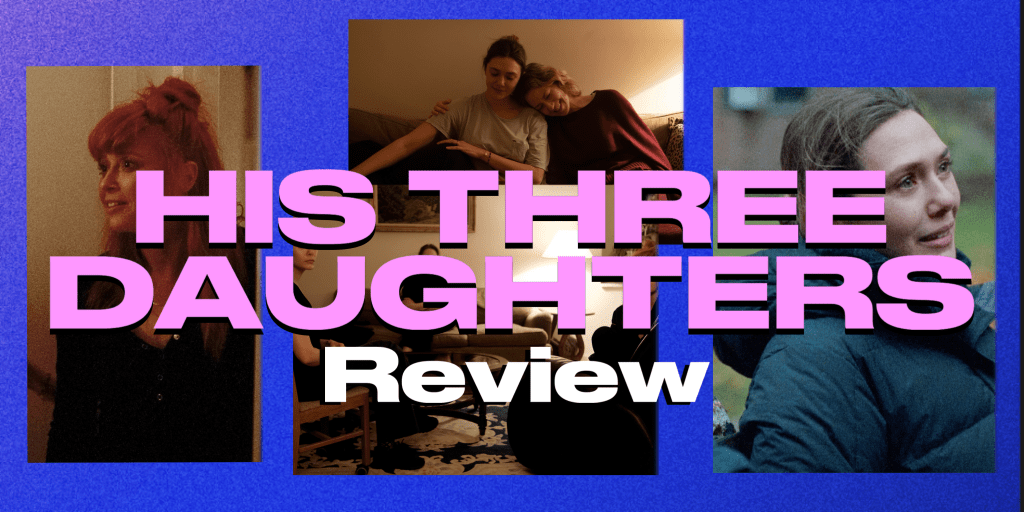
An observational drama set in the confines of a New York City apartment, Azazel Jacobs conducts a candid portrait of sisterhood and sorrow in His Three Daughters.
Hooked up on a heart monitor and lying in his bedroom, Vinnie’s presence looms over the rent-controlled Bronx apartment that has welcomed back his three daughters. Following the format of what one would do if a loved one were seconds away from dying, an obituary is written, shifts watching over their father are taken, and even the pursuit of finding a doctor to sign a DNR is at the top of one of the sister’s priorities. All the motions set in prep for what they know is the inevitable but hoping their presence will hold their father over for a bit into a miraculous recovery.
Jacob’s script introduces the three sisters with an established presence drastically different from one another but fits the typical stereotypes associated with an older sister, middle sister, and younger. All are perfectly cast with Carrie Coon, Elizabeth Olsen, and Natasha Lyonne taking the reigns in very familiar territory for each but using the vehicle of these identities to dig beneath the surface in a reaction to the idea of grief. Katie (Coon), a mother of three herself, lives in Brooklyn possessing a very high-maintenance essence positioning herself as having to pick up the slack of her other two sisters and family all the time. Normal firstborn tendencies are in full swing as she takes over caring for their father immediately pushing blame onto the middle child, Rachel.
Rachel (Lyonne) lives with her father, a middle-aged smoker, taking care of her father by feeding him the apples he has requested and watching New York sports games together. Rachel is not a biological daughter to Vinnie or a sister to Katie and Christina (Olsen). As the baby, Christina is seen as the serene one, living a life of bliss with her daughter and husband. When all three sisters are together the oppositions start with Christina and Katie allying up against Rachel, Katie’s control freak mind projects images of Rachel letting their father’s health decline all for the sake of getting the apartment. The guards are up from years of resentment towards one another that has come ahead during a very poignant time.
It is a time of grief where people assign themselves roles to feel that they did something when it’s time for that person to pass. There is an invisible guilt that takes over our thoughts when we must balance practicality with our emotions to make decisions in the best interest of those suffering and sometimes we make it in our best interests to avoid the sudden change of a death. Not exactly fight or flight as it can come slowly for death to finally reach but a sense of always being alert to make sure those last moments are not missed. There’s a point where it seems like the passing of Vinnie will finally happen and even though Katie, who has spent the entire movie stark and planning, begins to break when the thought of their father dying becomes real.
Death is inevitable and it is something people feel that they are prepared for knowing it will come, but the truth is no one is ready no matter how much they have prepped. In terms of our parents, we live most of our lives under the assumption they know everything and will take care of it forever. It is when that authority figure is removed we see the sibling dynamics often complicated scrambling to figure out what needs to be done. The business pulls us out of our dread into a role of importance to suppress the necessary emotions to fully process what this moment means.
Thinking of what our parents would want us to do or how they would like to be remembered in an obituary and suddenly those years of memories stored in our long-term bank are blank. Jacobs goes a step further to share brief glimpses into how Katie and Christina as mothers deliver this news of their father to their kids, Christina a child not entirely capable of understanding alleviates with her softness while Katie who has older kids that should be cognizant of how this impacts their mother delivers harsher tones.
With the sibling dynamic something like death can extrapolate the differences and similarities and in this case, there is peace to the eventual death. The situation of death allows a self-examination of each other and their years of living separately bringing them together on an unfortunate note. Dialogue is laced with the nuances hiding years of rocky relationships among the three. Not fully knowing one another as people built in the entity of a sister, while the term sister is meant as a familial relationship sometimes we never see our sisters past just that not validating them as humans we share more than blood with or we hold them to their memories never allowing them to develop into the people they have become.
The three also shine a light on how siblings can have different relationships with their parents leading to a different evolution to adulthood based on what those specialized relationships taught or meant to them. Christina at the time was alone with her father after the passing of his wife showing her a different painting of the man that Rachel and Katie would not know, while Rachel in the current day has been the one tending to their father in ways the other two would never understand. Their estrangement grows larger in the lack of context to put the pieces together of why they might be this way.
All three are confident in who they are and how they live and it’s not a story to try to get any of them to change. Moreso it is about the misunderstandings about how each other lives are built through a lack of conversation that because of sisterhood there will always be something pulling them together whether they like it or not. Olsen, Lyonne, and Coon know exactly the right beats each need to hit to build out a dramatic symphony of sister dynamics.
What adds to the constant sense of unsettlement is the choice to keep this film situated in one setting with some escapes to the outside. Being catastrophically packed into one open layout acts like the feeling of being stuck in the confines of grief. The sisters with their muddled relationship operate around the apartment like a chess game allowing cinematographer Sam Levy to get experimental with how many shots one can craft in a tight space. Levy shoots them all individually at the beginning only then allowing them to be shot in frame when some type of mutual understanding thaws as it takes Rachel and Katie the entire movie to finally be shot together. In one scene, Christina just wants to take a moment to shut her eyes in the living room but her body like her vulnerability is on full display to her sisters leaving her open for cross-examination to figure out why she is doing what she is doing.
Constantly glances over to Vinnie’s ajar door to a room the audience never enters but the sisters leave up to the imagination of what is happening behind those closed doors. It is the only time they can get away from the camera in a sense of peace and also is the location of their current unrest. The isolation in this one spot causes disorientation from the outside world for the audience and sisters they are locked in their grief. It is also a perfect setup to allow the different paths of the sisters to come together and unravel across the point of view to explain how they got to this exact moment through bitter banter and multifaceted monologues. Different angles of the apartment are unlocked as the sisters unlock their shared and false memories documenting the thorny relationship.
Jacobs’s script is a cathartic testimony to the belief our parents’ last wishes that they can rest knowing that we have the bond of our siblings there to fill the opening in our hearts.
Grade: A-
Oscars Prospects:
Likely: Best Original Screenplay, Best Supporting Actress (Natasha Lyonne)
Should be Considered: Best Original Screenplay, Best Supporting Actress (Natasha Lyonne and Elizabeth Olsen), Best Cinematography
Theatrical Release Date: September 6, 2024 in Select Theaters
Streaming Release Date: September 20, 2024 Streaming on Netflix

Jillian Chilingerian
she/her @JillianChili
Lives in LA. Loves Iced Americanos and slow burns.
Favorite Director: David Fincher
Sign: Leo


 offscreencentral.com
Leave a comment