
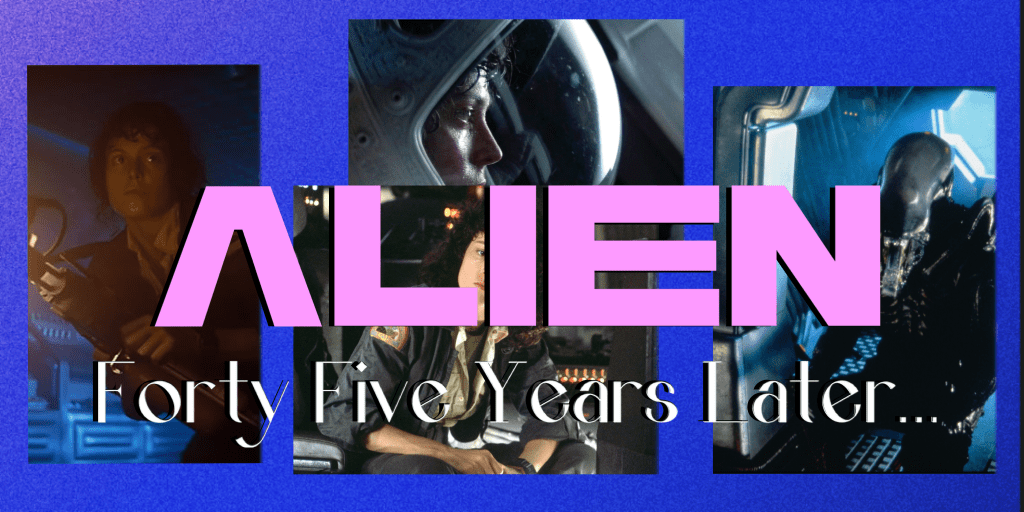
Horror and science fiction has always been genres which can be paired nicely together. From James Whales films such as Frankenstein (1931) and The Invisible Man (1933), to Don Siegel’s Invasion of the Body Snatchers (1956) and Kurt Neumann’s The Fly (1958), sci-fi horror has been a staple in cinema. But no film has had an impact quite like 1979’s Alien. Director Ridley Scott brought Dan O’Bannon’s terrifying screenplay to life.
The film follows a crew of a commercial spacecraft who track a transmission of unknown origin. Yet, as they explore this uncharted territory, they encounter a life form that threatens the lives of the crew. What begins as an intimate character study turns into a claustrophobic spacecraft of horrors. Brilliantly the film sets up our characters, building a very strong bond between the crew members so that when carnage began, the audience was invested in these people. Moreover, we don’t need intricate backstories for every character, but seeing their interactions establishes how they are as people. For instance, throughout the film, Parker (Yaphet Kotto) and Lambert (Veronica Cartwright) clearly have a close relationship.
When the true horror elements begin, as Kane (John Hurt) begins to convulse and an alien emerges from his chest, this is when the film takes a massive shift. From this point forward, it is unrelenting. The crew members are picked off one by one, leaving Ripley (Sigourney Weaver) as our Final Girl, fighting to survive a monster in the most desolate of places. It is truly remarkable how the film is able to sustain this heightened sense of danger, and even manages to up the ante throughout its runtime. Sustaining that level of tension and intensity takes immeasurable skill in the writing, directing, and editing of a film.
This past June, the original Alien film turned 45. And after 45 years, how has Alien remained in conversation and considered one of the greats? It first has to do with the imagery. From the alien on Hurt’s face to the aforementioned alien-popping-out-of-chest scene to Ian Holm’s head on a table to Weaver flamethrower-ing her way down a hallway, the images are striking. And those moments, those images have become ingrained in our pop culture. There have been references to Alien in shows such as South Park and Saturday Night Live. Mel Brooks directly parodied – yes we’re referencing it for a third time – the alien coming out of Kane’s chest scene in his own 1987 movie, Spaceballs. The fact there are many scenes and images from this film that have found their way into other pieces of cinema truly demonstrates its cultural impact.
The striking images leads to the second point: the practical effects. The Xenomorph was not a man in a blue or green leotard with dots all over themselves for special effects artists to computer generate an alien. Bolaji Badejo and Eddie Powell (the latter being uncredited) were the Xenomorph throughout the film. Badejo was just over seven feet tall, and that stature enhanced the terrifying nature of the alien. Having actors portray the Xenomorph – appearing on screen for astonishingly only four minutes – gives more the other actors on set. It helps immerse them in the world and the horrifying reality their characters are facing. It gives a level of authenticity to those interactions.
Due to the use of practical effects, much like Jaws, Alien relies on the imagination of its audience to fill in where technology was unable to create at the time. For instance, as Dallas (Tom Skerritt) hunts the alien in the air ducts, Scott relies on lighting and quick edits back to the other members as they track the movement in the air ducts. It is one of the most riveting scenes which leans so heavily into the horror genre.
Finally, one of the most enduring aspects of the film is the central character Ripley. Ripley is strong, smart, and resilient. In 1979, women were not getting parts like Ripley. Heck, even today, actresses are often reduced to sad wife/girlfriend doing laundry and staring longingly for their male counterpart to return from something important. Ripley is not perfect, but she is logical and fights for survival. Weaver is superb in this role. She embodies all of the qualities that make Ripley an otherworldly representation of women while always retaining Ripley’s humanity. Ripley could have easily been played by a male actor, but having a female actor, and one as incredible as Weaver sets Ripley apart from other heroes – or heroines – in cinema.
For the past 45 years, Alien has terrified audiences and cemented itself as a staple in the science fiction and horror genres. (A new film joins the IP this August with the release of Fede Alvarez’s Alien: Romulus). Alien holds up, both in its premise and in its special effects. The film has spurred a number of sequels and prequels and somewhere-in-between films. It has taken on a life of its own, spawning generations to join the frightening space of Alien.
 offscreencentral.com
Leave a comment